Moving West, and Dividing Over Slavery
แนะนำใหม่ 9:07
ช่วง 3: 1754 ถึง 1800
อังกฤษชนะสงคราม ยึดครองครึ่งหนึ่งของทวีป และทำลายคู่แข่งหลักในอเมริกาเหนือ สิบสองปีต่อมาอาณานิคมของตนได้กบฏอย่างเปิดเผย สองสิ่งนี้…
บรรยายภาษาอังกฤษ · สลับคำบรรยายภาษาอังกฤษและภาษาจีนได้
In this lesson
| English | ความหมาย |
|---|---|
| cotton gin/ˈkɒtn dʒɪn/ | Eli Whitney's 1793 machine that separated cotton fibre from seeds, making cotton farming far more profitable. |
| sectional/ˈsekʃənl/ | Relating to the rival interests of the North, South and West of the United States. |
The army's worst defeat, November 1791
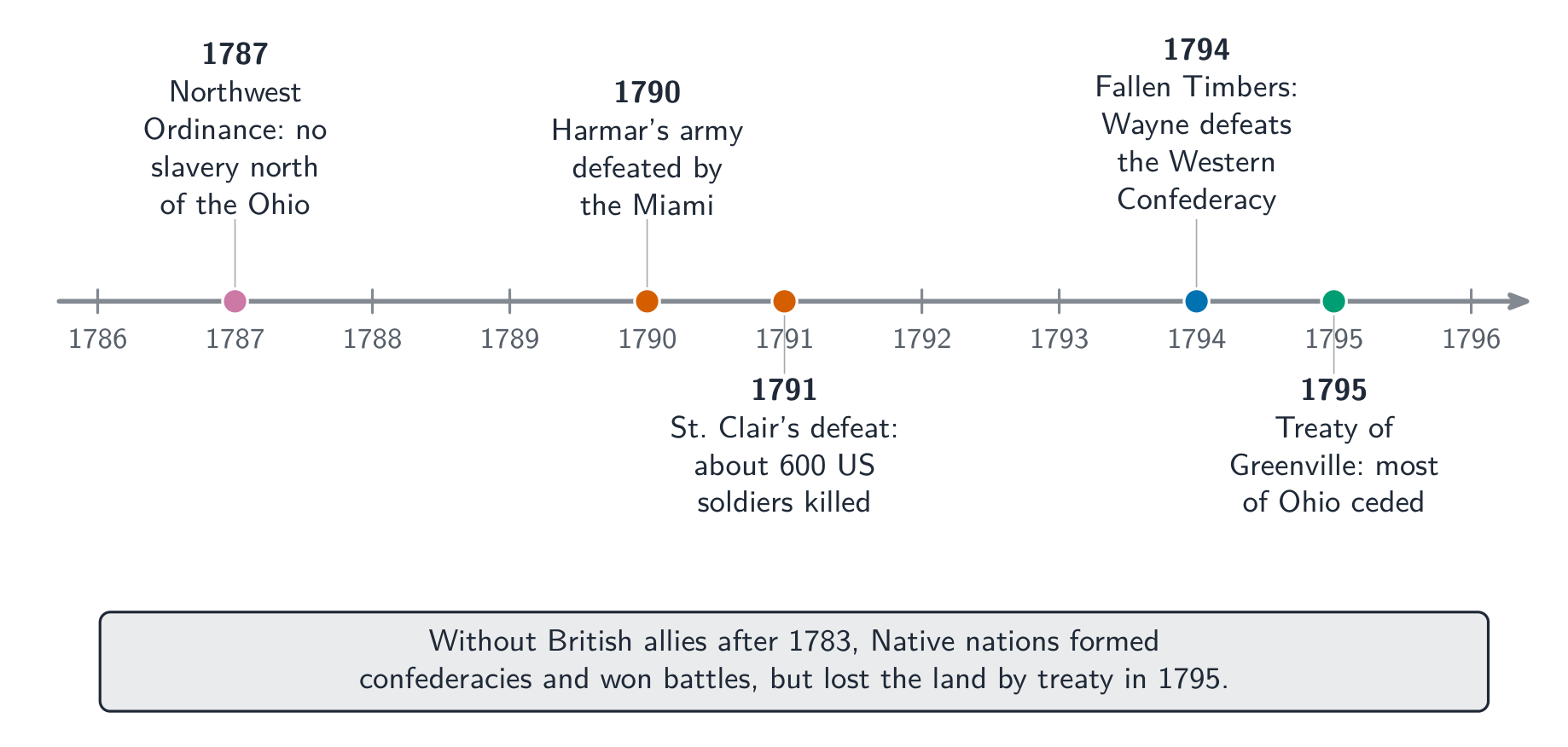
- At dawn on 4 November 1791, warriors of the Western Confederacy, led by Little Turtle of the Miami and Blue Jacket of the Shawnee, attacked General Arthur St. Clair's army camped near the Wabash River in Ohio. In three hours, about 600 American soldiers were killed — a quarter of the entire US Army. It remains the army's worst defeat by Native Americans.
- After independence, settlers moved west, Native nations fought and negotiated to keep their lands, and the new nation divided over slavery.
Why was St. Clair's defeat so important?
ความยาก 1/5 · 100 เหรียญ + บอนัสน้อยๆ เมื่อทำสำเร็จครั้งแรกในวันนี้
The army's worst defeat by Native Americans.
Native nations recalculated
- Without British allies after 1783, Native nations formed confederacies to defend the Ohio Valley.
- After their defeat at Fallen Timbers (1794), they signed the Treaty of Greenville (1795), giving up most of Ohio.
Put these events in order.
ความยาก 3/5 · 200 เหรียญ + บอนัสน้อยๆ เมื่อทำสำเร็จครั้งแรกในวันนี้
1791, 1793, 1794, 1795.
Frontier cultures grew
- Settlers poured over the Appalachians: Kentucky became a state in 1792 and Tennessee in 1796.
- Many were Scots-Irish farmers who wanted land and resented eastern governments and taxes.
Native diplomacy, frontier tension, or the slavery divide?
Sort each element of westward movement.
Worked example: two opposite movements over slavery
- North: states passed gradual emancipation laws — Pennsylvania (1780), New York (1799), New Jersey (1804).
- South: Eli Whitney's cotton gin 轧棉机 (1793) made short-staple cotton profitable, and slavery spread west with cotton.
- Numbers: the enslaved population grew from about 700 000 in 1790 to about 1.2 million in 1810.
Match each development to its region.
ความยาก 2/5 · 140 เหรียญ + บอนัสน้อยๆ เมื่อทำสำเร็จครั้งแรกในวันนี้
Opposite movements.
The enslaved population grew from about 700 000 in 1790 to about 1.2 million in 1810. By how many people did it grow?
ความยาก 2/5 · 140 เหรียญ + บอนัสน้อยๆ เมื่อทำสำเร็จครั้งแรกในวันนี้
1 200 000 − 700 000.
Why regions formed
- The Ohio River became a line: the Northwest Ordinance banned slavery north of it, while slavery spread south of it.
- A moral disagreement became a sectional 地区性的 border between free and slave states.
The Ohio River became a line between free and slave territory.
ความยาก 1/5 · 100 เหรียญ + บอนัสน้อยๆ เมื่อทำสำเร็จครั้งแรกในวันนี้
The Northwest Ordinance.
Native peoples in the South
- In the South, the Cherokee, Creek, Choctaw and Chickasaw nations adopted farming, written laws and, in some cases, slavery, hoping to keep their land.
- Settlers still wanted their land.
The North did not end slavery at once. Gradual emancipation laws freed people slowly; New York's last enslaved people were freed only in 1827.
Northern states ended slavery all at once after the Revolution.
ความยาก 1/5 · 100 เหรียญ + บอนัสน้อยๆ เมื่อทำสำเร็จครั้งแรกในวันนี้
Gradually, into the 1820s.
After 1783, Native confederacies defeated St. Clair but lost at Fallen Timbers and gave up Ohio at Greenville. Settlers created new western states. The North began gradual emancipation while the cotton gin spread slavery in the South, turning the Ohio River into a border between sections.
Explain why North and South moved in opposite directions on slavery after 1783.
Comparison.