Work, energy and power
แนะนำใหม่| English | ความหมาย |
|---|---|
| work done/wɜːk dʌn/ | งาน |
| displacement/dɪˈspleɪsmənt/ | การกระจัด |
| conservation of energy/ˌkɒnsəˈveɪʃn ɒv ˈenədʒi/ | การอนุรักษ์พลังงาน |
| efficiency/ɪˈfɪʃənsi/ | ประสิทธิภาพ |
| thermal energy/ˈθɜːml ˈenədʒi/ | พลังงานความร้อน |
| power/ˈpaʊə/ | กำลัง |
Holding a bag does no work
- Hold a heavy bag still and your arm aches — but in physics you do zero work.
- Work needs the force to move something along its own direction.
- No movement (or a sideways force) means no work done 功.
Work done by a force
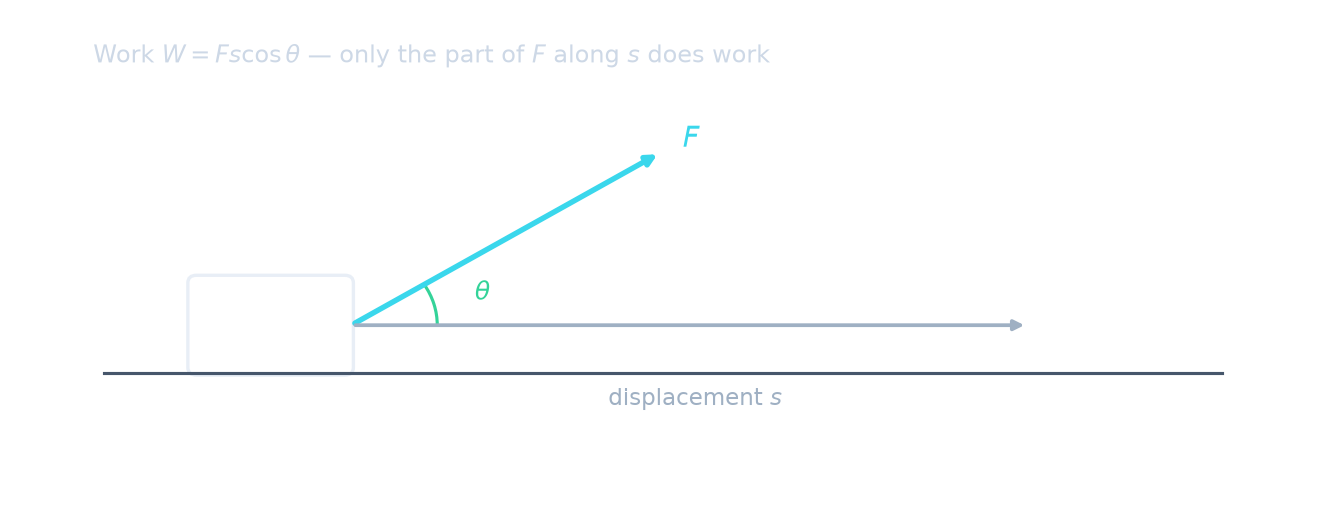
- $W = F s \cos\theta$, where $\theta$ is the angle between force and displacement 位移.
- Only the part of the force along the motion does work. Unit: $\text{J} = \text{N}\cdot\text{m}$.
Work, energy & power
PE + KE = ค่าคงที่
Work transfers พลังงาน; as it falls, PE becomes KE with the total fixed.
A force of $10\ \text{N}$ pushes a box $3.0\ \text{m}$ in the direction of the force. How much work is done?
ความยาก 2/5 · 140 เหรียญ + บอนัสน้อยๆ เมื่อทำสำเร็จครั้งแรกในวันนี้
Force is along the motion ($\theta = 0$), so $W = Fs = 10 \times 3.0 = 30\ \text{J}$.
Positive, negative, zero
- Force along the motion → positive work (energy given to the object).
- Force opposite the motion → negative work (e.g. friction takes energy away).
- Force at right angles → zero work.
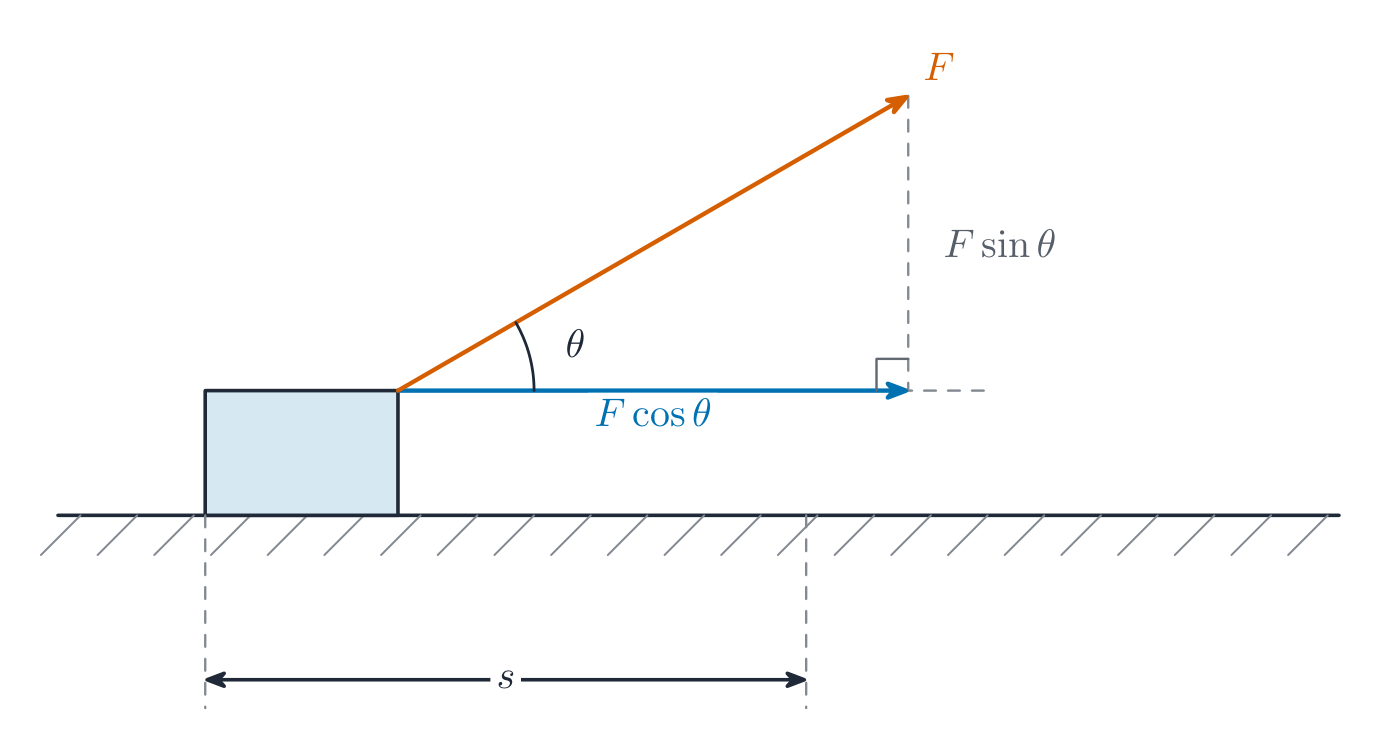
Only the component F cos(theta) along the displacement does work
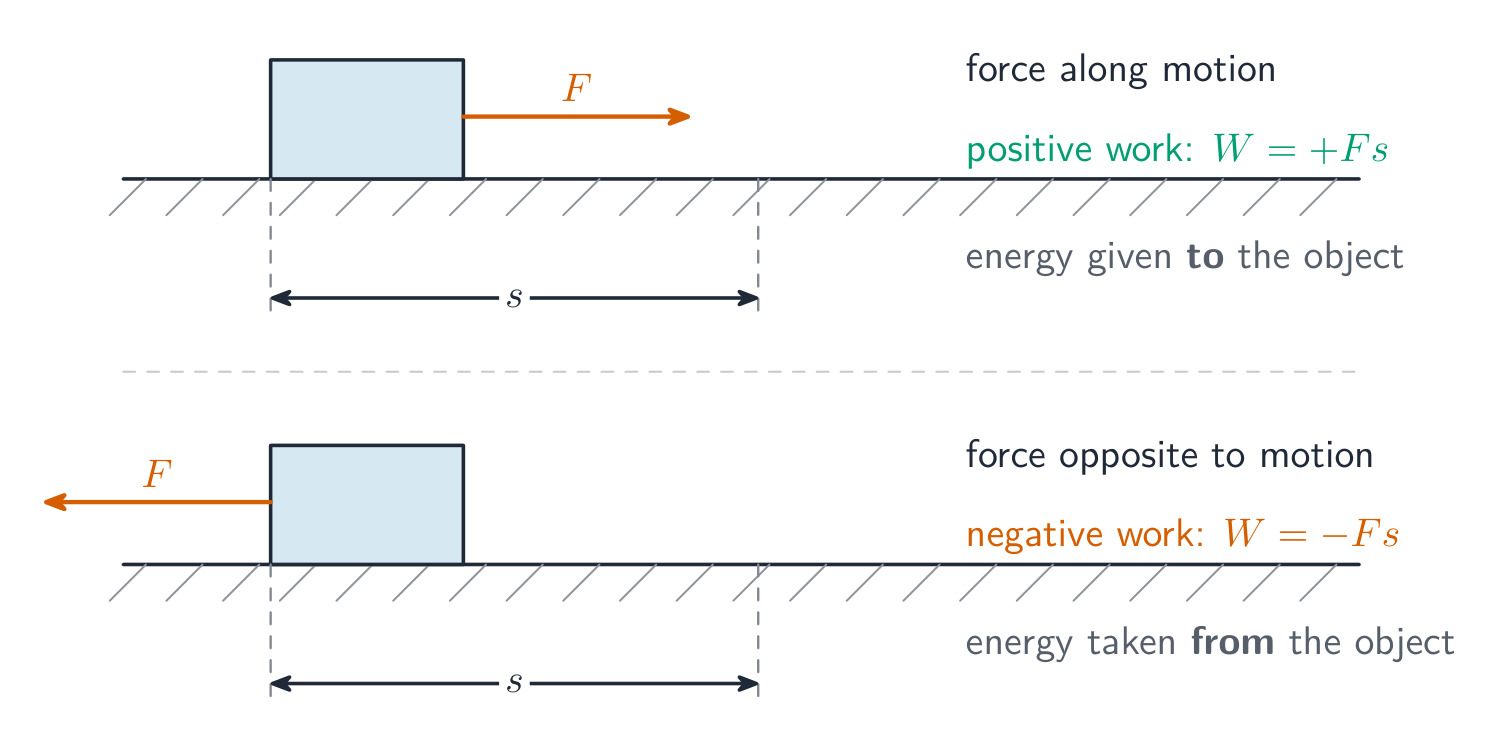
Positive work (force along motion) and negative work (force opposite motion)
แรงที่กระทำในแนวตั้งฉากกับการเคลื่อนที่ ทำงานได้มากน้อยเพียงใด?
ความยาก 1/5 · 100 เหรียญ + บอนัสน้อยๆ เมื่อทำสำเร็จครั้งแรกในวันนี้
$W = Fs\cos 90^{\circ} = 0$. แรงปฏิกิริยาตั้งฉากจากพื้นผิวราบต่อรถ ไม่ทำ работу.
แรงเสียดทานบนวัตถุที่ลื่นไถล ทำงานเป็นค่าลบ.
ความยาก 1/5 · 100 เหรียญ + บอนัสน้อยๆ เมื่อทำสำเร็จครั้งแรกในวันนี้
แรงเสียดทานชี้ตรงข้ามกับการเคลื่อนที่ ($\theta = 180^{\circ}$), ดังนั้น $W = -Fs$ — คือการดึงพลังงานออกไป.
Conservation of energy 能量守恒
- Energy is never made or destroyed — it only changes form or moves between objects.
- In a closed system the total energy stays constant.
พลังงานไม่สามารถถูกสร้างหรือทำลายได้ เพียงแต่ ____ จากหนึ่งรูปแบบไปอีกแบบหนึ่ง.
ความยาก 1/5 · 100 เหรียญ + บอนัสน้อยๆ เมื่อทำสำเร็จครั้งแรกในวันนี้
นั่นคือกฎการอนุรักษ์พลังงาน — ค่ารวมในระบบปิดคงที่.
จับคู่แต่ละคำศัพท์กับนิยามที่กรรมการให้คะแนน
ความยาก 2/5 · 140 เหรียญ + บอนัสน้อยๆ เมื่อทำสำเร็จครั้งแรกในวันนี้
วลีสุดท้ายของนิยามงานคือสิ่งที่ทำให้แรงที่ตั้งฉากกับการเคลื่อนที่ไม่ทำงานเลย
Efficiency 效率
- $\text{efficiency} = \dfrac{\text{useful output}}{\text{total input}} \times 100\%$.
- It is always below $100\%$ — some energy ends up as "useless" thermal energy 热能.
Energy flow & efficiency
The input energy divides into useful work and wasted energy; efficiency = useful ÷ input, and useful + wasted always equals the input.
เครื่องจักรรับเข้า $200\ \text{J}$ และให้خرج出来 $60\ \text{J}$ ของพลังงานที่มีประโยชน์ ประสิทธิภาพของมัน (ใน %) คืออะไร?
ความยาก 2/5 · 140 เหรียญ + บอนัสน้อยๆ เมื่อทำสำเร็จครั้งแรกในวันนี้
$\dfrac{60}{200} \times 100\% = 30\%$. ส่วนที่เหลือ $140\ \text{J}$ ถูกสูญเสียไป ส่วนใหญ่เป็นความร้อน.
Power 功率
- Power is the rate of doing work: $P = \dfrac{W}{t} = \dfrac{\Delta E}{\Delta t}$.
- Unit: $\text{W} = \dfrac{\text{J}}{\text{s}}$.
Power, force and velocity
- For a force $F$ along the motion at speed $v$: $P = Fv$.
- A car at steady speed needs $P = F_{\text{resist}} \times v$; lifting a weight at speed $v$ needs $P = mgv$.
แรง $F$ กระทำต่อวัตถุที่เคลื่อนที่ด้วยความเร็ว $v$ ในทิศทางเดียวกับแรง กำลังที่ส่งไปคือ:
ความยาก 1/5 · 100 เหรียญ + บอนัสน้อยๆ เมื่อทำสำเร็จครั้งแรกในวันนี้
ในช่วงเวลา $\Delta t$ การกระจัดคือ $v\Delta t$ และงานคือ $Fv\Delta t$; หารด้วย $\Delta t$ จะได้ $P = Fv$.
Worked example: a car at steady speed
- A car travels at a steady $25\ \text{m/s}$ against a total resistive force of $600\ \text{N}$. Find the useful output power of its engine.
- At steady speed the resultant force is zero, so the driving force equals the resistive force: $F = 600\ \text{N}$.
- $P = Fv = 600 \times 25 = 1.5\times10^{4}\ \text{W} = 15\ \text{kW}$.
- The step that carries the mark is stating why the driving force equals $600\ \text{N}$: constant velocity means zero resultant force.
- If the car were accelerating, the driving force would be larger than $600\ \text{N}$ and you could not use the resistive force in $P = Fv$ at all.
Marks that slip away
- Efficiency is useful output divided by total input. The input is always the larger number, so an answer above $100\%$ means the two were swapped.
- In $P = Fv$, $F$ is the driving force. It equals the resistive force only at constant speed.
- Use the vertical height in $mg\Delta h$, never the distance along a slope.
- Work done by a force is the force times the distance moved in the direction of the force. A force at right angles to the motion does no work.
- On a force-extension graph the area is the energy stored. The gradient is the stiffness, and reading one for the other is a whole question lost.
รถเคลื่อนที่ด้วยความเร็วคงที่ 25 m/s ต้านทานแรงต้านรวม 600 N กำลังส่งออกที่มี实用性是多少 kW?
ความยาก 2/5 · 140 เหรียญ + บอนัสน้อยๆ เมื่อทำสำเร็จครั้งแรกในวันนี้
ความเร็วคงที่หมายถึงแรงลัพธ์เป็นศูนย์ ดังนั้นแรงขับเคลื่อนจึง$600\ \text{N}$ และ$P = Fv = 15\ \text{kW}$ การอธิบาย WHY ว่าทำไมแรงขับเคลื่อนจึงเท่ากับแรงต้าน คือสิ่งที่จะได้รับคะแนน
ในกรณีใดที่แรงไม่ทำ work? เลือก ทุก ข้อที่ใช้ได้.
ความยาก 2/5 · 140 เหรียญ + บอนัสน้อยๆ เมื่อทำสำเร็จครั้งแรกในวันนี้
การเบรกทำงานอยู่เยอะ แต่เป็น work เป็นค่าลบ ส่วนวงโคจรเป็นเคสที่ชัดเจน: แรงโน้มถ่วงตั้งฉากกับการเคลื่อนที่เสมอ ดังนั้นความเร็วของดาวเทียมจึงไม่เปลี่ยนแปลง.
เรียงลำดับการคำนวณประสิทธิภาพ.
ความยาก 3/5 · 200 เหรียญ + บอนัสน้อยๆ เมื่อทำสำเร็จครั้งแรกในวันนี้
อินพุตจะเป็นตัวเลขที่ใหญ่กว่าเสมอ ประสิทธิภาพเกิน 100% แปลว่าสลับกันแล้ว และการหารด้วยพลังงานที่สูญเสียไปคือวิธีผิดทั่วไปอีกอย่างหนึ่ง.
You've got it
- work $W = Fs\cos\theta$ — only the part of $F$ along the motion counts
- energy is conserved; efficiency = useful ÷ total (always < 100%)
- power $P = \dfrac{W}{t} = Fv$