Differentiation (Pure 3)
แนะนำใหม่ 13:36
คณิตศาสตร์บริสุทธิ์ 3
เป็นเวลานานหลายศตวรรษ นักคณิตศาสตร์พบทางตัน: รากที่สองของลบหนึ่งคืออะไร? ไม่มีจำนวนธรรมดาใดที่เมื่อยกกำลังสองแล้วจะได้ค่าลบ พวกเขาเรียกว่าสิ่งที่เป็นไปไม่ได้ และ...
บรรยายภาษาอังกฤษ · สลับคำบรรยายภาษาอังกฤษและภาษาจีนได้
In this lesson
| English | ความหมาย |
|---|---|
| derivative/dɪˈrɪvətɪv/ | อนุพันธ์ |
| inverse tangent/ɪnˈvɜːs ˈtændʒənt/ | ฟังก์ชันกลับด้านของแทนเจนต์ |
| chain rule/tʃeɪn ruːl/ | กฎลูกโซ่ |
| parametric/ˌpærəˈmetrɪk/ | พารามิเตอร์ |
| product rule/ˈprɒdʌkt ruːl/ | กฎผลคูณ |
| reciprocal/rɪˈsɪprəkl/ | ส่วนกลับ |
| implicit differentiation/ɪmˈplɪsɪt ˌdɪfəˌrenʃɪˈeɪʃn/ | การหาอนุพันธ์โดยฟังก์ชันนัยแฝง |
The last standard derivative
- Pure 3 differentiation uses the Pure 2 rules (product, quotient, chain, parametric and implicit) and adds one new derivative: the inverse tangent 反正切, $\tan^{-1}x$.
- Exam questions combine them: find where a curve has a horizontal tangent, or the equation of a tangent or normal to a curve given implicitly or by parameters.
The Pure 2 rules, quickly
- Chain 链式法则: $\dfrac{d}{dx}f(g(x))=f'(g(x))\,g'(x)$. Product: $(uv)'=uv'+vu'$. Quotient: $\left(\dfrac uv\right)'=\dfrac{vu'-uv'}{v^2}$.
$y=x^2e^{3x}$: product rule with $u=x^2$, $v=e^{3x}$:
ความชันที่จุดหนึ่ง
gradient = dy/dx
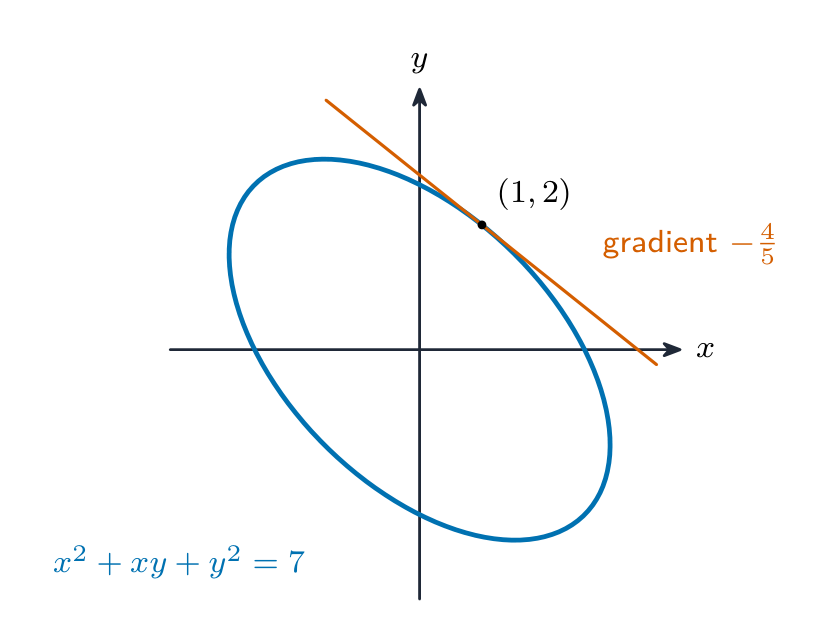
Implicit or not, the derivative is still the slope of the เส้นสัมผัส — slide the point to see it.
Pure 3 differentiation still uses the product, quotient and chain rules from Pure 2.
ความยาก 1/5 · 100 เหรียญ + บอนัสน้อยๆ เมื่อทำสำเร็จครั้งแรกในวันนี้
Those rules carry over; only the inverse-tangent derivative is new.
If y = x²e^(3x), then dy/dx = e^(3x)(2x + 3x²). At x = 0, dy/dx = ?
ความยาก 2/5 · 140 เหรียญ + บอนัสน้อยๆ เมื่อทำสำเร็จครั้งแรกในวันนี้
At x = 0: e⁰(0 + 0) = 1 × 0 = 0.
The derivative of tan⁻¹x
- Why: let $y=\tan^{-1}x$, so $\tan y=x$. Differentiate implicitly: $\sec^2y\,\dfrac{dy}{dx}=1$. Since $\sec^2y=1+\tan^2y=1+x^2$, we get $\dfrac{dy}{dx}=\dfrac1{1+x^2}$.
- With the chain rule: $\dfrac{d}{dx}\tan^{-1}(2x)=\dfrac{2}{1+4x^2}$.
$\tan^{-1}x$ is not $\dfrac1{\tan x}$. It is the inverse function (arctan). The reciprocal of $\tan x$ is $\cot x$ 倒数.
The derivative of tan⁻¹x is 1/(1+x²). What is its value at x = 1?
ความยาก 2/5 · 140 เหรียญ + บอนัสน้อยๆ เมื่อทำสำเร็จครั้งแรกในวันนี้
1/(1 + 1²) = 1/2 = 0.5.
What is the derivative of tan⁻¹x at x = 0?
ความยาก 2/5 · 140 เหรียญ + บอนัสน้อยๆ เมื่อทำสำเร็จครั้งแรกในวันนี้
1/(1 + 0²) = 1/1 = 1.
tan⁻¹x means 1/tan x.
ความยาก 1/5 · 100 เหรียญ + บอนัสน้อยๆ เมื่อทำสำเร็จครั้งแรกในวันนี้
tan⁻¹x is the inverse function (arctan), not the reciprocal. The reciprocal is cot x.
For y = arctan of 2x, what is the derivative at x = 0?
At zero the denominator is 1, so the derivative equals the chain factor 2.
y = tan⁻¹(x²). Find dy/dx at x = 1.
ความยาก 2/5 · 140 เหรียญ + บอนัสน้อยๆ เมื่อทำสำเร็จครั้งแรกในวันนี้
dy/dx = 2x / (1 + x⁴). At x = 1: 2/2 = 1.
Implicit curves: horizontal and vertical tangents
- Differentiate every term with respect to $x$; a $y$ term gets a factor $\dfrac{dy}{dx}$; then make $\dfrac{dy}{dx}$ the subject.
- When $\dfrac{dy}{dx}=\dfrac{N}{D}$: the tangent is horizontal where $N=0$ (and $D\ne0$), and vertical where $D=0$. Solve that condition together with the curve's equation.
When differentiating y² implicitly with respect to x, you get:
ความยาก 1/5 · 100 เหรียญ + บอนัสน้อยๆ เมื่อทำสำเร็จครั้งแรกในวันนี้
By the chain rule: d/dx(y²) = 2y · dy/dx.
Parametric curves with trig
- $\dfrac{dy}{dx}=\dfrac{dy/dt}{dx/dt}$. The normal has gradient $-1\Big/\dfrac{dy}{dx}$.
The ellipse $x=2\cos t$, $y=3\sin t$:
At $t=\tfrac\pi4$: the point is $\left(\sqrt2,\ \tfrac{3\sqrt2}2\right)$, the gradient is $-\tfrac32$ and the normal's gradient is $\tfrac23$.
x = 2cos t, y = 3sin t. Find the gradient of the normal at t = π/4, as a decimal to 3 significant figures.
ความยาก 2/5 · 140 เหรียญ + บอนัสน้อยๆ เมื่อทำสำเร็จครั้งแรกในวันนี้
dy/dx = −(3/2)cot t = −1.5 at t = π/4, so the normal gradient is 1/1.5 = 0.667.
Worked exam question: horizontal tangents
Question (6 marks). The curve $C$ has equation $x^2+xy+y^2=3$. Find the coordinates of the points on $C$ where the tangent is parallel to the $x$-axis.
- Differentiate implicitly (M1 A1): $2x+y+x\dfrac{dy}{dx}+2y\dfrac{dy}{dx}=0$, so
- Horizontal tangent (M1): the numerator is zero, so $2x+y=0$ and $y=-2x$.
- Substitute into $C$ (M1): $x^2-2x^2+4x^2=3$, so $3x^2=3$ and $x=\pm1$.
- Points (A1 A1): $(1,\,-2)$ and $(-1,\,2)$. Check the denominator: $x+2y=-3$ and $3$, not zero.
Why answers lose marks: setting the denominator to zero (that gives vertical tangents), or finding $y=-2x$ and stopping without substituting back into the curve.
Find the points on x² − xy + y² = 3 where the tangent is parallel to the x-axis.
Same method as the worked question.
You've got it
- $\dfrac{d}{dx}\tan^{-1}x=\dfrac1{1+x^2}$; with the chain rule $\dfrac{d}{dx}\tan^{-1}(ax)=\dfrac{a}{1+a^2x^2}$
- implicit: $\dfrac{dy}{dx}=\dfrac ND$; horizontal tangent $N=0$, vertical $D=0$; solve with the curve's equation
- parametric: $\dfrac{dy}{dx}=\dfrac{dy/dt}{dx/dt}$; normal gradient $=-1\Big/\dfrac{dy}{dx}$
What is the derivative at x = 0?
ความยาก 1/5 · 100 เหรียญ + บอนัสน้อยๆ เมื่อทำสำเร็จครั้งแรกในวันนี้
2 divided by 1 is 2. Other options — 1/2 (the derivative of arctan x at x = 1); 0 (because x is 0).