Acyl chlorides
แนะนำใหม่| English | ความหมาย |
|---|---|
| acyl chloride/əˈkɪl ˈklɔːraɪd/ | อะไซลคลอไรด์ |
| nucleophile/ˈnjuːklɪɒfaɪl/ | นิวคลีโอไฟล์ |
| addition–elimination/əˈdɪʃn ɪˌlɪmɪˈneɪʃn/ | การเพิ่มเข้า-กำจัดออก |
| amide/əˈmaɪd/ | แอมิด |
The most reactive derivatives
- Open a bottle of ethanoyl chloride and it fumes: it is reacting with the water vapour in the air. Acyl chlorides 酰氯 are the most reactive carboxylic-acid derivatives.
- They react with water, alcohols, ammonia and amines by addition–elimination 加成消去, always releasing HCl.
Acyl chloride reaction map
Follow why acyl chlorides are reactive acylating agents.
Acyl chlorides react vigorously with water to give a carboxylic acid and ______ chloride gas.
ความยาก 1/5 · 100 เหรียญ + บอนัสน้อยๆ เมื่อทำสำเร็จครั้งแรกในวันนี้
Misty fumes of HCl form.
Reactions (all give HCl)
| Reactant | Product |
|---|---|
| water | the carboxylic acid |
| an alcohol | an ester |
| phenol | an ester |
| ammonia | an amide 酰胺 |
| a 1°/2° amine | an amide |

Addition-elimination mechanism of an acyl chloride
An acyl chloride reacting with ammonia gives:
ความยาก 1/5 · 100 เหรียญ + บอนัสน้อยๆ เมื่อทำสำเร็จครั้งแรกในวันนี้
Ammonia (or a 1°/2° amine) reacts with an acyl chloride to give an amide.
An acyl chloride reacting with water gives:
ความยาก 1/5 · 100 เหรียญ + บอนัสน้อยๆ เมื่อทำสำเร็จครั้งแรกในวันนี้
Hydrolysis of an acyl chloride regenerates the carboxylic acid (very vigorously).
Match each term to its meaning.
ความยาก 2/5 · 140 เหรียญ + บอนัสน้อยๆ เมื่อทำสำเร็จครั้งแรกในวันนี้
Each item links the term to its correct meaning.
Addition–elimination
- A nucleophile adds to the slightly positive carbonyl carbon → a tetrahedral intermediate.
- Then the C=O reforms and $\text{Cl}^-$ leaves as HCl (elimination).
- Ease of hydrolysis: $\text{acyl chloride} \gg \text{alkyl chloride} \gg \text{aryl chloride}$ (the aryl C–Cl is strengthened by the ring).
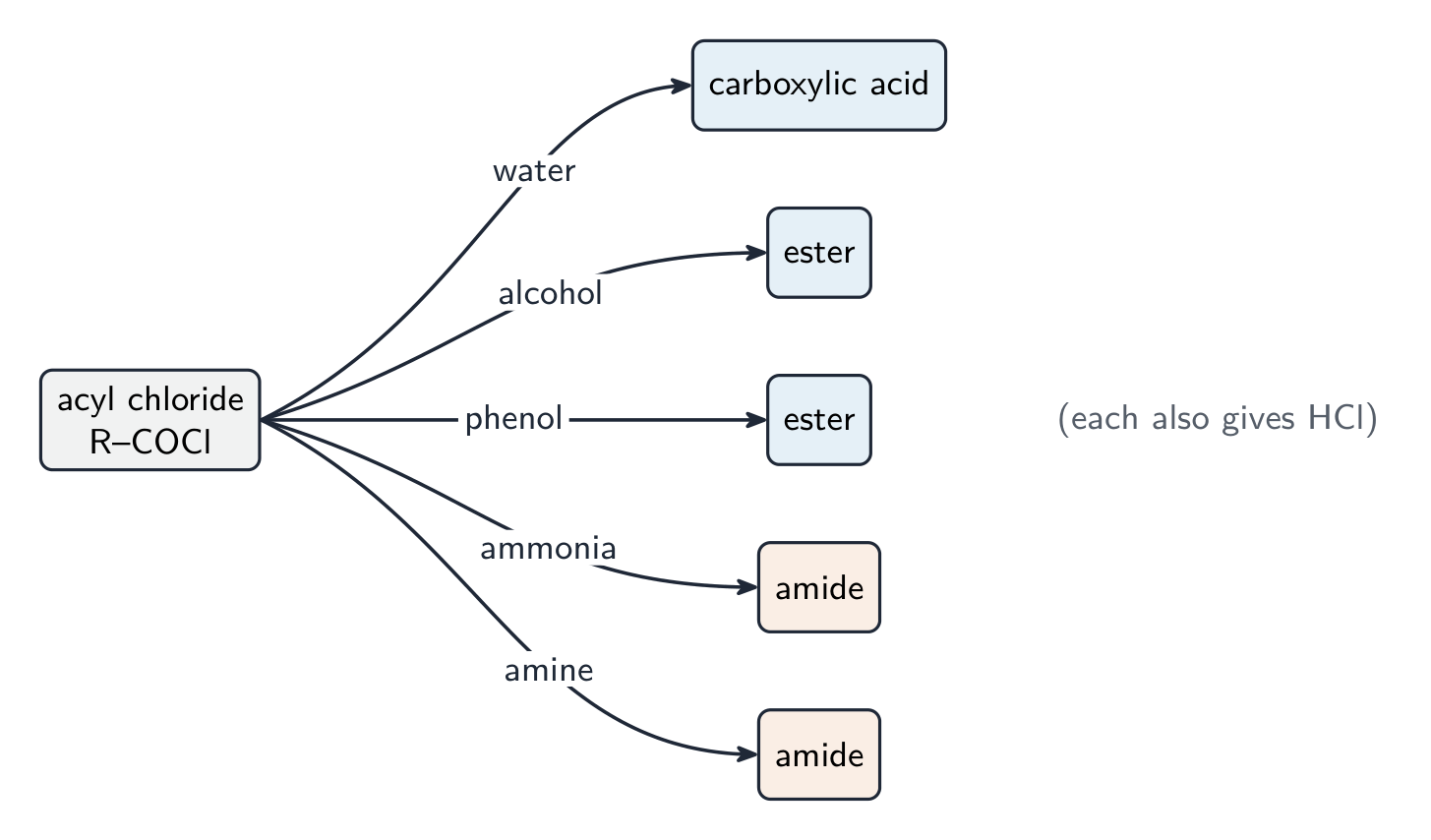
Acyl chlorides react with many nucleophiles
The reactions of acyl chlorides follow which mechanism?
ความยาก 1/5 · 100 เหรียญ + บอนัสน้อยๆ เมื่อทำสำเร็จครั้งแรกในวันนี้
A nucleophile adds to the carbonyl carbon; the C=O reforms and Cl⁻ leaves as HCl.
The order of ease of hydrolysis is:
ความยาก 1/5 · 100 เหรียญ + บอนัสน้อยๆ เมื่อทำสำเร็จครั้งแรกในวันนี้
Acyl chlorides hydrolyse violently, alkyl slowly, and aryl chlorides not at all (ring-strengthened C–Cl).
Three chlorides with water and silver nitrate
| Compound | With water | Then AgNO₃(aq) |
|---|---|---|
| ethanoyl chloride, CH₃COCl | violent at room temperature, steamy HCl fumes | white precipitate at once |
| chloroethane, C₂H₅Cl | slow, needs warming | white precipitate slowly |
| chlorobenzene, C₆H₅Cl | no reaction | no precipitate |
- The C=O carbon in an acyl chloride carries a large δ+ (two electronegative atoms, O and Cl, pull on it), and it is flat, so nucleophiles attack it easily.
Three chlorides are added to water containing AgNO₃. Which gives a precipitate fastest?
ความยาก 1/5 · 100 เหรียญ + บอนัสน้อยๆ เมื่อทำสำเร็จครั้งแรกในวันนี้
Acyl chloride ≫ alkyl chloride ≫ aryl chloride. The acyl chloride hydrolyses at once, releasing Cl⁻.
Worked example: predict and name the product
Give the organic product when ethanoyl chloride, $\text{CH}_3\text{COCl}$, reacts at room temperature with water, with ammonia and with methylamine.
- Water: $\text{CH}_3\text{COOH}$, ethanoic acid. Ammonia: $\text{CH}_3\text{CONH}_2$, ethanamide. In each the nucleophile replaces Cl, and HCl is lost.
- With methylamine, $\text{CH}_3\text{NH}_2$, the product is $\text{CH}_3\text{CONHCH}_3$, N-methylethanamide. The "N-" shows the methyl group is on the nitrogen. The HCl then reacts with more amine, so two moles of amine are used per mole of acyl chloride.
What forms when propanoyl chloride, $\text{CH}_3\text{CH}_2\text{COCl}$, reacts with ethylamine?
ความยาก 1/5 · 100 เหรียญ + บอนัสน้อยๆ เมื่อทำสำเร็จครั้งแรกในวันนี้
The acyl group (propanoyl) gives the "-amide" part and the amine's ethyl group sits on N. An ester would need an alcohol.
- With ammonia or an amine, the HCl made reacts with more of the base, so two moles of NH₃ or amine are needed per mole of acyl chloride.
- The intermediate in addition–elimination is tetrahedral, with O⁻.
- An amide made from a primary amine is named N-alkyl…amide (CH₃CONHC₂H₅ is N-ethylethanamide).
How many moles of methylamine are used up per mole of ethanoyl chloride?
ความยาก 2/5 · 140 เหรียญ + บอนัสน้อยๆ เมื่อทำสำเร็จครั้งแรกในวันนี้
One mole forms the amide; a second mole reacts with the HCl to form methylammonium chloride.
You've got it
- acyl chlorides are very reactive; with water → acid, alcohol/phenol → ester, ammonia/amine → amide (all + HCl)
- mechanism = addition–elimination (nucleophile adds to the carbonyl carbon, then HCl is eliminated)
- hydrolysis ease: acyl ≫ alkyl ≫ aryl chloride