Skip to content · ⁨ข้ามไปยังเนื้อหา⁩
Subjects · ⁨รายวิชา⁩

GAC Science · ⁨GAC วิทยาศาสตร์⁩

Tips · ⁨เคล็ดลับ⁩

GAC Science is two modules and they do different jobs. GAC013 is about science itself, its history, the scientific method, the language of units and notation, how the discipline is organised and the issues it raises. GAC023 is combined subject content, covering biology and classification, ecosystems, earth resources, chemistry and its environmental effects, and wave motion in physics.

The investigation is the centrepiece. Planning and carrying out an experiment, then writing it up to scientific and academic conventions, appears as an outcome in both modules and carries substantial weight.

Units and notation are assessed explicitly. Writing a quantity with the right symbol, the right unit and a sensible number of significant figures is a named outcome, not a presentation detail.

The breadth is deliberate. GAC023 crosses biology, chemistry, earth science and physics in one semester, so the aim is confident general science in English rather than specialist depth in one subject.

Practice on this site is original, and the science content borrows explanations and diagrams from our IGCSE and A-Level material where the topic is genuinely the same.

  • 1

    GAC013 Science II: Scientific Principles · ⁨GAC013 วิทยาศาสตร์ II: หลักการทางวิทยาศาสตร์⁩

    1.1

    What this module is, and how it is marked · ⁨บทนี้คืออะไร และมีวิธีการให้คะแนนอย่างไร⁩

    English

    Two paper samples retain different amounts of water. Does that mean one is best for every cleaning task? To answer well, a scientist asks how the comparison was made, which properties were tested and what remains unknown.

    This guide supports GAC013: the development of scientific ideas, investigation, scientific language, the organisation of research and scientific issues. Science includes evidence, methods, explanations and a growing body of knowledge. Its questions connect physics, chemistry, biology and other fields.

    A practical investigation 探究实验 needs a safe, permitted method that fits its question. An investigation report 实验报告 records that method, the actual observations and a conclusion limited by the evidence. Follow your teacher's current brief for assessment criteria, structure and deadlines. The original companion sheets are practice, not official assessment papers. No result or phrase guarantees a mark. Never replace an unexpected observation with a predicted answer.

    ไทย

    กระดาษสองตัวอย่างดูดซับน้ำในปริมาณต่างกัน สิ่งนี้หมายความว่ากระดาษชนิดหนึ่งดีที่สุดสำหรับการทำความสะอาดทุกงานหรือไม่ เพื่อตอบคำถามนี้ นักวิทยาศาสตร์จะถามว่าการเปรียบเทียบนั้นทำอย่างไร چهคุณสมบัติใดถูกทดสอบ และ还有哪些สิ่งที่ยังไม่ทราบ

    คู่มือนี้สนับสนุน GAC013: การพัฒนาแนวคิดทางวิทยาศาสตร์ การสืบสวนหาความรู้ ภาษาทางวิทยาศาสตร์ การจัดระเบียบการวิจัย และประเด็นทางวิทยาศาสตร์ วิทยาศาสตร์รวมถึงหลักฐาน วิธีการ อธิบาย และองค์ความรู้ที่ขยายตัว คำถามของวิทยาศาสตร์เชื่อมโยงฟิสิกส์ เคมี ชีววิทยา และสาขาอื่น ๆ เข้าด้วยกัน

    การ สืบสวนทดลอง ต้องใช้วิธีที่ปลอดภัยและได้รับอนุญาตซึ่งเหมาะสมกับคำถามของการสืบนั้น การ รายงานผลการสืบสวน บันทึกวิธีนั้น การสังเกตจริง และข้อสรุปที่จำกัดอยู่ตามหลักฐาน ให้ปฏิบัติตาม brief ปัจจุบันของคุณครูเพื่อเกณฑ์การประเมิน โครงสร้าง และกำหนดเวลา แผ่นคู่แบบเดิมเป็นการฝึกฝน ไม่ใช่ใบสอบประเมินอย่างเป็นทางการ ไม่มีผลลัพธ์หรือวลีใดการันตีคะแนน ไม่ควรแทนที่การสังเกตที่ไม่คาดคิดด้วยคำตอบที่คาดหมายไว้

    1.1

    The history of science · ⁨ประวัติศาสตร์ของวิทยาศาสตร์⁩

    Syllabus · ⁨หลักสูตร⁩
    English

    Unit 1 of 5 in GAC013 Science II: Scientific Principles (Level II). The module is taught over about 40 class hours plus 20 hours of independent study, and is assessed at the teaching centre and moderated by ACT — there is no external exam.

    Module purpose: On completion of this module, students should be able to demonstrate knowledge and understanding of the basic laws, theories and principles of contemporary science.

    The module outcomes this unit works towards:

    Learning Objective GAC013.1: Demonstrate knowledge and understanding of the historical development of scientific ideas, and apply that knowledge to differentiate between the different areas of science.

    ไทย

    หน่วยที่ 1 จากทั้งหมด 5 หน่วยใน GAC013 วิทยาศาสตร์ II: หลักการทางวิทยาศาสตร์ (ระดับ II)含量 module taught over about 40 class hours plus 20 hours of independent study, and is assessed at the teaching centre and moderated by ACT — there is no external exam.

    วัตถุประสงค์ของโมดูล: เมื่อเรียนจบโมดูลนี้ นักเรียนควรสามารถแสดงความรู้และความเข้าใจเกี่ยวกับกฎ ทฤษฎี และหลักการพื้นฐานของวิทยาศาสตร์สมัยใหม่

    ผลลัพธ์การเรียนรู้ submodule ที่หน่วยนี้มุ่งสู่:

    วัตถุประสงค์การเรียนรู้ GAC013.1: แสดงความรู้และความเข้าใจในการพัฒนาทางประวัติศาสตร์ของความคิดทางวิทยาศาสตร์ และนำความรู้ดังกล่าวไปใช้เพื่อแยกแยะระหว่างสาขาวิชาวิทยาศาสตร์ต่างๆ

    Source: Cambridge International syllabus · ⁨แหล่งที่มา: หลักสูตร Cambridge International⁩

    English

    A paradigm 范式 is a broad framework shaping explanations and questions. A paradigm shift 范式转换 is a substantial change in that framework. Not every revised number or new observation is a shift of this scale.

    Scientific explanations are provisional 暂定的: they remain open to evidence-led revision. This does not mean that every explanation is equally uncertain. A model represents selected features of a system; observations test how well its predictions and explanations work within a stated scope.

    Worked example: separate event dates from award dates

    Thomson identified the electron in 1897. Rutherford's 1911 atomic-structure analysis drew on scattering measurements, including work by Geiger and Marsden. Chadwick established evidence for the neutron in 1932. These are selected developments, not a complete history of science. A scientist's award year is not automatically the discovery or publication year.

    Sources checked 2 October 2026: Nobel atomic-history timeline, electron discovery, and Chadwick facts.

    Physics studies matter and energy. Chemistry studies substances and their changes. Biology studies living systems. A plant-growth investigation can be biological while using physical measurements of light and chemical ideas about materials. Naming its main field does not supply its result.

    ไทย

    Paradigm (กรอบแนวคิดหลัก) คือกรอบกว้างๆ ที่กำหนดรูปแบบการอธิบายและคำถาม Paradigm shift (การเปลี่ยนแปลงกรอบแนวคิดหลัก) คือการเปลี่ยนแปลงที่สำคัญในกรอบนั้น ไม่ใช่ทุกตัวเลขที่ถูกแก้ไขหรือการสังเกตใหม่คือการเปลี่ยนแปลงในระดับนี้

    คำอธิบายทางวิทยาศาสตร์มีลักษณะ ชั่วคราว: มันยังคงเปิดโอกาสให้ทบทวนตามหลักฐาน สิ่งนี้ไม่ได้หมายความว่าทุกคำอธิบายมีความไม่แน่นอนเท่ากัน โมเดลแสดงถึงคุณลักษณะที่เลือกมาของระบบ; การสังเกตทดสอบว่าคำทำนายและคำอธิบายของมันทำงานได้ดีเพียงใดภายในขอบเขตที่กำหนด

    หลักฐานที่เลือกเกี่ยวกับอิเล็กตรอน โครงสร้างอะตอม และนิวตรอน contribute ต่อการเปลี่ยนแปลงแนวคิดเกี่ยวกับอะตอม.

    ตัวอย่างที่แสดงวิธีทำ: แยกวันที่เหตุการณ์จากวันที่ได้รับรางวัล

    Thomson_identified อิเล็กตรอนในปี 1897 การวิเคราะห์โครงสร้างอะตอมของ Rutherford ในปี 1911 ใช้ข้อมูลจากการวัดการกระเจิง รวมถึงงานของ Geiger และ Marsden Chadwick สร้างหลักฐานสำหรับนิวตรอนในปี 1932 นี่คือการพัฒนาที่เลือกมา ไม่ใช่ประวัติศาสตร์วิทยาศาสตร์ทั้งหมด ปีที่ได้รับรางวัลของนักวิทยาศาสตร์ไม่จำเป็นต้องเป็นปีของการค้นพบหรือการตีพิมพ์เสมอไป

    แหล่งข้อมูลที่ตรวจสอบเมื่อวันที่ 2 ตุลาคม 2026: Nobel atomic-history timeline, electron discovery, และ Chadwick facts.

    ฟิสิกส์ศึกษาสสารและพลังงาน เคมีศึกษาสารและการเปลี่ยนแปลง ชีววิทยาศึกษาระบบมีชีวิต การสืบสวนการเจริญเติบโตของพืชอาจเป็นชีววิทยาแต่ใช้การวัดแสงทางฟิสิกส์และแนวคิดทางเคมีเกี่ยวกับวัสดุ การระบุสาขาหลักไม่ได้ให้ผลลัพธ์ออกมา

    Vocabulary · ⁨คำศัพท์⁩ Train · ⁨ฝึกฝน⁩
    English ไทย
    practical investigation/ˈpræktɪkl ɪnˌvestɪˈɡeɪʃn/ การสืบเสาะหาความรู้เชิงปฏิบัติ
    investigation report/ɪnˌvestɪˈɡeɪʃn rɪˈpɔːt/ รายงานการสืบเสาะหาความรู้
    paradigm/ˈpærədaɪm/ แนวความคิดในการเขียนโปรแกรม (paradigm)
    paradigm shift/ˈpærədaɪm ʃɪft/ การเปลี่ยนแปลงกรอบแนวคิด
    provisional/prəˈvɪʒənl/ ชั่วคราว
    1.2

    The scientific method · ⁨วิธีทางวิทยาศาสตร์⁩

    Syllabus · ⁨หลักสูตร⁩
    English

    Unit 2 of 5 in GAC013 Science II: Scientific Principles (Level II). The module is taught over about 40 class hours plus 20 hours of independent study, and is assessed at the teaching centre and moderated by ACT — there is no external exam.

    The module outcomes this unit works towards:

    Learning Objective GAC013.2: Apply the scientific method to plan and conduct scientific investigations.

    Learning Objective GAC013.3: Create an investigation report following scientific and academic conventions.

    ไทย

    หน่วยที่ 2 จากทั้งหมด 5 หน่วยใน GAC013 วิทยาศาสตร์ II: หลักการทางวิทยาศาสตร์ (ระดับ II)含量 module taught over about 40 class hours plus 20 hours of independent study, and is assessed at the teaching centre and moderated by ACT — there is no external exam.

    ผลลัพธ์การเรียนรู้ submodule ที่หน่วยนี้มุ่งสู่:

    วัตถุประสงค์การเรียนรู้ GAC013.2: ใช้วิธีทางวิทยาศาสตร์ในการวางแผนและดำเนินการสืบเสาะหาความรู้ทางวิทยาศาสตร์

    วัตถุประสงค์การเรียนรู้ GAC013.3: จัดทำรายงานการสืบเสาะหาความรู้ตามธรรมเนียมปฏิบัติทางวิทยาศาสตร์และวิชาการ

    Source: Cambridge International syllabus · ⁨แหล่งที่มา: หลักสูตร Cambridge International⁩

    English

    A hypothesis 假设 is a testable proposed explanation or prediction. Identify what observations would support or challenge it. Research can involve controlled experiments, observation, modelling and revision; it does not always follow one straight sequence.

    In a controlled experiment, the independent variable 自变量 is deliberately changed, the dependent variable 因变量 is the measured response, and control variables 控制变量 are kept comparable. A control group 对照组 can provide a comparison without the treatment where the design requires it. Comparing two materials is not automatically a treatment-versus-no-treatment design.

    Repeat 重复 trials to examine variation and reduce dependence on one reading. Repeats do not repair a systematically unequal procedure, and a single careful observation is not automatically worthless. Report what the evidence permits and what further checking would help.

    Worked example: controlled conditions and a mean

    In the fictional written task, fresh squares of two paper types have the same area. Each is immersed for 60 seconds, drained for 10 seconds without squeezing, and weighed using the same checked balance. Retained-water mass is wet mass minus dry mass. Type A records 3.0, 3.2 and 2.8 grams; B records 4.2, 4.0 and 4.4 grams.

    The mean summarises the three trials:

    $$\bar m=\frac{m_1+m_2+m_3}{3}$$
    $$\bar m_A=\frac{3.0+3.2+2.8}{3}=3.0\ \text{g}$$
    $$\bar m_B=\frac{4.2+4.0+4.4}{3}=4.2\ \text{g}$$

    The difference between means is 1.2 grams. Individual trials vary. Squeezing only A adds another changed condition and undermines a comparison of paper type. Strength, price and other uses were not tested, so “B is always best” is unsupported. Any real practical activity requires the teacher's approved procedure and supervision.

    ไทย

    Hypothesis (สมมติฐาน) คือคำอธิบายหรือคำทำนายที่ทดสอบได้ ระบุว่าการสังเกตอะไรจะสนับสนุนหรือท้าทายสมมตินี้ การวิจัยอาจเกี่ยวข้องกับการทดลองควบคุม การสังเกต การสร้างแบบจำลอง และการทบทวน; มันไม่จำเป็นต้องทำตามลำดับตรงๆ เสมอไป

    ในการทดลองที่ควบคุม ตัวแปรอิสระ ถูกเปลี่ยนไปอย่างตั้งใจ ตัวแปรตาม คือการตอบสนองที่ถูกวัด และ ตัวแปรควบคุม ถูกรักษาให้อยู่ในสภาพเทียบเคียงกันได้ กลุ่มควบคุม สามารถให้การเปรียบเทียบโดยไม่มีการจัดการเมื่อการออกแบบต้องการ การเปรียบเทียบวัสดุสองชนิดไม่จำเป็นต้องเป็นแบบการทดลองระหว่างมีและไม่มี treatment เสมอไป

    ทำซ้ำ การทดลองเพื่อตรวจสอบความแปรปรวนและลดการพึ่งพาการอ่านค่าเดียว การทำซ้ำไม่ซ่อมแซมกระบวนการที่ขาดสมดุลอย่างเป็นระบบ และการสังเกตที่ระมัดระวังครั้งเดียวไม่จำเป็นต้องไร้ค่าเสมอไป รายงานสิ่งที่หลักฐานอนุญาตและสิ่งที่การตรวจสอบเพิ่มเติมจะช่วยได้

    การเปรียบเทียบกระดาษรักษาพื้นที่และเวลาให้เทียบเคียงกันได้ก่อนวัดมวลเปียกลบแห้ง.

    ตัวอย่างการแก้ปัญหา: สภาวะควบคุมและค่าเฉลี่ย

    ในกิจกรรมเขียนสมมติ มุมกระดาษสดจากกระดาษสองชนิดมีพื้นที่เท่ากัน โดยแต่ละชิ้นถูกจุ่มน้ำเป็นเวลา 60 วินาที แห้งทิ้งไว้ 10 วินาทีโดยไม่บีบ และชั่งน้ำหนักด้วยตราชั่งที่ผ่านการตรวจสอบเดียวกัน มวลน้ำคงเหลือคือมวลเปียกลบด้วยมวลแห้ง ชนิด A บันทึกได้ 3.0, 3.2 และ 2.8 กรัม; ชนิด B บันทึกได้ 4.2, 4.0 และ 4.4 กรัม

    ค่าเฉลี่ยสรุปผลจากการทดลองทั้งสามครั้ง:

    $$\bar m=\frac{m_1+m_2+m_3}{3}$$
    $$\bar m_A=\frac{3.0+3.2+2.8}{3}=3.0\ \text{g}$$
    $$\bar m_B=\frac{4.2+4.0+4.4}{3}=4.2\ \text{g}$$

    ความแตกต่างระหว่างค่าเฉลี่ยคือ 1.2 กรัม การทดลองแต่ละครั้งมีความแปรปรวน การบีบเพียงชนิด A เพิ่มสภาวะที่เปลี่ยนแปลงไปอีกอย่างหนึ่งและทำให้การเปรียบเทียบชนิดกระดาษไม่ถูกต้อง ความแข็งแรง ราคา และการใช้งานอื่นๆ ไม่ได้ถูกทดสอบ ดังนั้นข้อสรุปว่า “B ดีเสมอ” จึงไม่มีหลักฐานรองรับ กิจกรรมทางปฏิบัติจริงใดๆ ต้องใช้ขั้นตอนที่ครูอนุมัติและอยู่ภายใต้การดูแล

    Vocabulary · ⁨คำศัพท์⁩ Train · ⁨ฝึกฝน⁩
    English ไทย
    hypothesis/haɪˈpɒθəsɪs/ สมมติฐาน
    independent variable/ˌɪndɪˈpendənt ˈveərɪəbl/ ตัวแปรอิสระ
    dependent variable/dɪˈpendənt ˈveərɪəbl/ ตัวแปรตาม
    control variables/kənˈtrəʊl ˈveərɪəblz/ ตัวแปรควบคุม
    control group/kənˈtrəʊl ɡruːp/ กลุ่มควบคุม (control group)
    Repeat/rɪˈpiːt/ ทำซ้ำ
    1.3

    The language of science · ⁨ภาษาของวิทยาศาสตร์⁩

    Syllabus · ⁨หลักสูตร⁩
    English

    Unit 3 of 5 in GAC013 Science II: Scientific Principles (Level II). The module is taught over about 40 class hours plus 20 hours of independent study, and is assessed at the teaching centre and moderated by ACT — there is no external exam.

    The module outcomes this unit works towards:

    Learning Objective GAC013.5: Demonstrate knowledge of scientific concepts and terminology from the different areas of science.

    Learning Objective GAC013.6: Demonstrate familiarity with and ability to use scientific language, units and notation correctly.

    ไทย

    หน่วยที่ 3 จากทั้งหมด 5 หน่วยใน GAC013 วิทยาศาสตร์ II: หลักการทางวิทยาศาสตร์ (ระดับ II)含量 module taught over about 40 class hours plus 20 hours of independent study, and is assessed at the teaching centre and moderated by ACT — there is no external exam.

    ผลลัพธ์การเรียนรู้ submodule ที่หน่วยนี้มุ่งสู่:

    วัตถุประสงค์การเรียนรู้ GAC013.5: แสดงความรู้เกี่ยวกับแนวคิดและคำศัพท์เฉพาะทางวิทยาศาสตร์จากสาขาวิชาต่างๆ

    วัตถุประสงค์การเรียนรู้ GAC013.6: แสดงความคุ้นเคยและความสามารถในการใช้ภาษา หนึ่ง และสัญลักษณ์ทางวิทยาศาสตร์ได้อย่างถูกต้อง

    Source: Cambridge International syllabus · ⁨แหล่งที่มา: หลักสูตร Cambridge International⁩

    English

    Units 单位 identify the scale of a physical quantity. Some quantities, such as a count or a ratio, are dimensionless but still need a clear definition. A unit conversion changes representation, not the physical quantity. For area, square the length conversion factor.

    Accuracy 准确度 concerns closeness to a suitable reference or true value. Precision 精密度 concerns closeness of repeated readings. An instrument can give close repeats with a systematic offset. Significant figures help communicate the supported numerical precision; calculator output is not evidence for extra digits.

    Uncertainty 不确定度 describes limitations on a measurement or estimate. Instrument resolution, procedure and variation can contribute. Do not invent an uncertainty range or confidence level that was never established.

    Worked example: average speed is not constant speed

    For the supplied trolley record, travelled distance is 3.60 metres and elapsed time is 48.0 seconds. Average speed is distance per elapsed time:

    $$v_{\text{avg}}=\frac{d}{t}$$
    $$v_{\text{avg}}=\frac{3.60\ \text{m}}{48.0\ \text{s}}=0.0750\ \frac{\text{m}}{\text{s}}$$

    This is an interval average, not a speed at every moment. Separately, timer repeats of 10.1, 10.1 and 10.2 seconds are close, but they disagree with a supplied 12.0-second reference. Investigate the timing procedure instead of claiming accuracy from closeness alone.

    ไทย

    หน่วย บ่งบอกขนาดของปริมาณทางกายภาพ บางปริมาณ เช่น จำนวนหรืออัตราส่วน ไม่มีมิติแต่ยังต้องการนิยามที่ชัดเจน การแปลงหน่วยเป็นการเปลี่ยนรูปแบบ Representation ไม่ใช่การเปลี่ยนปริมาณทางกายภาพ สำหรับพื้นที่ ให้ยกกำลังสองตัวคูณการแปลงความยาว

    ความแม่นยำ (Accuracy) เกี่ยวข้องกับความใกล้เคียงกับค่าอ้างอิงที่เหมาะสมหรือค่าจริง ความละเอียด (Precision) เกี่ยวข้องกับความใกล้เคียงของการอ่านซ้ำๆ เครื่องมืออาจให้ค่าที่ซ้ำกันใกล้กันแต่มีค่าเบี่ยงเบนระบบ的数字 Significant figures ช่วยสื่อสารความละเอียดทางตัวเลขที่รองรับ; ผลลัพธ์จากเครื่องคิดเลขไม่ใช่หลักฐานสำหรับหลักทศนิยมเพิ่มเติม

    ความไม่แน่นอน (Uncertainty) อธิบายข้อจำกัดในการวัดหรือการประมาณ ค่าความละเอียดของเครื่องมือ ขั้นตอน และความแปรปรวนสามารถมีส่วนร่วมได้ ห้ามสร้างช่วงความไม่แน่นอนหรือระดับความเชื่อมั่นที่ไม่มีข้อมูลสนับสนุน

    ระยะทางและเวลาที่ใช้กำหนดความเร็วเฉลี่ย; ความละเอียดซ้ำยังต้องการการตรวจสอบความแม่นยำ

    ตัวอย่างการแก้ปัญหา: ความเร็วเฉลี่ยไม่ใช่ความเร็วคงที่

    สำหรับบันทึกรถเข็นที่กำหนด ระยะทางที่เคลื่อนที่คือ 3.60 เมตร และเวลาที่ใช้คือ 48.0 วินาที ความเร็วเฉลี่ยคือระยะทางต่อเวลาที่ใช้:

    $$v_{\text{avg}}=\frac{d}{t}$$
    $$v_{\text{avg}}=\frac{3.60\ \text{m}}{48.0\ \text{s}}=0.0750\ \frac{\text{m}}{\text{s}}$$

    นี่เป็นค่าเฉลี่ยในช่วงเวลา ไม่ใช่ความเร็ว在每个 момент แยกต่างหาก การจับเวลาซ้ำ 10.1, 10.1 และ 10.2 วินาทีนั้นใกล้เคียงกัน แต่ขัดแย้งกับค่าอ้างอิง 12.0 วินาทีที่กำหนด ให้ตรวจสอบขั้นตอนการจับเวลาแทนที่จะอ้างความแม่นยำจากความใกล้เคียงเพียงอย่างเดียว

    Vocabulary · ⁨คำศัพท์⁩ Train · ⁨ฝึกฝน⁩
    English ไทย
    Units/ˈjuːnɪts/ หน่วย (Units)
    Accuracy/ˈækjʊrəsi/ ความถูกต้อง
    precision/prɪˈsɪʒn/ ความละเอียด
    Uncertainty/ʌnˈsɜːtənti/ ความไม่แน่นอน
    1.4

    The organization of science · ⁨การจัดระเบียบทางวิทยาศาสตร์⁩

    Syllabus · ⁨หลักสูตร⁩
    English

    Unit 4 of 5 in GAC013 Science II: Scientific Principles (Level II). The module is taught over about 40 class hours plus 20 hours of independent study, and is assessed at the teaching centre and moderated by ACT — there is no external exam.

    The module outcomes this unit works towards:

    Learning Objective GAC013.1: Demonstrate knowledge and understanding of the historical development of scientific ideas, and apply that knowledge to differentiate between the different areas of science.

    Learning Objective GAC013.5: Demonstrate knowledge of scientific concepts and terminology from the different areas of science.

    ไทย

    หน่วยที่ 4 จากทั้งหมด 5 หน่วยใน GAC013 วิทยาศาสตร์ II: หลักการทางวิทยาศาสตร์ (ระดับ II)含量 module taught over about 40 class hours plus 20 hours of independent study, and is assessed at the teaching centre and moderated by ACT — there is no external exam.

    ผลลัพธ์การเรียนรู้ submodule ที่หน่วยนี้มุ่งสู่:

    วัตถุประสงค์การเรียนรู้ GAC013.1: แสดงความรู้และความเข้าใจในการพัฒนาทางประวัติศาสตร์ของความคิดทางวิทยาศาสตร์ และนำความรู้ดังกล่าวไปใช้เพื่อแยกแยะระหว่างสาขาวิชาวิทยาศาสตร์ต่างๆ

    วัตถุประสงค์การเรียนรู้ GAC013.5: แสดงความรู้เกี่ยวกับแนวคิดและคำศัพท์เฉพาะทางวิทยาศาสตร์จากสาขาวิชาต่างๆ

    Source: Cambridge International syllabus · ⁨แหล่งที่มา: หลักสูตร Cambridge International⁩

    English

    Peer review 同行评审 asks relevant specialists to examine a study's methods and reasoning. It can identify weaknesses, but is not automatic product certification. Replication 可重复性 obtains new observations using an appropriately comparable procedure to investigate a finding. Checking calculations on the same readings is useful, but does not supply a new independent experiment.

    Research institutions 机构 provide people, resources and rules. Disclose funding and relevant interests. Examine whether they affect design, analysis or reporting; funding alone proves neither honesty nor dishonesty. Transparent records and independent scrutiny help readers judge a claim.

    Worked example: a review finds a condition that matters

    A fictional insulating-sleeve report compares cups starting at different temperatures. A reviewer flags that difference. A second calculation cannot remove the unequal starting condition. A second school's independent experiment could improve checking, but it supplies no confirmation until performed. Keep the original record and explain its limit rather than inventing a successful replication.

    ไทย

    การประเมินโดยเพื่อนผู้เชี่ยวชาญ (Peer review) ต้องการให้ผู้เชี่ยวชาญที่เกี่ยวข้องตรวจสอบวิธีการและเหตุผลของงานวิจัย สามารถระบุจุดอ่อนได้แต่ไม่ใช่การรับรองผลิตภัณฑ์อัตโนมัติ การทำซ้ำ (Replication) คือการเก็บข้อมูลใหม่โดยใช้ขั้นตอนที่เทียบเคียงได้อย่างเหมาะสมเพื่อตรวจสอบข้อค้นพบ การตรวจสอบคำนวณบนข้อมูลเดิมมีประโยชน์แต่ไม่เป็นการทดลองอิสระใหม่

    สถาบันวิจัย Institutions จัดหาบุคลากร ทรัพยากรและกฎระเบียบ ควรเปิดเผยแหล่งทุนและความสนใจที่เกี่ยวข้อง ตรวจสอบว่าส่งผลต่อการออกแบบ การวิเคราะห์ หรือการรายงานหรือไม่ การมีแหล่งทุนเพียงอย่างเดียวพิสูจน์ไม่ได้ทั้งความซื่อสัตย์และไม่ซื่อสัตย์ บันทึกที่โปร่งใสและการตรวจสอบโดยบุคคลที่สามช่วยให้นักอ่านตัดสินคำกล่าวอ้างได้

    งานวิจัยต้นฉบับ การตรวจสอบโดยผู้เชี่ยวชาญ และการทดสอบอิสระที่วางแผนไว้ มีบทบาททางหลักฐานที่แตกต่างกัน

    ตัวอย่างการแก้ปัญหา: การทบทวนพบว่าสภาวะที่มีนัยสำคัญ

    รายงานปลอกฉนวนสมมติเปรียบเทียบถ้วยที่มีอุณหภูมิเริ่มต้นต่างกัน ผู้ทบทวนชี้ให้เห็นความแตกต่างนี้ การคำนวณครั้งที่สองไม่สามารถขจัดสภาวะเริ่มต้นที่ไม่เท่ากันได้ การทดลองอิสระจากโรงเรียนอื่นอาจช่วยตรวจสอบได้ดีขึ้นแต่จะให้การยืนยันก็ต่อเมื่อดำเนินการแล้ว ควรเก็บบันทึกเดิมและอธิบายข้อจำกัดแทนการสร้างการทำซ้ำที่สำเร็จขึ้นมาเอง

    Vocabulary · ⁨คำศัพท์⁩ Train · ⁨ฝึกฝน⁩
    English ไทย
    Peer review/pɪə rɪˈvjuː/ การประเมินโดยเพื่อนร่วมวิชาชีพ
    Replication/ˌreplɪˈkeɪʃn/ การทำซ้ำ (Replication)
    institutions/ˌɪnstɪˈtjuːʃnz/ สถาบัน
    1.5

    Scientific issues · ⁨Issues ทางวิทยาศาสตร์⁩

    Syllabus · ⁨หลักสูตร⁩
    English

    Unit 5 of 5 in GAC013 Science II: Scientific Principles (Level II). The module is taught over about 40 class hours plus 20 hours of independent study, and is assessed at the teaching centre and moderated by ACT — there is no external exam.

    The module outcomes this unit works towards:

    Learning Objective GAC013.4: Discuss the contribution of scientific advances.

    ไทย

    หน่วยที่ 5 จากทั้งหมด 5 หน่วยใน GAC013 วิทยาศาสตร์ II: หลักการทางวิทยาศาสตร์ (ระดับ II)含量 module taught over about 40 class hours plus 20 hours of independent study, and is assessed at the teaching centre and moderated by ACT — there is no external exam.

    ผลลัพธ์การเรียนรู้ submodule ที่หน่วยนี้มุ่งสู่:

    วัตถุประสงค์การเรียนรู้ GAC013.4: วิเคราะห์ถึงบทบาทของการพัฒนาทางวิทยาศาสตร์

    Source: Cambridge International syllabus · ⁨แหล่งที่มา: หลักสูตร Cambridge International⁩

    English

    Scientific work can inform decisions about technologies and their effects. Evidence does not by itself decide every value, cost or acceptable trade-off. A risk 风险 concerns both the chance and seriousness of harm; a possible harm is not automatically frequent, and uncertainty is not proof of zero risk.

    Communicating uncertainty 传达不确定性 means describing the assumptions, scope and unknowns accurately. Use an established range where available, but do not invent one because a single number looks insufficient. A bounded estimate can still be useful.

    Worked example: an energy benefit is one decision input

    Assume a lamp operates 5 hours daily for 20 days: 100 hours. Compare constant powers of 60 watts and 10 watts. Convert to kilowatts because the requested energy unit is kilowatt-hours:

    $$E=Pt$$
    $$E_{old}=0.060\ \text{kW}\times100\ \text{h}=6.0\ \text{kWh}$$
    $$E_{new}=0.010\ \text{kW}\times100\ \text{h}=1.0\ \text{kWh}$$

    The estimated reduction is 5.0 kilowatt-hours under those assumptions. No tariff establishes a monetary saving, and no lighting measurement establishes equal brightness. Check required performance, purchase and installation costs, compatibility and reliability. Replacement needs school approval and authorised personnel. Students should analyse the supplied data, not carry out electrical installation.

    ไทย

    งานทางวิทยาศาสตร์สามารถให้ข้อมูลเพื่อการตัดสินใจเกี่ยวกับเทคโนโลยีและผลกระทบ Evidence ไม่สามารถตัดสินใจทุกค่านิยม ต้นทุน หรือทางเลือกที่ยอมรับได้ด้วยตนเอง ความเสี่ยง (Risk) เกี่ยวข้องทั้งโอกาสและความรุนแรงของความเสียหาย ความเสียหายที่เป็นไปได้ไม่จำเป็นต้องเกิดบ่อย และความไม่แน่นอนไม่ใช่หลักฐานของความไร้ความเสี่ยง

    การสื่อสารความไม่แน่นอน หมายถึงการอธิบายสมมติฐาน ขอบเขต และสิ่งที่ไม่ทราบอย่างถูกต้อง ใช้ช่วงที่确立了ไว้ถ้ามี แต่อย่าสร้างขึ้นมาเองเพราะตัวเลขเดียวดูไม่เพียงพอ การประมาณที่มีขอบเขตก็ยัง有用ได้

    การประมาณกำลังไฟและเวลาช่วยให้เปรียบเทียบโคมไฟก่อนการตัดสินใจเรื่องความเหมาะสมและการอนุมัติ

    ตัวอย่างการแก้ปัญหา: ประโยชน์ด้านพลังงานเป็นปัจจัยตัดสินใจหนึ่ง

    สมมติว่าโคมไฟเปิดวันละ 5 ชั่วโมง เป็นเวลา 20 วัน รวม 100 ชั่วโมง เปรียบเทียบกำลังไฟคงที่ 60 วัตต์ และ 10 วัตต์ แปลงเป็นกิโลวัตต์เนื่องจากหน่วยพลังงานที่ต้องการคือกิโลวัตต์-ชั่วโมง:

    $$E=Pt$$
    $$E_{old}=0.060\ \text{kW}\times100\ \text{h}=6.0\ \text{kWh}$$
    $$E_{new}=0.010\ \text{kW}\times100\ \text{h}=1.0\ \text{kWh}$$

    การลดประมาณการคือ 5.0 กิโลวัตต์-ชั่วโมง ภายใต้สมมติฐานดังกล่าว ไม่มีอัตราค่าไฟฟ้าที่กำหนดเงินประหยัด และการวัดแสงไม่ยืนยันความสว่างเท่ากัน ตรวจสอบประสิทธิภาพที่ต้องการ ต้นทุนซื้อและติดตั้ง ความเข้ากันได้ และความน่าเชื่อถือ การเปลี่ยนต้องได้รับการอนุมัติจากโรงเรียนและมีเจ้าหน้าที่ที่มีอำนาจ นักเรียนควรวิเคราะห์ข้อมูลที่กำหนดให้而不是ดำเนินการติดตั้งไฟฟ้าเอง

    Vocabulary · ⁨คำศัพท์⁩ Train · ⁨ฝึกฝน⁩
    English ไทย
    Risk/rɪsk/ ความเสี่ยง
    Communicating uncertainty/kəˈmjuːnɪkeɪtɪŋ ʌnˈsɜːtənti/ การสื่อสารเรื่องความไม่แน่นอน
    Additional notes PDF

    From readings to an investigation report

    A paper holds more water in one comparison. What should its report actually claim? A strong report lets the reader trace the conclusion back to the method and readings. These extra notes develop the reporting outcome alongside the original GAC013 handout. Your teacher's actual brief sets the required structure and assessment criteria.

    Plan, conduct and record

    A research question 研究问题 identifies what you want to find out. For example: which of two paper types retains more water under the stated procedure? A hypothesis 假设 gives a testable prediction or explanation. Predict a difference between paper types, then identify which readings could challenge that prediction.

    Specify the independent variable 自变量, measured response and relevant controlled conditions before starting. Here, paper type is the independent variable. Retained-water mass, measured as wet mass minus dry mass, is the dependent variable 因变量. Use fresh squares with the same area, the same immersion and draining times, and the same checked balance. Do not squeeze only one paper type. State how the order of trials will be chosen. A change in procedure must be recorded; it cannot be repaired by hiding a reading.

    Obtain teacher agreement on a safe, permitted method before conducting any practical activity. Keep a dated record of materials, instructions, units, readings and changes to the plan. Record what happened, including unexpected observations and missing readings. Do not invent completed trials.

    Show the evidence and the calculation

    The following table repeats the original handout's fictional data. It is written practice, not a new completed investigation.

    Trial A retained-water mass / g B retained-water mass / g
    1 3.0 4.2
    2 3.2 4.0
    3 2.8 4.4
    Mean 平均值 3.0 4.2

    A mean summarises the readings. Show enough calculation for a reader to check it:

    $$\bar m_A=\frac{3.0+3.2+2.8}{3}=3.0\ \text{g}$$
    $$\bar m_B=\frac{4.2+4.0+4.4}{3}=4.2\ \text{g}$$

    The difference between these means is $4.2-3.0=1.2\ \text{g}$. Each paper's readings span 0.4 grams. This spread is not automatically the full measurement uncertainty 测量不确定度. The balance, timing and draining procedure may also contribute to uncertainty. No statistical test 统计检验 or confidence level 置信水平 has been supplied; do not invent one.

    Write a conclusion that fits the test

    A conclusion 结论 answers the research question using the recorded evidence. For these fictional readings, B retained more water on average under the supplied conditions. The observed difference is 1.2 grams. Both types show variation between trials.

    Do not write “B is best for every task”. Strength, price and performance in other uses were not tested. Do not claim that repeats repaired an unequal procedure. Repeats help examine variation, not remove systematic bias 系统性偏差. A limitation should identify a specific problem and explain its effect on the interpretation. An improvement should address that problem, not promise perfect results.

    Worked evaluation. One trial used a longer draining time for A. Its reading may be lower because of the changed draining procedure, rather than paper type alone. Keep the original record and flag the departure from the plan. A later permitted trial using the agreed timing can add evidence; it does not make the earlier event disappear.

    Organise and reference the report

    Report part What the reader needs
    Question and background The question, prediction and relevant scientific ideas
    Method Materials, variables, procedure, safety and reasons for key choices
    Results Actual observations, units, tables and checked calculations
    Discussion and conclusion The answer, alternative explanations, limits and justified improvements
    References and supporting material Sources of background claims and the records needed to check the work

    A reference 参考文献 identifies where a borrowed fact, idea or image came from. Use the reference style required by your brief. Keep enough information to locate each source. Mark supplied case data as supplied data. Distinguish research you propose from work actually completed. Copying a claim from a website is not independent confirmation of it. Check who produced the source, which evidence it provides and whether it addresses your question.

    Practice and explained answers

    1. Identify the changed variable and measured response.
    2. Why do three repeats not repair squeezing only A?
    3. Calculate the mean difference and each set's range.
    4. Write a conclusion without a universal product claim.
    5. How should a report describe a test that is only planned?

    Answers.

    1. Change paper type; measure wet mass minus dry mass, in grams.
    2. Squeezing changes another condition. Repeats do not isolate paper type.
    3. Mean difference: 1.2 g. Each range: 0.4 g, not the whole uncertainty.
    4. B retained more water under these conditions; other properties were not tested.
    5. Label it as planned; it adds no observations or confirmation until performed.
  • 2

    GAC023 Science III: General Science · ⁨GAC023 วิทยาศาสตร์ III: วิทยาศาสตร์ทั่วไป⁩

    2.1

    What this module is, and how it is marked · ⁨บทนี้คืออะไร และมีวิธีการให้คะแนนอย่างไร⁩

    English

    A pond contains organisms, water, minerals and energy transfers. Understanding it needs several kinds of science, and no single observation answers every question. A plant can be present without proving drinking-water safety. A lower chemical concentration can be useful without proving that a substance has been destroyed.

    This guide supports GAC023: biology, classification, ecosystems, Earth resources, chemistry, environmental chemistry and waves. A collaborative investigation 合作探究 assigns clear roles and uses a safe, approved procedure. Its report connects recorded observations with a question, method and bounded conclusion. Follow your actual assignment brief; the companion exercise sheets are original practice, not official assessment papers. Invented case data are labelled separately from cited background facts.

    ไทย

    บ่อมีสิ่งมีชีวิต น้ำ แร่ธาตุและการถ่ายโอนพลังงาน การเข้าใจมันต้องใช้วิทยาศาสตร์หลายประเภท และการสังเกตเดียวตอบไม่ได้ทุกคำถาม พืชอาจมีอยู่โดยไม่证明了ความปลอดภัยของน้ำดื่ม ความเข้มข้นสารเคมีที่ต่ำอาจ有用โดยไม่证明了สารนั้นถูกทำลายแล้ว

    คู่มือนี้รองรับ GAC023: ชีววิทยา การจำแนกหมวดหมู่ ระบบนิเวศ ทรัพยากรโลก เคมี เคมีสิ่งแวดล้อม และคลื่น การสืบสวนร่วมกัน (Collaborative investigation) กำหนดบทบาทที่ชัดเจนและใช้ขั้นตอนที่ปลอดภัยและได้รับการอนุมัติ รายงานเชื่อมโยงการสังเกตที่บันทึกไว้กับคำถาม วิธีการ และข้อสรุปที่มีขอบเขต Follow assignment brief จริงของคุณ; ใบงานคู่เป็นแบบฝึกหัดต้นฉบับไม่ใช่วารสารประเมินทางการ ข้อมูลกรณีสมมติจะถูกแยกป้ายออกจากข้อเท็จจริงพื้นหลังที่ถูกอ้างอิง

    Vocabulary · ⁨คำศัพท์⁩ Train · ⁨ฝึกฝน⁩
    English ไทย
    collaborative investigation/kəˈlæbrətɪv ɪnˌvestɪˈɡeɪʃn/ การสืบเสาะหาความรู้ร่วมกัน
    Biology/baɪˈɒlədʒi/ ชีววิทยา
    2.1

    The history, nature and practice of biology · ⁨ประวัติศาสตร์ ธรรมชาติ และแนวปฏิบัติของชีววิทยา⁩

    Syllabus · ⁨หลักสูตร⁩
    English

    Unit 1 of 7 in GAC023 Science III: General Science (Level III). The module is taught over about 40 class hours plus 20 hours of independent study, and is assessed at the teaching centre and moderated by ACT — there is no external exam.

    Module purpose: On completion of this module, students should be able to demonstrate a sound understanding of the laws, theories and principles of Biology, Chemistry, Physics, Environmental Science and Earth Sciences.

    The module outcomes this unit works towards:

    Learning Objective GAC023.1: Demonstrate knowledge and understanding of major biological concepts and ideas.

    Learning Objective GAC023.7: Collaboratively plan and implement a scientific investigation following scientific and academic conventions.

    ไทย

    หน่วยที่ 1 จากทั้งหมด 7 หน่วยใน GAC023 วิทยาศาสตร์ III: วิทยาศาสตร์ทั่วไป (ระดับ III)含量 module taught over about 40 class hours plus 20 hours of independent study, and is assessed at the teaching centre and moderated by ACT — there is no external exam.

    วัตถุประสงค์ของโมดูล: เมื่อเรียนจบโมดูลนี้ นักเรียนควรสามารถแสดงความเข้าใจอย่างถ่องแท้เกี่ยวกับกฎ ทฤษฎี และหลักการของชีววิทยา เคมี ฟิสิกส์ วิทยาศาสตร์สิ่งแวดล้อม และวิทยาศาสตร์โลก

    ผลลัพธ์การเรียนรู้ submodule ที่หน่วยนี้มุ่งสู่:

    วัตถุประสงค์การเรียนรู้ GAC023.1: แสดงความรู้และความเข้าใจเกี่ยวกับแนวคิดและแนวคิดหลักทางชีววิทยา

    จุดประสงค์การเรียนรู้ GAC023.7: วางแผนและดำเนินการสืบเสาะหาความรู้ทางวิทยาศาสตร์ร่วมกันตามธรรมเนียมปฏิบัติทางวิทยาศาสตร์และวิชาการ

    Source: Cambridge International syllabus · ⁨แหล่งที่มา: หลักสูตร Cambridge International⁩

    English

    Biology 生物学 studies living systems, including structure, function and change. A cell 细胞 is the basic structural and functional unit of organisms. Prokaryotic 原核 cells have DNA without a membrane-bound nucleus. Eukaryotic 真核 cells typically contain a nucleus and other membrane-bound structures, with specialised exceptions. Do not infer that a structure is absent simply because one poor image does not show it.

    Homeostasis 稳态 is regulation of internal conditions within suitable limits as external conditions vary. It does not mean every internal value stays exactly constant. Biological observations should distinguish what is seen, what is inferred and what would need another method.

    Historical context and a scale check

    Hooke's Micrographia, published in 1665, used “cell” for the tiny spaces observed in cork. This is a selected historical development, not the whole history of cell theory. Sources checked 2 October 2026: Royal Society account and digitised Micrographia.

    In the supplied case, a printed cell is 30.0 millimetres long and its stated actual length is 0.0500 millimetres. Use the same units in the ratio:

    $$M=\frac{L_{image}}{L_{actual}}$$
    $$M=\frac{30.0\ \text{mm}}{0.0500\ \text{mm}}=600$$

    The magnification is ×600, not a length. Shape and scale alone do not establish growth rate. A permitted growth study needs a specified measure, comparable organisms, conditions and observation period.

    ไทย

    ชีววิทยา เป็นการศึกษาเกี่ยวกับระบบที่มีชีวิต รวมถึงโครงสร้าง ฟังก์ชัน และการเปลี่ยนแปลง เซลล์ คือหน่วยพื้นฐานของโครงสร้างและหน้าที่ในสิ่งมีชีวิต เซลล์โปรคาริโอต มี DNA โดยไม่มีนิวเคลียสที่หุ้มด้วยเมมเบรน เซลล์ยูคาริโอต โดยทั่วไปจะมีนิวเคลียสและโครงสร้างอื่นๆ ที่หุ้มด้วยเมมเบรน พร้อมข้อ pengecเว้นเฉพาะบางกรณี อย่าสรุปว่าโครงสร้างนั้นหายไปเพียงเพราะภาพหนึ่งที่ไม่ชัดเจนไม่แสดงมัน

    โฮโมโอสตาซิส คือการ调控สภาพภายในให้อยู่ในช่วงที่เหมาะสมเมื่อสภาพภายนอกเปลี่ยนแปลง มันไม่ได้หมายความว่าทุกค่าภายในจะคงที่อย่างแม่นยำเสมอไป การสังเกตทางชีววิทยาควรแยกแยะระหว่างสิ่งที่เห็น สิ่งที่สรุปได้ และสิ่งที่ต้องใช้วิธีการอื่นในการตรวจสอบ

    บริบททางประวัติศาสตร์และการตรวจสอบสเกล

    หนังสือ Micrographia ของฮุค ซึ่งตีพิมพ์ในปี 1665 ได้ใช้คำว่า “เซลล์” เพื่ออธิบายช่องว่างขนาดเล็กที่สังเกตได้ในไม้กอก นี่คือพัฒนาการทางประวัติศาสตร์ที่เลือกมา ไม่ใช่ประวัติทั้งหมดของทฤษฎีเซลล์ แหล่งข้อมูลที่ตรวจสอบเมื่อวันที่ 2 ตุลาคม 2026: รายงานของ Royal Society และ Micrographia แบบดิจิทัล

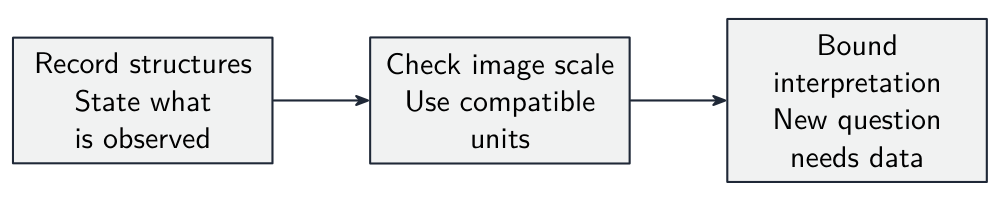
    โครงสร้างที่บันทึกไว้และการตรวจสอบสเกลช่วยในการตีความ ในขณะที่คำถามใหม่ต้องการหลักฐานใหม่

    ในกรณีตัวอย่างที่ให้มา เซลล์ที่พิมพ์มีความยาว 30.0 มิลลิเมตร และความยาวจริงที่ระบุไว้คือ 0.0500 มิลลิเมตร ใช้หน่วยเดียวกันในอัตราส่วน:

    $$M=\frac{L_{image}}{L_{actual}}$$
    $$M=\frac{30.0\ \text{mm}}{0.0500\ \text{mm}}=600$$

    กำลังขยายคือ ×600 ไม่ใช่ความยาวรูปร่างและสเกลเพียงอย่างเดียวไม่สามารถกำหนดอัตราการเจริญเติบโตได้ การศึกษาการเจริญเติบโตที่ได้รับการอนุญาตจำเป็นต้องมีเกณฑ์การวัดที่กำหนดชัดเจน สิ่งมีชีวิตที่เปรียบเทียบได้ สภาวะแวดล้อม และช่วงเวลาการสังเกต

    Vocabulary · ⁨คำศัพท์⁩ Train · ⁨ฝึกฝน⁩
    English ไทย
    cell/sel/ เซลล์
    Prokaryotic/ˌprɒkərɪˈɒtɪk/ โปรคาริโอต
    eukaryotic/ˌjuːkərɪˈɒtɪk/ eukaryotic
    Homeostasis/ˌhəʊmiːəˈstɑːsiz/ โฮมโอสตาซิส (Homeostasis)
    2.2

    The classification of living things · ⁨การจัดหมวดหมู่สิ่งมีชีวิต⁩

    Syllabus · ⁨หลักสูตร⁩
    English

    Unit 2 of 7 in GAC023 Science III: General Science (Level III). The module is taught over about 40 class hours plus 20 hours of independent study, and is assessed at the teaching centre and moderated by ACT — there is no external exam.

    The module outcomes this unit works towards:

    Learning Objective GAC023.1: Demonstrate knowledge and understanding of major biological concepts and ideas.

    ไทย

    หน่วยที่ 2 จากทั้งหมด 7 หน่วยใน GAC023 Science III: General Science (ระดับ III) มอดูลนี้สอนเป็นเวลาประมาณ 40 ชั่วโมงเรียน plus 20 ชั่วโมงศึกษาด้วยตนเอง และประเมินผลที่ศูนย์การสอนโดย ACT — ไม่มีข้อสอบภายนอก

    ผลลัพธ์การเรียนรู้ submodule ที่หน่วยนี้มุ่งสู่:

    วัตถุประสงค์การเรียนรู้ GAC023.1: แสดงความรู้และความเข้าใจเกี่ยวกับแนวคิดและแนวคิดหลักทางชีววิทยา

    Source: Cambridge International syllabus · ⁨แหล่งที่มา: หลักสูตร Cambridge International⁩

    English

    Classification 分类 organises organisms using evidence about relationships, including inherited traits and molecular information. A traditional hierarchy is kingdom, phylum, class, order, family, genus and species 物种. Broader groups can contain several groups at the next level. A visible feature helps identification but does not alone establish ancestry.

    Binomial nomenclature 双名法 gives a species a genus name and a specific epithet. Capitalise the genus, use lower case for the epithet and italicise both words in print. When handwriting, underline both as required by the task. The epithet alone is not the full species name.

    Worked example: one genus, different species

    The supplied table places lion, tiger and domestic cat in Felidae. Lion and tiger share Panthera, but their species names are Panthera leo and Panthera tigris. The domestic cat is Felis catus, a different genus within that family. Names checked 2 October 2026 against ITIS records.

    A classroom leaf key can separate needle-like leaves from broad leaves, then smooth margins from toothed margins. This identifies prepared cards from stated features. The key's branch order is not evidence that plants evolved in that order.

    ไทย

    การจัดหมวดหมู่ จัดระเบียบสิ่งมีชีวิตโดยใช้หลักฐานเกี่ยวกับความสัมพันธ์ ซึ่งรวมถึงลักษณะที่สืบทอดและข้อมูลระดับโมเลกุลลำดับชั้นแบบดั้งเดิมคืออาณาจักร พาราม class Order Family Genus และ ชนิด กลุ่มที่ใหญ่กว่าสามารถประกอบด้วยกลุ่มย่อยหลายกลุ่มในระดับถัดไปได้ลักษณะที่มองเห็นได้ช่วยในการระบุแต่เพียงอย่างเดียวไม่สามารถยืนยันบรรพบุรุษได้

    ชื่อเรียกแบบสองคำ (Binomial nomenclature) ให้ชื่อสกุลและชื่อจำเพาะแก่ชนิดใดชนิดหนึ่ง ตัวอักษรต้นของชื่อสกุลต้องเขียนตัวใหญ่ ใช้ตัวเล็กสำหรับชื่อจำเพาะ และจัดตัวเอียงสำหรับทั้งสองคำเมื่อพิมพ์ เมื่อเขียนด้วยลายมือ ให้ขีดเส้นใต้ทั้งสองตามข้อกำหนดของงาน ชื่อจำเพาะเพียงอย่างเดียวไม่ใช่ชื่อชนิดที่สมบูรณ์

    ครอบครัวหนึ่งอาจประกอบด้วยสกุลหลายสกุล แต่ละสกุลอาจประกอบด้วยชนิดหลายชนิด

    ตัวอย่างวิธีทำ: สกุลหนึ่ง但与不同ชนิด

    ตารางที่ให้มาจัดให้อนุสาวรีย์ เสือ และแมวบ้านอยู่ในวงศ์ Felidae อนุสาวรีย์และเสือมีสกุล Panthera ร่วมกัน แต่ชื่อชนิดของ它们是 Panthera leo และ Panthera tigris แมวบ้านคือ Felis catus ซึ่งเป็นสกุลต่างwithin那个family. Names checked 2 October 2026 against ITIS records.

    Leaf key ในห้องเรียนสามารถแยกใบคล้ายเข็มออกจากใบกว้าง แล้วแยกขอบเรียบจากขอบฟันเลื่อย วิธีนี้ช่วยระบุบัตรเตรียมจากคุณสมบัติที่ระบุ的顺序不是 evidence that plants evolved in that order.

    Vocabulary · ⁨คำศัพท์⁩ Train · ⁨ฝึกฝน⁩
    English ไทย
    Classification/ˌklæsɪfɪˈkeɪʃn/ Classification
    species/ˈspiːsiːz/ ชนิด (species)
    Binomial nomenclature/baɪˈnəʊmɪəl nəˈmeŋklətʃə/ ชื่อวิทยาศาสตร์แบบทวินนาม
    2.3

    Ecosystems · ⁨ระบบนิเวศ⁩

    Syllabus · ⁨หลักสูตร⁩
    English

    Unit 3 of 7 in GAC023 Science III: General Science (Level III). The module is taught over about 40 class hours plus 20 hours of independent study, and is assessed at the teaching centre and moderated by ACT — there is no external exam.

    The module outcomes this unit works towards:

    Learning Objective GAC023.2: Describe the main components of an ecosystem and the main processes that take place in it.

    ไทย

    หน่วยที่ 3 จากทั้งหมด 7 หน่วยใน GAC023 Science III: General Science (ระดับ III) มอดูลนี้สอนเป็นเวลาประมาณ 40 ชั่วโมงเรียน plus 20 ชั่วโมงศึกษาด้วยตนเอง และประเมินผลที่ศูนย์การสอนโดย ACT — ไม่มีข้อสอบภายนอก

    ผลลัพธ์การเรียนรู้ submodule ที่หน่วยนี้มุ่งสู่:

    จุดประสงค์การเรียนรู้ GAC023.2: อธิบายองค์ประกอบหลักของระบบนิเวศและกระบวนการสำคัญที่เกิดขึ้นภายในนั้น

    Source: Cambridge International syllabus · ⁨แหล่งที่มา: หลักสูตร Cambridge International⁩

    English

    An ecosystem 生态系统 includes organisms and nonliving conditions. Producers 生产者 make organic material using an energy source. Consumers 消费者 obtain it from other organisms. Decomposers 分解者 break down dead material and waste, helping return nutrients to available forms.

    Food-chain arrows point from food to consumer. Energy enters and transfers through the system, with dissipation through respiration and other pathways. It does not disappear from existence or cycle indefinitely back to the producer. Matter can cycle through living and nonliving parts, although a local system can also gain or lose matter across its boundary.

    Biodiversity 生物多样性 concerns the variety of life. Species richness and distributions of abundance are possible measures, depending on the question. Counting only one species does not describe all this variety. Diversity may affect ecosystem responses, but it does not guarantee resistance to every disturbance.

    Worked example: transfer percentages are case-specific

    For the separate meadow record, grass has 5,000 joules in its defined level, grasshoppers receive 600 and frogs receive 60. The efficiency relation is:

    $$\eta=\frac{E_{next}}{E_{previous}}\times100\%$$
    $$\eta_1=\frac{600}{5000}\times100\%=12\%$$
    $$\eta_2=\frac{60}{600}\times100\%=10\%$$

    Neither result makes ten percent a universal law. Not all material is eaten or assimilated, and energy is used and dissipated. This period's budget contains no population trend, so it cannot predict an exact frog decline the next week.

    ไทย

    ระบบนิเวศ ประกอบด้วยสิ่งมีชีวิตและสภาพที่ไม่ใช่สิ่งมีชีวิต ผู้ผลิต สร้างสารอินทรีย์โดยใช้แหล่งพลังงาน ผู้บริโภค ได้รับสารนั้นจากสิ่งมีชีวิตอื่น ผู้ย่อยสลาย ย่อยสลายวัสดุที่ตายแล้วและของเสีย ช่วย归还nutrients กลับสู่รูปที่พร้อมใช้งาน

    ลูกศรในห่วงโซ่อาหารชี้จากอาหารไปยังผู้บริโภค พลังงานเข้าสู่และถ่ายโอนผ่านระบบ ด้วยการสูญเสียผ่านการหายใจและเส้นทางอื่นๆ พลังงานไม่หายไปจากโลกหรือหมุนเวียนกลับไปยังผู้ผลิตอย่างไม่มีที่สิ้นสุด的物质可以循环利用 through living and nonliving parts although a local system can also gain or lose matter across its boundary.

    ความหลากหลายทางชีวภาพ เกี่ยวข้องกับความหลากหลายของชีวิต ความอุดมสมบูรณ์ของชนิดและการกระจายตัวของจำนวนเป็น metrics ที่เป็นไปได้ขึ้นอยู่กับคำถาม การนับเพียงชนิดเดียวไม่สามารถอธิบายความหลากหลายทั้งหมดนี้ได้ ความหลากหลายอาจส่งผลต่อresponseของระบบนิเวศแต่ไม่รับประกันความต้านทานต่อการรบกวนทุกประเภท

     chaîne d'algues illustrating uses其 supplied energy values, not a universal transfer rule.

    ตัวอย่างวิธีทำ: อัตราการถ่ายโอนเป็น case-specific

    สำหรับ record Meadow แยกกัน หญ้ามีพลังงาน 5,000 joules ในระดับที่กำหนด เกริ่น réception 600 และกบ reception 60 ความสัมพันธ์ประสิทธิภาพคือ:

    $$\eta=\frac{E_{next}}{E_{previous}}\times100\%$$
    $$\eta_1=\frac{600}{5000}\times100\%=12\%$$
    $$\eta_2=\frac{60}{600}\times100\%=10\%$$

    ผลลัพธ์ทั้งสองไม่ทำให้สิบเปอร์เซ็นต์เป็นกฎสากล วัสดุทั้งหมดไม่ถูกกินหรือดูดซึม และพลังงานถูกใช้และสูญเสีย งบประมาณของช่วงเวลานี้ไม่包含population trend ดังนั้นจึงไม่สามารถทำนายการลดลงของกบที่แน่นอนในสัปดาห์หน้าได้

    Vocabulary · ⁨คำศัพท์⁩ Train · ⁨ฝึกฝน⁩
    English ไทย
    ecosystem/ˈiːkəʊsɪstəm/ ระบบนิเวศ
    Producers/prəˈdjuːsəz/ ผู้ผลิต
    consumers/kənˈsuːməz/ ผู้บริโภคหลัก
    decomposers/ˌdiːkəmˈpəʊzəz/ ตัวย่อยสลาย
    Biodiversity/ˌbaɪəʊdaɪˈvɜːsɪti/ ความหลากหลายทางชีวภาพ
    rock cycle/rɒk ˈsaɪkl/ วัฏจักรหิน
    Renewable/rɪˈnjuːəbl/ تجدได้
    non-renewable/nɒn rɪˈnjuːəbl/ ไม่สามารถ obnovитьได้
    water cycle/ˈwɔːtə ˈsaɪkl/ วัฏจักรน้ำ
    2.4

    Earth resources · ⁨ทรัพยากรธรณี⁩

    Syllabus · ⁨หลักสูตร⁩
    English

    Unit 4 of 7 in GAC023 Science III: General Science (Level III). The module is taught over about 40 class hours plus 20 hours of independent study, and is assessed at the teaching centre and moderated by ACT — there is no external exam.

    The module outcomes this unit works towards:

    Learning Objective GAC023.3: Identify and describe the physical, chemical and biological features of the local environment.

    Learning Objective GAC023.8: Create a written report following scientific and academic conventions using Internet research.

    ไทย

    หน่วยที่ 4 จากทั้งหมด 7 หน่วยใน GAC023 Science III: General Science (ระดับ III) มอดูลนี้สอนเป็นเวลาประมาณ 40 ชั่วโมงเรียน plus 20 ชั่วโมงศึกษาด้วยตนเอง และประเมินผลที่ศูนย์การสอนโดย ACT — ไม่มีข้อสอบภายนอก

    ผลลัพธ์การเรียนรู้ submodule ที่หน่วยนี้มุ่งสู่:

    จุดประสงค์การเรียนรู้ GAC023.3: ระบุและอธิบายลักษณะทางกายภาพ เคมี และชีววิทยาของสิ่งแวดล้อมในพื้นที่

    จุดประสงค์การเรียนรู้ GAC023.8: สร้างรายงานเขียนตามธรรมเนียมปฏิบัติทางวิทยาศาสตร์และวิชาการโดยใช้การค้นคว้าจากอินเทอร์เน็ต

    Source: Cambridge International syllabus · ⁨แหล่งที่มา: หลักสูตร Cambridge International⁩

    English

    The rock cycle 岩石循环 connects formation and change. Cooling and solidification form igneous rock; sediment deposition, compaction and cementation can form sedimentary rock; heat and pressure can alter rock into metamorphic rock without melting it. Weathering and erosion produce sediment, while melting and later cooling form another route. These processes are not one compulsory circular sequence for every rock.

    Renewable 可再生 resources can be replenished on a relevant timescale. Non-renewable 不可再生 resources are not replenished fast enough on human-use timescales. Renewable does not mean unlimited: demand can exceed replacement, and ecosystem needs also matter.

    The water cycle 水循环 includes evaporation, condensation, precipitation and movement or storage through runoff, infiltration and groundwater. A local pond is open to inputs and losses. A report should combine physical layout, dated chemical measurements and non-destructive biological records, citing their sources and methods.

    Worked example: renewal versus extraction

    In the simplified supplied budget, inputs are 30 cubic metres, outlet loss is 18 and evaporation is 7. Other changes are excluded by assumption:

    $$\Delta S=I-O-E$$
    $$\Delta S=30-18-7=5\ \text{m}^3$$

    With a proposed additional extraction of 12 cubic metres:

    $$\Delta S=I-O-E-X$$
    $$\Delta S=30-18-7-12=-7\ \text{m}^3$$

    That period's estimate does not establish long-term sustainability, initial storage or permission to extract. Reeds do not prove drinking-water safety. A rock photograph does not establish every rock's type or exact age.

    ไทย

    วัฏจักรหิน เชื่อมโยงการสร้างและการเปลี่ยนแปลง การเย็นตัวและการแข็งตัวสร้างหินอัคนี; การสะสมตะกอน การอัดตัวและการ cementation สามารถสร้างหินทรุดตัว; ความร้อนและความดันสามารถเปลี่ยนหินให้เป็นหินแปรโดยไม่ละลายมัน การผุกร่อนและการกัดเซาะสร้างตะกอน ส่วนการหลอมเหลวและการเย็นตัวต่อไปเป็นเส้นทางอื่น กระบวนการเหล่านี้ไม่ใช่ sequence วงกลมบังคับเดียวสำหรับหินทุกชนิด

    ทรัพยากร تجدได้ สามารถเติมเต็มได้ใน timeframe ที่เกี่ยวข้อง ทรัพยากรไม่ تجدได้ ไม่เติมเต็มได้เร็วพอบน human-use timescales تجدได้ไม่หมายถึงไม่มีจำกัด: ความต้องการอาจแทนที่การเติมเต็ม และความต้องการของระบบนิเวศก็สำคัญเช่นกัน

    วัฏจักรน้ำ включает evaporation, condensation, precipitation และการเคลื่อนย้ายหรือจัดเก็บผ่าน runoff, infiltration และ groundwater บ่อในพื้นที่เปิดรับ inputs และ losses รายงานควรรวม layout ทางกายา การวัดทางเคมีที่มีวันที่ และ biological records แบบไม่ทำลาย citing sources และ methods ของ它们

    Local pond budget records inputs, storage and losses within a stated boundary and period.

    ตัวอย่างวิธีทำ: การเติมเต็มเทียบกับ extraction

    ใน simplified budget ที่ให้มา inputs คือ 30 ลูกบาศก์เมตร outlet loss คือ 18 และ evaporation คือ 7 การเปลี่ยนแปลงอื่น ๆ ถูก exclude by assumption:

    $$\Delta S=I-O-E$$
    $$\Delta S=30-18-7=5\ \text{m}^3$$

    ด้วยการ extraction เพิ่มเติมที่เสนอ 12 ลูกบาศก์เมตร:

    $$\Delta S=I-O-E-X$$
    $$\Delta S=30-18-7-12=-7\ \text{m}^3$$

    การประมาณค่าในช่วงเวลานั้นไม่ได้ชี้แจงความยั่งยืนในระยะยาว การเก็บกักเริ่มต้น หรืออนุญาตในการสกัด รอยยิ้มไม่ได้พิสูจน์ความปลอดภัยของน้ำดื่ม ภาพถ่ายหินไม่ได้ระบุประเภทหรืออายุที่แน่นอนของหินทุกชนิด

    2.5

    Chemistry · ⁨เคมี⁩

    Syllabus · ⁨หลักสูตร⁩
    English

    Unit 5 of 7 in GAC023 Science III: General Science (Level III). The module is taught over about 40 class hours plus 20 hours of independent study, and is assessed at the teaching centre and moderated by ACT — there is no external exam.

    The module outcomes this unit works towards:

    Learning Objective GAC023.4: Demonstrate an understanding of atomic structure, the changes it can undergo and the use of the Periodic Table.

    ไทย

    หน่วยที่ 5 จากทั้งหมด 7 หน่วยใน GAC023 Science III: General Science (ระดับ III) มอดูลนี้สอนเป็นเวลาประมาณ 40 ชั่วโมงเรียน plus 20 ชั่วโมงศึกษาด้วยตนเอง และประเมินผลที่ศูนย์การสอนโดย ACT — ไม่มีข้อสอบภายนอก

    ผลลัพธ์การเรียนรู้ submodule ที่หน่วยนี้มุ่งสู่:

    จุดประสงค์การเรียนรู้ GAC023.4: แสดงความเข้าใจเกี่ยวกับโครงสร้างอะตอม การเปลี่ยนแปลงที่เกิดขึ้นกับมัน และการใช้ตารางธาตุ

    Source: Cambridge International syllabus · ⁨แหล่งที่มา: หลักสูตร Cambridge International⁩

    English

    An atom 原子 has a nucleus and electrons. Its atomic number 原子序数 is its proton count, while its mass number 质量数 counts protons and neutrons. Most nuclei contain both, but hydrogen-1 has one proton and no neutron. Isotopes 同位素 of an element have the same proton count and different neutron counts.

    The periodic table 元素周期表 orders elements by atomic number. In an introductory main-group model, outer electron arrangements help explain similarities within groups. The elements are not identical, and the simplified rule should not be extended without care to every element.

    Ionic bonds 离子键 are attractions between oppositely charged ions. Electron transfer can explain their formation; it is not the attraction itself. Covalent bonds 共价键 involve shared electron pairs. These are explanatory models, not instructions to handle reactive materials.

    Worked example: keep proton number unchanged

    Sodium-23 has 11 protons and mass number 23:

    $$N=A-Z$$
    $$N=23-11=12$$

    Its neutral atom has 11 electrons. Losing one gives Na⁺ with ten electrons and the same eleven protons. Sodium-24 has thirteen neutrons but remains sodium. Neutral chlorine has seventeen electrons; gaining one gives Cl⁻ with eighteen. Their opposite charges explain attraction.

    ไทย

    อะตอม มีนิวเคลียสและอิเล็กตรอน เลขอะตอม ของมันคือจำนวนโปรตอน ในขณะที่ เลขมวล นับรวมโปรตอนและนิวตรอน นิวเคลียสส่วนใหญ่มีทั้งสองอย่าง แต่ไฮโดรเจน-1 มีเพียงโปรตอนหนึ่งตัวและไม่มีการนับนิวตรอน ไอโซโทป ของธาตุหนึ่งมีจำนวนโปรตอนเท่ากันแต่มีจำนวนนิวตรอนต่างกัน

    ตารางสารเคมี เรียงลำดับธาตุตามเลขอะตอม ในแบบจำลองกลุ่มหลักเบื้องต้น การจัดเรียงอิเล็กตรอนชั้นนอกช่วยอธิบายความคล้ายคลึงกันในหมู่ธาตุ ธาตุเหล่านี้ไม่เหมือนกัน และกฎที่ลดทอนควรไม่ถูกขยายโดยไม่ระมัดระวังไปยังธาตุทุกชนิด

    พันธะไอออนิก คือแรงดึงดูดระหว่างไอออนที่มีประจุตรงข้าม การถ่ายโอนอิเล็กตรอนสามารถอธิบายการเกิดพันธะนี้ได้ แต่ไม่ใช่แรงดึงดูดเอง พันธะโคเวเลนต์ เกี่ยวข้องกับการจับคู่ของอิเล็กตรอนร่วมกัน นี่คือแบบจำลองเพื่ออธิบาย ไม่ใช่คำแนะนำในการจัดการกับวัสดุที่มีปฏิกิริยาสูง

    โปรตอนระบุธาตุ นิวตรอนแยกแยะไอโซโทป และการเปลี่ยนแปลงอิเล็กตรอนกำหนดประจุไอออน

    ตัวอย่างวิธีทำ: รักษาเลขอะตอมให้คงที่

    โซเดียม-23 มีโปรตอน 11 ตัวและมีเลขมวล 23:

    $$N=A-Z$$
    $$N=23-11=12$$

    อะตอมที่เป็นกลางของมันมีอิเล็กตรอน 11 ตัว การสูญเสียหนึ่งตัวจะทำให้ได้ Na⁺ ที่มีอิเล็กตรอนสิบตัวและโปรตอนสิบหนึ่งตัวเท่าเดิม โซเดียม-24 มีนิวตรอนสิบสามตัวแต่ยังคงเป็นโซเดียม คลอรีนที่เป็นกลางมีอิเล็กตรอน 17 ตัว การได้รับหนึ่งตัวจะได้ Cl⁻ ที่มี 18 อิเล็กตรอน ประจุตรงข้ามของทั้งสองอธิบายแรงดึงดูด

    Vocabulary · ⁨คำศัพท์⁩ Train · ⁨ฝึกฝน⁩
    English ไทย
    atom/ˈætəm/ อะตอม
    atomic number/əˈtɒmɪk ˈnʌmbə/ เลขอะตอม
    mass number/mæs ˈnʌmbə/ เลขมวล
    isotopes/ˈaɪsətəʊps/ ไอโซโทป
    periodic table/ˌpɪərɪˈɒdɪk ˈteɪbl/ ตารางธาตุ
    Ionic bonds/aɪˈɒnɪk bɒndz/ พันธะไอออนิก
    covalent bonds/ˈkəʊvələnt bɒndz/ พันธะโคเวเลนต์
    Combustion/kəmˈbʌstʃn/ การเผาไหม้ (Combustion)
    greenhouse effect/ˈɡriːnhaʊs ɪˈfekt/ ปรากฏการณ์เรือนกระจก (greenhouse effect)
    Acid rain/ˈæsɪd reɪn/ ฝนกรด
    Pollution/pəˈluːʃn/ Pollution
    2.6

    Chemistry and the environment · ⁨เคมีกับสิ่งแวดล้อม⁩

    Syllabus · ⁨หลักสูตร⁩
    English

    Unit 6 of 7 in GAC023 Science III: General Science (Level III). The module is taught over about 40 class hours plus 20 hours of independent study, and is assessed at the teaching centre and moderated by ACT — there is no external exam.

    The module outcomes this unit works towards:

    Learning Objective GAC023.5: Explain how applications of chemistry affect the environment.

    ไทย

    หน่วยที่ 6 จากทั้งหมด 7 หน่วยใน GAC023 Science III: General Science (ระดับ III) มอดูลนี้สอนเป็นเวลาประมาณ 40 ชั่วโมงเรียน plus 20 ชั่วโมงศึกษาด้วยตนเอง และประเมินผลที่ศูนย์การสอนโดย ACT — ไม่มีข้อสอบภายนอก

    ผลลัพธ์การเรียนรู้ submodule ที่หน่วยนี้มุ่งสู่:

    จุดประสงค์การเรียนรู้ GAC023.5: อธิบายว่าการใช้งานเคมีส่งผลต่อสิ่งแวดล้อมอย่างไร

    Source: Cambridge International syllabus · ⁨แหล่งที่มา: หลักสูตร Cambridge International⁩

    English

    Combustion 燃烧 of carbon-containing fuels can release carbon dioxide. The greenhouse effect 温室效应 involves absorption and emission of thermal infrared by gases including carbon dioxide. Acid rain 酸雨 involves atmospheric reactions of sulfur dioxide and nitrogen oxides forming acidic compounds. These are different mechanisms, with different evidence and responses.

    Pollution 污染 depends on a substance or agent, its amount, pathway and effects. Chemistry can help monitor and treat it, but moving material into another output is not necessarily destroying it. Assess benefits alongside energy use, residual material and appropriate waste handling. Sources checked 2 October 2026: EPA acid-rain explanation and NASA radiation budget.

    Worked example: a reduction can still miss a target

    An invented 10-litre treatment record falls from 12.0 to 3.0 milligrams per litre. At unchanged volume:

    $$m=CV$$
    $$m_{remaining}=3.0\ \frac{\text{mg}}{\text{L}}\times10.0\ \text{L}=30\ \text{mg}$$

    The initial mass was 120 milligrams, so ninety are retained on the filter under the stated assumptions. The concentration reduction is seventy-five percent, but the final 3.0 still exceeds the fictional task target of 2.0 milligrams per litre. This is not a real safety standard. Students analyse the supplied data and do not discharge chemicals.

    ไทย

    การเผาไหม้ ของเชื้อเพลิงที่มีคาร์บอนสามารถปล่อยก๊าซคาร์บอนไดออกไซด์ได้ ปรากฏการณ์เรือนกระจก เกี่ยวข้องกับการดูดกลืนและการแผ่รังสีอินฟราเรดความร้อนโดยก๊าซต่างๆ بماทั้งคาร์บอนไดออกไซด์ ฝนกรด เกี่ยวข้องกับปฏิกิริยาในบรรยากาศของซัลเฟอร์ไดออกไซด์และไนโตรเจนออกไซด์ที่สร้างสารประกอบที่เป็นกรด สิ่งเหล่านี้เป็นกลไกที่แตกต่างกัน มีหลักฐานและการตอบสนองที่แตกต่างกัน

    มลพิษ ขึ้นอยู่กับสารหรือปัจจัย ปริมาณ เส้นทาง และผลกระทบ เคมีสามารถช่วยในการตรวจสอบและกำจัดมลพิษได้ แต่การย้ายวัสดุไปยังผลลัพธ์อื่นอาจไม่ใช่การทำลายมัน ควรประเมินประโยชน์ควบคู่กับการใช้พลังงาน วัสดุที่เหลืออยู่ และการจัดการขยะที่เหมาะสม แหล่งข้อมูลตรวจสอบวันที่ 2 ตุลาคม 2026: คำอธิบายฝนกรดของ EPA และ งบประมาณรังสีของ NASA

    กระบวนการบำบัดที่จัดเตรียมไว้มีผลผลิตเป็นของเหลวและของเสียจากตัวกรอง ซึ่งทั้งสองอย่างนี้ยังคงอยู่ในบัญชีสาร

    ตัวอย่างวิธีทำ: การลดปริมาณอาจยังพลาดเป้าหมาย

    บันทึกการบำบัดขนาด 10 ลิตรที่สมมติลดลงจาก 12.0 เป็น 3.0 มิลลิกรัมต่อลิตร ที่ปริมาตรคงที่:

    $$m=CV$$
    $$m_{remaining}=3.0\ \frac{\text{mg}}{\text{L}}\times10.0\ \text{L}=30\ \text{mg}$$

    มวลเริ่มต้นคือ 120 มิลลิกรัม ดังนั้นเก้าสิบจะคงอยู่ที่ตัวกรองภายใต้ข้อสมมติฐานที่กำหนด การลดความเข้มข้นคือเจ็ดสิบห้าเปอร์เซ็นต์ แต่ค่าสุดท้าย 3.0 ยังคงเกินเป้าหมายการปฏิบัติสมมติที่ 2.0 มิลลิกรัมต่อลิตร สิ่งนี้ไม่ใช่มาตรฐานความปลอดภัยจริง นักเรียนวิเคราะห์ข้อมูลที่จัดเตรียมและไม่ปล่อยสารเคมี

    2.7

    Physics · ⁨ฟิสิกส์⁩

    Syllabus · ⁨หลักสูตร⁩
    English

    Unit 7 of 7 in GAC023 Science III: General Science (Level III). The module is taught over about 40 class hours plus 20 hours of independent study, and is assessed at the teaching centre and moderated by ACT — there is no external exam.

    The module outcomes this unit works towards:

    Learning Objective GAC023.6: Demonstrate an understanding of wave motion.

    ไทย

    หน่วยที่ 7 จากทั้งหมด 7 หน่วยใน GAC023 Science III: General Science (ระดับ III) มอดูลนี้สอนเป็นเวลาประมาณ 40 ชั่วโมงเรียน plus 20 ชั่วโมงศึกษาด้วยตนเอง และประเมินผลที่ศูนย์การสอนโดย ACT — ไม่มีข้อสอบภายนอก

    ผลลัพธ์การเรียนรู้ submodule ที่หน่วยนี้มุ่งสู่:

    จุดประสงค์การเรียนรู้ GAC023.6: แสดงความเข้าใจเกี่ยวกับการเคลื่อนที่ของคลื่น

    Source: Cambridge International syllabus · ⁨แหล่งที่มา: หลักสูตร Cambridge International⁩

    English

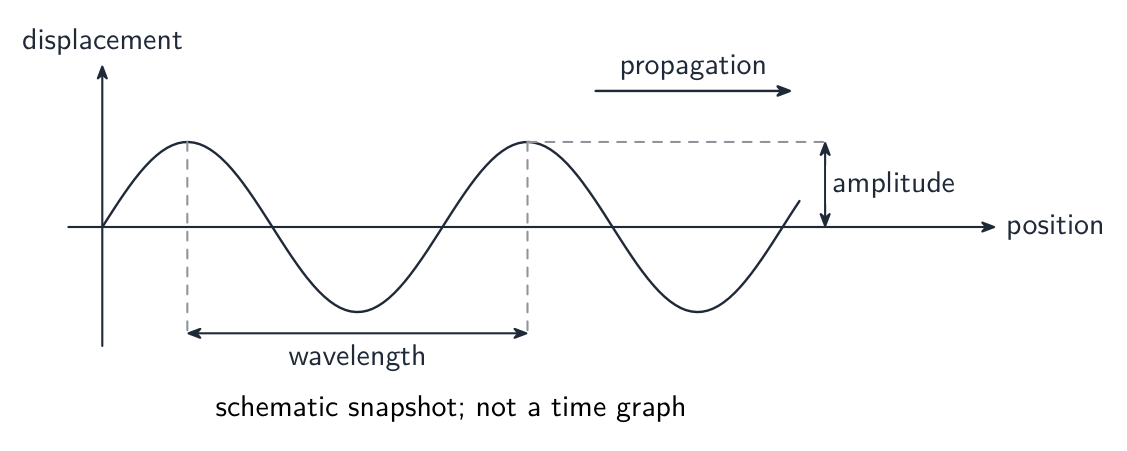
    A wave 波 transfers energy through a travelling disturbance without carrying each medium particle along with it. Frequency 频率 counts complete oscillations per second. Wavelength 波长 is the spacing of successive points in the same phase. Speed 波速 relates them through the wave equation. Amplitude is maximum displacement from equilibrium, not crest-to-trough height.

    Transverse waves 横波 oscillate perpendicular to propagation; longitudinal waves 纵波 oscillate parallel to it. The direction drawn on a page alone does not decide the type. A string point may oscillate vertically while the disturbance moves horizontally.

    The electromagnetic spectrum 电磁波谱 runs through radio, microwaves, infrared, visible light, ultraviolet, X-rays and gamma rays. Electromagnetic waves do not require a material medium. They share the same vacuum speed while differing in frequency and wavelength; mechanical waves do not all have that speed.

    Worked example: choose the equation for the question

    The supplied string wave has frequency 5.0 hertz and wavelength 0.40 metres:

    $$v=f\lambda$$
    $$v=5.0\ \text{Hz}\times0.40\ \text{m}=2.0\ \frac{\text{m}}{\text{s}}$$

    Its period is the time per complete oscillation:

    $$T=\frac{1}{f}$$
    $$T=\frac{1}{5.0}=0.20\ \text{s}$$

    An amplitude of 0.030 metres gives a crest-to-trough height of 0.060 metres. Neither is the 0.40-metre wavelength. A marked point oscillates about equilibrium; no supplied observation establishes that changing amplitude changes frequency.

    ไทย

    คลื่น ส่งผ่านพลังงานผ่านการรบกวนที่เคลื่อนที่โดยไม่พาอนุภาคของสื่อทุกตัวไปด้วย ความถี่ นับรอบการสั่นสมบูรณ์ต่อวินาที ความยาวคลื่น คือระยะห่างระหว่างจุดต่อเนื่องในเฟสเดียวกัน ความเร็ว เชื่อมโยงสิ่งเหล่านี้ผ่านสมการคลื่น แอมพลิจูดคือการกระจัดสูงสุดจากตำแหน่งสมดุล ไม่ใช่ความสูงยอดถึงบ่อ

    คลื่นขวาง สั่นตั้งฉากกับการแพร่กระจาย ส่วน คลื่นยาว สั่นขนานกับทิศทางนั้น ทิศทางที่วาดบนหน้ากระดาษเพียงอย่างเดียวไม่ได้กำหนดชนิด คลื่นสายเคเบิลอาจสั่นในแนวตั้งขณะที่การรบกวนเคลื่อนที่ในแนวนอน

    สเปกตรัมแม่เหล็กไฟฟ้า ครอบคลุมวิทยุ ไมโครเวฟ อินฟราเรด แสงที่มองเห็นได้ อัลตราไวโอเลต รังสีเอกซ์ และรังสีแกมมา คลื่นแม่เหล็กไฟฟ้าไม่จำเป็นต้องใช้สื่อทางกายภาพ พวกมันมีความเร็วในสุญญากาศเท่ากันแต่แตกต่างกันในความถี่และความยาวคลื่น ส่วนคลื่นกลไม่ทั้งหมดมีความเร็วดังกล่าว

    แผนภาพตัวอย่างคลื่นขวางแยกความยาวคลื่นและแอมพลิจูดออกจากทิศทางการแพร่กระจาย

    ตัวอย่างวิธีทำ: เลือกสมการสำหรับคำถาม

    คลื่นสายเคเบิลที่จัดเตรียมมีความถี่ 5.0 เฮิร์ตซ์ และความยาวคลื่น 0.40 เมตร:

    $$v=f\lambda$$
    $$v=5.0\ \text{Hz}\times0.40\ \text{m}=2.0\ \frac{\text{m}}{\text{s}}$$

    คาบคือเวลาต่อรอบการสั่นสมบูรณ์:

    $$T=\frac{1}{f}$$
    $$T=\frac{1}{5.0}=0.20\ \text{s}$$

    แอมพลิจูด 0.030 เมตรให้ความสูงยอดถึงบ่อ 0.060 เมตร ทั้งสองค่าไม่ใช่ความยาวคลื่น 0.40 เมตร จุดที่ระบุจะสั่นรอบตำแหน่งสมดุล ไม่มีข้อมูลสังเกตการณ์ใดที่จัดเตรียมไว้ว่าแอมพลิจูดที่เปลี่ยนไปจะส่งผลต่อความถี่

    Vocabulary · ⁨คำศัพท์⁩ Train · ⁨ฝึกฝน⁩
    English ไทย
    wave/weɪv/ คลื่น
    Frequency/ˈfriːkwənsi/ ความถี่
    wavelength/ˈweɪvleŋθ/ ความยาวคลื่น
    speed/spiːd/ ความเร็ว
    Transverse waves/trænsˈvɜːs weɪvz/ คลื่นขวาง
    longitudinal waves/ˌlɒŋɡɪˈtjuːdɪnl weɪvz/ คลื่น longitudinal
    electromagnetic spectrum/ɪˌlektrəʊməɡˈnetɪk ˈspektrəm/ สเปกตรัมคลื่นแม่เหล็กไฟฟ้า
    Additional notes PDF

    A team investigation needs more than divided writing

    Two teams describe the same pond. One records where and when observations were made; the other combines undated photographs and a website's general statements. Which report lets a reader check its conclusions? This supplement develops the collaborative investigation and Internet-research outcomes alongside the original GAC023 handout. Follow the current centre brief for the required task, methods and assessment criteria.

    Agree a question, method and team record

    A collaborative investigation 合作探究 shares a scientific task with clear responsibilities and a common method. Choose a narrow question that permitted observations can address. For example: how does the proportion of ground covered by the selected plant differ between two accessible, teacher-approved areas? This is a comparison of coverage, not automatically a test of growth rate or proof of the cause of a difference.

    A sampling method 取样方法 specifies how observations are selected. Define the areas and observation period before collecting records. Use the same frame size and counting rule at both areas. Select positions by an agreed method, rather than choosing only attractive examples. Random selection within an accessible area can reduce deliberate selection, but cannot represent places excluded from that area. Keep repeats 重复测量 distinct from revisiting the exact same record: ten photographs of one patch are not ten independent patches.

    Agree which member records location and time, which estimates coverage and which checks the entries. Rotate or check roles if different observers could systematically use different rules. A common recording sheet needs labels, units, the selection method and any deviations. Keep each original record and identify its observer. Resolve a disagreement by checking the agreed rule and evidence; do not replace an inconvenient result with the group average.

    Obtain teacher agreement before fieldwork. Respect access restrictions, weather and local site rules. Use permitted observations without entering unsafe water or collecting unknown organisms or chemicals. A report about a proposed investigation must call it proposed. Research does not replace required fieldwork.

    Analyse a supplied case without inventing causes

    The following supplied data 给定数据 are fictional practice records, not a completed field investigation. Both areas use the same coverage rule and frame size. Each row represents a different selected position.

    Position Area A coverage / % Area B coverage / %
    1 20 40
    2 30 50
    3 40 60
    Mean 30 50

    Calculate each mean from its three records. The mean difference is 50 − 30 = 20 percentage points 百分点. Each area's range is twenty percentage points. A difference of twenty percentage points is not the same statement as a twenty-percent relative increase: relative to A's mean, the increase would be 20 ÷ 30 × 100%, approximately 66.7%.

    A suitable conclusion 结论 is: in the supplied samples, mean coverage was greater in B, with variation within both areas. Three samples do not establish all seasons or every part of the pond. The table gives no light, soil, water or time-series measurements. It therefore cannot show that pollution caused the difference or that a plant grew faster. Coverage also does not measure species richness. Identify the additional question and measurements needed rather than inventing an explanation.

    Describe the local environment through different evidence

    A physical feature 物理特征 concerns conditions such as layout, slope, shade or water movement. A chemical feature 化学特征 concerns substances and quantities, such as a dated concentration measured by a stated method. A biological feature 生物特征 concerns organisms, their distribution and relationships. Keep the categories connected without treating one as proof of another.

    For a local environment report, use a labelled location description and dated records. State which observations your team made and which came from another source. An organism photograph can support an identification within its limits; it cannot establish drinking-water safety. A chemical result without a date, unit or method may be unsuitable for the comparison. If the assignment uses secondary information only, state that limitation rather than presenting it as your own measurement.

    Research online and make the report traceable

    A secondary source 二手资料 reports information collected or interpreted by someone else. Check the producer, date, purpose, method and relevance to your question. Prefer the original measurement record or research report when available. A search-result preview does not replace reading the source. Two websites repeating one report are not two independent observations.

    Keep a source log as you research: author or organisation, title, date, address, the exact claim used and its limits. Use the reference style required by your brief. A citation 引用标注 links a claim to its source; the reference list gives the details needed to locate it. Explain the idea in your own words while citing it. Cite borrowed images and respect their permitted use. Do not make a missing date, method or author up.

    Organise the report around question and background, method and team responsibilities, results, discussion and conclusion, and references. Distinguish observation from explanation, and your records from published background. Show checked calculations, units and labelled tables. Discuss a specific limitation and a matching improvement. A reflection should identify each person's actual contribution and a concrete coordination issue; equal-length paragraphs do not demonstrate equal participation.

    Practice and explained answers

    1. Why are ten photographs of one patch not ten independent patches?
    2. Calculate the mean difference for the supplied coverage data, with its unit.
    3. Can these data prove pollution caused the coverage difference? Explain.
    4. What must accompany a borrowed chemical measurement?
    5. Two sites repeat one report. How many independent records does this establish?
    6. What should a team do when its members disagree about one coverage entry?

    Answers.

    1. The sampled location has not changed; extra photographs do not broaden sampling.
    2. 50 − 30 = 20 percentage points, not twenty percent relative to A.
    3. No. Pollution was not measured, and alternative explanations remain.
    4. Its source, date, unit, method and relevant limitations.
    5. One underlying report; repetition alone adds no independent observation.
    6. Check the shared rule and evidence; retain the original record and correction trail.

Log in or create account · ⁨เข้าสู่ระบบหรือสร้างบัญชี⁩

IGCSE, A-Level & AP