Enduring Understanding (DAT-1): The way a computer represents data internally is different from the way the data are interpreted and displayed for the user. Programs are used to translate data into a representation more easily understood by people.
Learning Objective DAT-1.A: Explain how data can be represented using bits. [Skill 3.C]
- DAT-1.A.1 Data values can be stored in variables, lists of items, or standalone constants and can be passed as input to (or output from) procedures.
- DAT-1.A.2 Computing devices represent data digitally, meaning that the lowest-level components of any value are bits.
- DAT-1.A.3 Bit is shorthand for binary digit and is either 0 or 1.
- DAT-1.A.4 A byte is 8 bits.
- DAT-1.A.5 Abstraction is the process of reducing complexity by focusing on the main idea. By hiding details irrelevant to the question at hand and bringing together related and useful details, abstraction reduces complexity and allows one to focus on the idea.
- DAT-1.A.6 Bits are grouped to represent abstractions. These abstractions include, but are not limited to, numbers, characters, and color.
- DAT-1.A.7 The same sequence of bits may represent different types of data in different contexts.
- DAT-1.A.8 Analog data have values that change smoothly, rather than in discrete intervals, over time. Some examples of analog data include pitch and volume of music, colors of a painting, or position of a sprinter during a race.
- DAT-1.A.9 The use of digital data to approximate real-world analog data is an example of abstraction.
- DAT-1.A.10 Analog data can be closely approximated digitally using a sampling technique, which means measuring values of the analog signal at regular intervals called samples. The samples are measured to figure out the exact bits required to store each sample.
Learning Objective DAT-1.B: Explain the consequences of using bits to represent data. [Skill 1.D]
- DAT-1.B.1 In many programming languages, integers are represented by a fixed number of bits, which limits the range of integer values and mathematical operations on those values. This limitation can result in overflow or other errors.
- DAT-1.B.2 Other programming languages provide an abstraction through which the size of representable integers is limited only by the size of the computer's memory; this is the case for the language defined in the exam reference sheet.
- DAT-1.B.3 In programming languages, the fixed number of bits used to represent real numbers limits the range and mathematical operations on these values; this limitation can result in round-off and other errors. Some real numbers are represented as approximations in computer storage.
- Exclusion statement: Specific range limitations for real numbers are outside the scope of this course and the AP Exam.
Learning Objective DAT-1.C: For binary numbers: a. Calculate the binary (base 2) equivalent of a positive integer (base 10) and vice versa. [Skill 2.B] b. Compare and order binary numbers. [Skill 2.B]
- DAT-1.C.1 Number bases, including binary and decimal, are used to represent data.
- DAT-1.C.2 Binary (base 2) uses only combinations of the digits zero and one.
- DAT-1.C.3 Decimal (base 10) uses only combinations of the digits $0 - 9$.
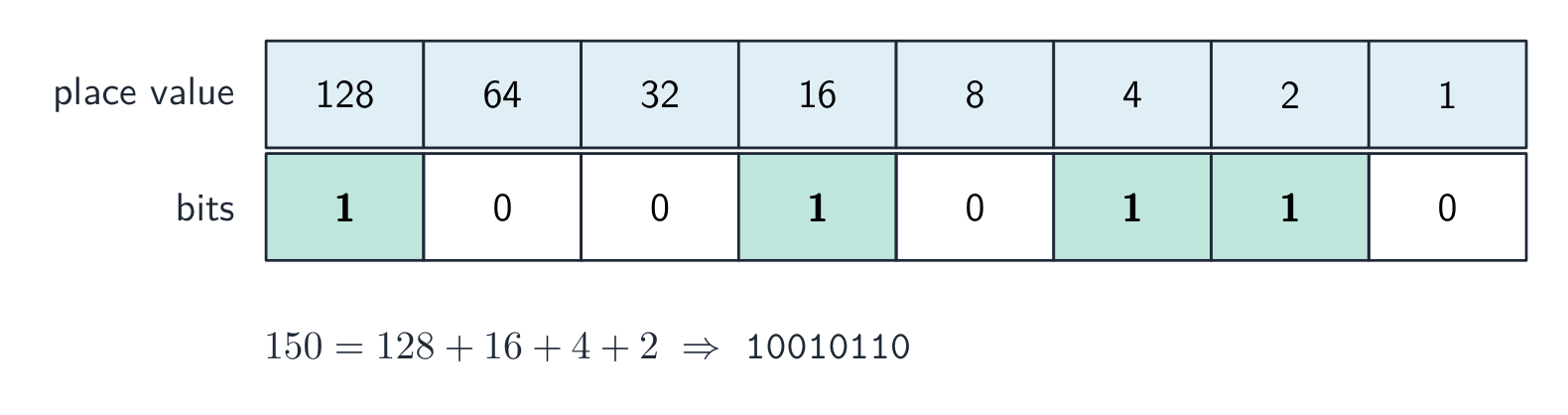
- DAT-1.C.4 As with decimal, a digit's position in the binary sequence determines its numeric value. The numeric value is equal to the bit's value (0 or 1) multiplied by the place value of its position.
- DAT-1.C.5 The place value of each position is determined by the base raised to the power of the position. Positions are numbered starting at the rightmost position with 0 and increasing by 1 for each subsequent position to the left.
ความเข้าใจที่ยั่งยืน (DAT-1): วิธีการที่คอมพิวเตอร์แสดงข้อมูลภายใน differs จากวิธีการที่ข้อมูลถูกตีความและแสดงผลให้กับผู้ใช้ โปรแกรมถูกใช้เพื่อแปลงข้อมูลให้อยู่ในรูปแบบที่มนุษย์เข้าใจได้ง่ายขึ้น
วัตถุประสงค์การเรียนรู้ DAT-1.A: อธิบายวิธีการที่ข้อมูลสามารถถูกแสดงด้วยบิต [ทักษะ 3.C]
- DAT-1.A.1 ค่าข้อมูลสามารถจัดเก็บในตัวแปร, รายการของรายการ, หรือคงที่แบบอิสระ และสามารถส่งเป็นอินพุตเข้า (หรือเอาออก) จาก procédure
- DAT-1.A.2 อุปกรณ์คำนวณแสดงข้อมูลในรูปแบบดิจิทัล ซึ่งหมายความว่าส่วนประกอบพื้นฐานที่สุดของค่าใดๆ คือบิต
- DAT-1.A.3 บิต เป็นคำย่อของ ตัวเลขฐานสอง และมีค่าเป็น 0 หรือ 1 เท่านั้น
- DAT-1.A.4 ไบต์ มีขนาด 8 บิต
- DAT-1.A.5 การนามธรรม คือกระบวนการลดความซับซ้อนโดยมุ่งเน้นไปที่แนวคิดหลัก通过将无关细节隐藏起来并将相关且有用的细节结合起来,抽象化降低了复杂性,使人们能够专注于概念。
- DAT-1.A.6 บิตถูกจัดกลุ่มเพื่อแสดงถึงการนามธรรม การนามธรรมเหล่านี้รวมถึงแต่ไม่จำกัดเพียงตัวเลข, ตัวอักษร, และสี
- DAT-1.A.7 ลำดับบิตเดียวกันอาจแสดงถึงประเภทข้อมูลที่แตกต่างกันในบริบทที่ต่างกัน
- DAT-1.A.8 ข้อมูลอนาล็อกมีค่าที่เปลี่ยนแปลงอย่างต่อเนื่องตามเวลา แทนที่จะเป็นช่วงที่แยกจากกัน ตัวอย่างของข้อมูลอนาล็อกได้แก่ pitched และ volume ของเพลง, สีของภาพวาด, หรือตำแหน่งของนักวิ่งสprints ระหว่างการแข่งขัน
- DAT-1.A.9 การใช้ข้อมูลดิจิทัลเพื่อประมาณข้อมูลอนาล็อกในโลกจริงเป็นตัวอย่างของการนามธรรม
- DAT-1.A.10 ข้อมูลอนาล็อกสามารถถูกประมาณได้ด้วยวิธีดิจิทัลโดยใช้ เทคนิคการสุ่ม, ซึ่งหมายถึงการวัดค่าของสัญญาณอนาล็อกในช่วงเวลาที่เรียกว่า ตัวอย่าง ตัวอย่างจะถูกวัดเพื่อหาค่าบิตที่จำเป็นในการจัดเก็บแต่ละตัวอย่าง
วัตถุประสงค์การเรียนรู้ DAT-1.B: อธิบายผลกระทบของการใช้บิตเพื่อแสดงข้อมูล [ทักษะ 1.D]
- DAT-1.B.1 ในหลายภาษาการเขียนโปรแกรม จำนวนเต็มจะถูกแสดงด้วยจำนวนบิตที่ตายตัว ซึ่งจำกัดช่วงของค่าจำนวนเต็มและการดำเนินการทางคณิตศาสตร์บนค่าเหล่านั้น ข้อจำกัดนี้สามารถนำไปสู่การล้น (overflow) หรือข้อผิดพลาดอื่นๆ
- DAT-1.B.2 ภาษาการเขียนโปรแกรมอื่น ๆ ให้การนามธรรมที่ทำให้ขนาดของจำนวนเต็มที่แสดงได้ถูกจำกัดเฉพาะขนาดของหน่วยความจำของคอมพิวเตอร์เท่านั้น ซึ่งเป็นกรณีสำหรับภาษาที่กำหนดไว้ในใบอ้างอิงการสอบ
- DAT-1.B.3 ในภาษาการเขียน NUMERICAL, จำนวนบิตที่ตายตัวที่ใช้แสดงจำนวนจริงจำกัดช่วงและการดำเนินการทางคณิตศาสตร์บนค่าเหล่านี้; ข้อจำกัดนี้สามารถนำไปสู่การปัดเศษและข้อผิดพลาดอื่นๆ บางจำนวนจริงถูกแสดงเป็นการประมาณในหน่วยความจำของคอมพิวเตอร์
- คำสั่งการยกเว้น: ข้อจำกัดช่วงเฉพาะสำหรับจำนวนจริงอยู่นอกเหนือขอบเขตของหลักสูตรนี้และข้อสอบ AP
วัตถุประสงค์การเรียนรู้ DAT-1.C: สำหรับตัวเลขฐานสอง: a. คำนวณเทียบเท่าฐานสอง (ฐาน 2) ของจำนวนเต็มบวก (ฐาน 10) และในทางกลับกัน [ทักษะ 2.B] b. เปรียบเทียบและเรียงลำดับตัวเลขฐานสอง [ทักษะ 2.B]
- DAT-1.C.1 ฐานของตัวเลข รวมถึงฐานสองและฐานสิบ ถูกใช้เพื่อแสดงข้อมูล
- DAT-1.C.2 ฐานสอง (ฐาน 2) ใช้เพียงการผสมผสานของเลขศูนย์และหนึ่งเท่านั้น
- DAT-1.C.3 ฐานสิบ (ฐาน 10) ใช้เพียงการผสมผสานของเลข $0 - 9$.
- DAT-1.C.4 เหมือนกับฐานสิบ ตำแหน่งของเลขในลำดับฐานสองกำหนดค่าทางคณิตศาสตร์ของมัน ค่าทางคณิตศาสตร์เท่ากับค่าของบิต (0 หรือ 1) คูณด้วยตำแหน่งของตำแหน่ง
- DAT-1.C.5 ตำแหน่งของตำแหน่งของแต่ละตำแหน่งถูกกำหนดโดยฐานยกกำลังตำแหน่ง ตำแหน่ง numbering เริ่มจากตำแหน่งขวาสุดด้วย 0 และเพิ่มขึ้น 1 สำหรับแต่ละตำแหน่งถัดไปทางซ้าย