Nitrogen metabolism and the urea cycle
Введено| English | Значение |
|---|---|
| transamination | transamination |
| glutamate/ˈɡluːtəmeɪt/ | glutamate |
| urea cycle | urea cycle |
| glutamine | glutamine |
| alanine | alanine |
Nitrogen cannot be stored
- Every amino acid not needed today must be broken down today, and the ammonia it releases poisons the brain at micromolar levels.
- Disposal is not optional: it is a five-step conveyor that runs across two compartments of the liver cell.
Collecting the amino groups
- Transamination 转氨基作用 moves amino groups onto α-ketoglutarate: amino acid + α-ketoglutarate ⇌ keto acid + glutamate 谷氨酸.
- In liver mitochondria, oxidative deamination then frees the nitrogen from glutamate as NH₃, right where the urea cycle starts.
Alanine transaminates with α-ketoglutarate. What are the products?
Сложность 1/5 · 100 монет + небольшой бонус за первое завершение сегодня
The amino group moves to α-ketoglutarate, making glutamate; alanine's carbon skeleton is left as pyruvate.
The urea cycle
- The urea cycle 尿素循环 starts in the mitochondrion: NH₃ + CO₂ → carbamoyl phosphate → citrulline.
- In the cytosol: citrulline + aspartate → argininosuccinate → arginine → urea, and ornithine returns to start again.
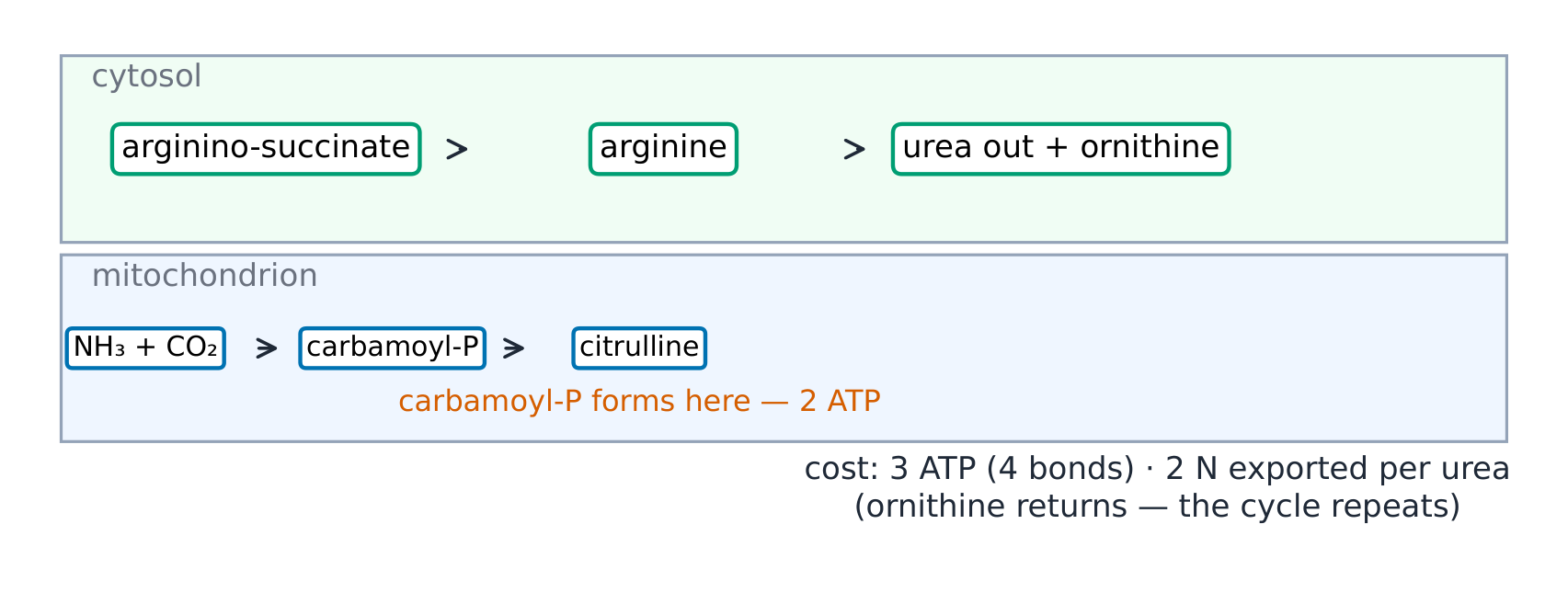
Put the urea cycle intermediates in order, starting from ammonia.
Сложность 3/5 · 200 монет + небольшой бонус за первое завершение сегодня
The first two steps are in the mitochondrion; citrulline then moves to the cytosol for the rest.
Urea by the numbers
- Each urea carries 2 N: one from NH₃, one from aspartate. Making it costs 3 ATP, which is 4 high-energy bonds.
- Normal blood ammonia is only about 10–35 µmol per L, and it must stay that low because the brain has no urea cycle.
How many high-energy phosphate bonds does making one urea cost?
Сложность 2/5 · 140 монет + небольшой бонус за первое завершение сегодня
3 ATP are used, but one is split to AMP + PPi, which costs two bonds, so 4 bonds in total.
Why the liver, and the nitrogen taxis
- Blood from the gut goes straight to the liver through the portal vein, so the liver removes amino acids and ammonia before they reach the rest of the body.
- Other tissues send their nitrogen to the liver in safe forms: glutamine 谷氨酰胺 (carrying ammonia) and alanine 丙氨酸 (carrying nitrogen and carbon from muscle).
Match each molecule to its role in nitrogen transport.
Сложность 2/5 · 140 монет + небольшой бонус за первое завершение сегодня
Tissues ship nitrogen to the liver in non-toxic forms; the liver converts it to urea for the kidneys.
Worked example: the daily ledger
- A diet with about 90 g of protein a day holds about 14 g of N (protein is about 16% N). Almost all of it leaves as urea.
- Urea is 28 g of N in every 60 g, 47% N. So 14 g N ÷ 0.47 ≈ 30 g of urea a day, which matches what urine contains.
A patient eats 120 g of protein a day (16% N). If all the N leaves as urea (47% N), how many grams of urea is that?
Сложность 2/5 · 140 монет + небольшой бонус за первое завершение сегодня
120 × 0.16 = 19.2 g N, and 19.2 / 0.47 ≈ 41 g of urea a day.
Worked example: the blocked conveyor
- (Fictional newborn) Sleepy, then in a coma after the first feeds, with very high ammonia and orotic acid in the urine. Ornithine transcarbamylase (OTC), the cycle's second step, is missing.
- Carbamoyl phosphate cannot move on, so it spills into pyrimidine synthesis and makes orotic acid. Treatment follows the block: less nitrogen in, drugs that remove ammonia, and the missing products supplied.
Why is orotic acid high in the urine in OTC deficiency?
Сложность 1/5 · 100 монет + небольшой бонус за первое завершение сегодня
The block is right after carbamoyl phosphate, which then enters the pyrimidine pathway and makes orotate.
Three common slips
- "Urea removes ammonia." It removes two nitrogens: one from NH₃ and one from aspartate.
- Urea cycle in the brain. It runs only in the liver, which is why ammonia harms the brain.
- Free disposal. Each urea costs 4 high-energy bonds.
The brain can protect itself from ammonia by running its own urea cycle.
Сложность 1/5 · 100 монет + небольшой бонус за первое завершение сегодня
The urea cycle runs in the liver. The brain can only trap ammonia as glutamine, which is why high ammonia harms it.
Recap
- Transamination collects nitrogen on glutamate; the liver releases it as NH₃.
- The urea cycle spans mitochondrion and cytosol and costs 3 ATP per urea, removing 2 N.
- Glutamine and alanine carry nitrogen to the liver; high ammonia with orotic acid points to OTC.