TCA cycle and oxidative phosphorylation
Введено| English | Значение |
|---|---|
| TCA cycle | TCA cycle |
| ATP synthase/ˌeɪ tiː ˈpiː ˈsɪnθeɪs/ | An enzyme complex that uses the movement of protons down their electrochemical gradient to synthesise ATP. |
| electron transport chain/ɪˈlektrɒn ˈtrænspɔːt tʃeɪn/ | A series of electron carriers that transfer electrons through redox reactions and can establish a proton gradient for ATP production. |
| oxidative phosphorylation/ˈɒksɪdətɪv ˌfɒsfɔːrɪˈleɪʃn/ | oxidative phosphorylation |
Why we breathe
- Oxygen has one job in the body: to accept electrons at the end of the transport chain.
- The TCA cycle turns acetyl units into those electrons, and ATP synthase turns their fall into about 90% of the body's ATP.
The TCA cycle
- In the TCA cycle 三羧酸循环, acetyl-CoA (2 C) joins oxaloacetate (4 C) to make citrate (6 C). Two carbons leave as CO₂ and oxaloacetate comes back.
- Each turn yields 3 NADH, 1 FADH₂ and 1 GTP. The cycle makes almost no ATP itself; it loads electron carriers.
One glucose gives two acetyl-CoA. How many NADH do the two TCA turns make?
Сложность 2/5 · 140 монет + небольшой бонус за первое завершение сегодня
3 NADH per turn × 2 turns = 6, plus 2 FADH₂ and 2 GTP.
The electron transport chain
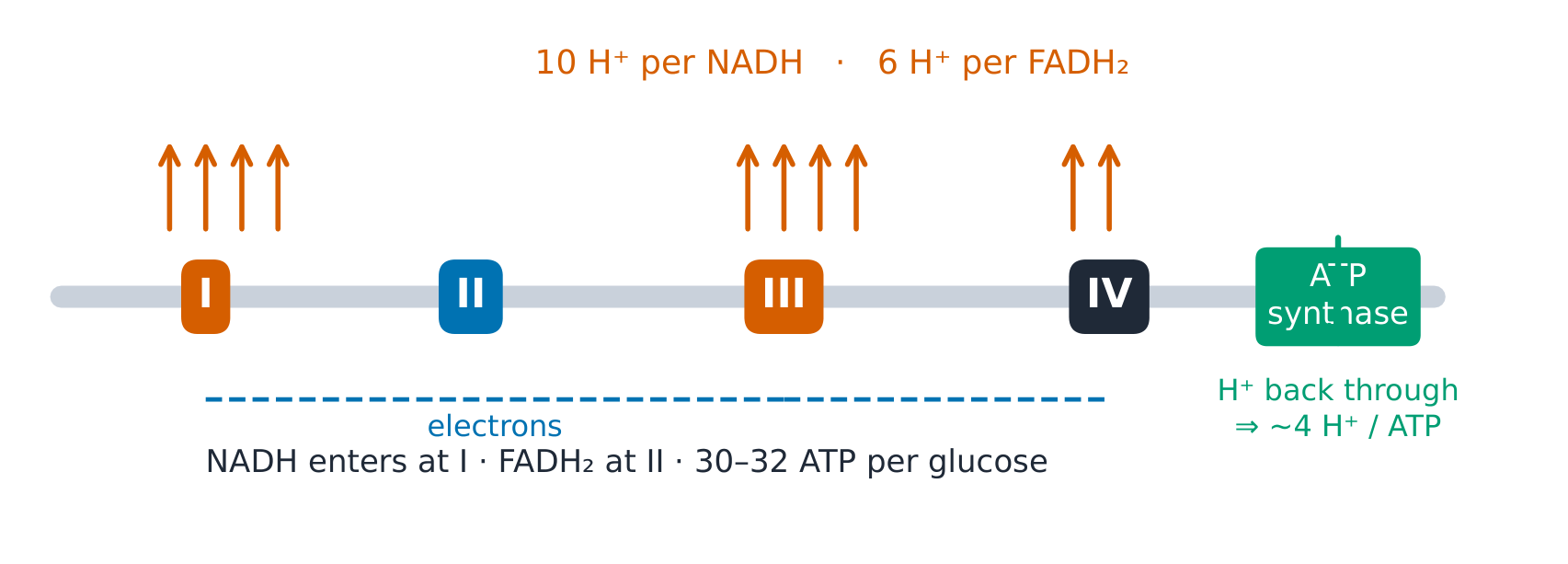
- In the inner mitochondrial membrane, the electron transport chain 电子传递链 passes electrons from NADH and FADH₂ down to O₂. Complexes I, III and IV pump H⁺ out as they go.
- H⁺ flows back through ATP synthase ATP合酶, which turns like a turbine and makes ATP. This coupling is oxidative phosphorylation 氧化磷酸化.
Put the path of an electron from NADH in order.
Сложность 3/5 · 200 монет + небольшой бонус за первое завершение сегодня
Each step is downhill in energy, and complexes I, III and IV use the fall to pump H⁺.
Counting protons
- NADH enters at complex I: I + III + IV pump 4 + 4 + 2 = 10 H⁺. FADH₂ enters at complex II, so only III + IV pump: 6 H⁺.
- ATP synthase needs about 3 H⁺ per ATP, plus 1 to bring in phosphate: 4 H⁺ per ATP. So NADH ≈ 10/4 = 2.5 ATP and FADH₂ ≈ 6/4 = 1.5 ATP.
Why is FADH₂ worth less ATP than NADH?
Сложность 1/5 · 100 монет + небольшой бонус за первое завершение сегодня
Fewer H⁺ pumped means less ATP: 6/4 = 1.5 against 10/4 = 2.5.
Worked example: one glucose, 32 ATP
- Glycolysis: 2 ATP + 2 NADH (5 via the malate shuttle). Pyruvate dehydrogenase: 2 NADH (5). Two TCA turns: 2 GTP + 6 NADH (15) + 2 FADH₂ (3).
- Total: 2 + 5 + 5 + 2 + 15 + 3 = 32 ATP; 30 with the glycerol phosphate shuttle. The older "36–38" used rounded values of 3 and 2.
Using 2.5 per NADH, 1.5 per FADH₂ and the glycerol phosphate shuttle (cytosolic NADH worth 1.5), how many ATP does one glucose give?
Сложность 2/5 · 140 монет + небольшой бонус за первое завершение сегодня
The two glycolytic NADH give 3 instead of 5, so 32 − 2 = 30 ATP.
Where the energy really is
- Pyruvate dehydrogenase and two TCA turns give 2 GTP + 8 NADH + 2 FADH₂ = 2 + 20 + 3 = 25 ATP: about three quarters of the total.
- So most of glucose's energy is captured as electron pairs that end on O₂. Each acetyl-CoA alone is worth $3\times2.5 + 1.5 + 1 = 10$ ATP.
Most of the ATP from aerobic glucose breakdown comes from the TCA cycle's reduced carriers and pyruvate dehydrogenase, not from glycolysis.
Сложность 1/5 · 100 монет + небольшой бонус за первое завершение сегодня
25 of 32 ATP come from pyruvate dehydrogenase and the TCA cycle; glycolysis gives 2 ATP plus its 2 NADH.
Worked example: the blocked turbine
- (Fictional poisoning) A patient collapses with bright-red venous blood. Cyanide binds complex IV: electrons cannot reach O₂, pumping stops and the H⁺ gradient collapses.
- Tissues cannot use O₂, so venous blood stays red; only glycolysis is left, so lactate soars. The signs follow from one blocked complex.
Why does venous blood stay bright red in cyanide poisoning?
Сложность 1/5 · 100 монет + небольшой бонус за первое завершение сегодня
With no electron flow to O₂, tissues extract little O₂, so blood returns almost as saturated as it left.
Three common slips
- "The TCA cycle makes the ATP." It makes GTP and loaded carriers; the chain and ATP synthase make the ATP.
- "This turn's CO₂ comes from this turn's acetyl." The new acetyl carbons leave in later turns.
- Mixing conventions. Say whether you use 2.5 and 1.5 (modern) or 3 and 2 (older).
Match each carrier to its ATP value (modern count).
Сложность 2/5 · 140 монет + небольшой бонус за первое завершение сегодня
10 H⁺ / 4, 6 H⁺ / 4, and 3 × 2.5 + 1.5 + 1 = 10.
Recap
- Per acetyl: 3 NADH + 1 FADH₂ + 1 GTP, worth 10 ATP.
- 10 H⁺ per NADH, 6 per FADH₂, about 4 per ATP: 2.5 and 1.5.
- 30–32 ATP per glucose; complex IV is where O₂ does its job.