Cost behaviour: date your assumptions
Введено| English | Значение |
|---|---|
| variable cost/ˈveərɪəbl kɒst/ | variable cost |
| fixed cost/fɪkst kɒst/ | A cost that does not change with output within a specified period and relevant range of activity. |
| relevant range | The band where each claim holds — behaviour statements expire at thresholds. |
Unit cost is not a law of nature
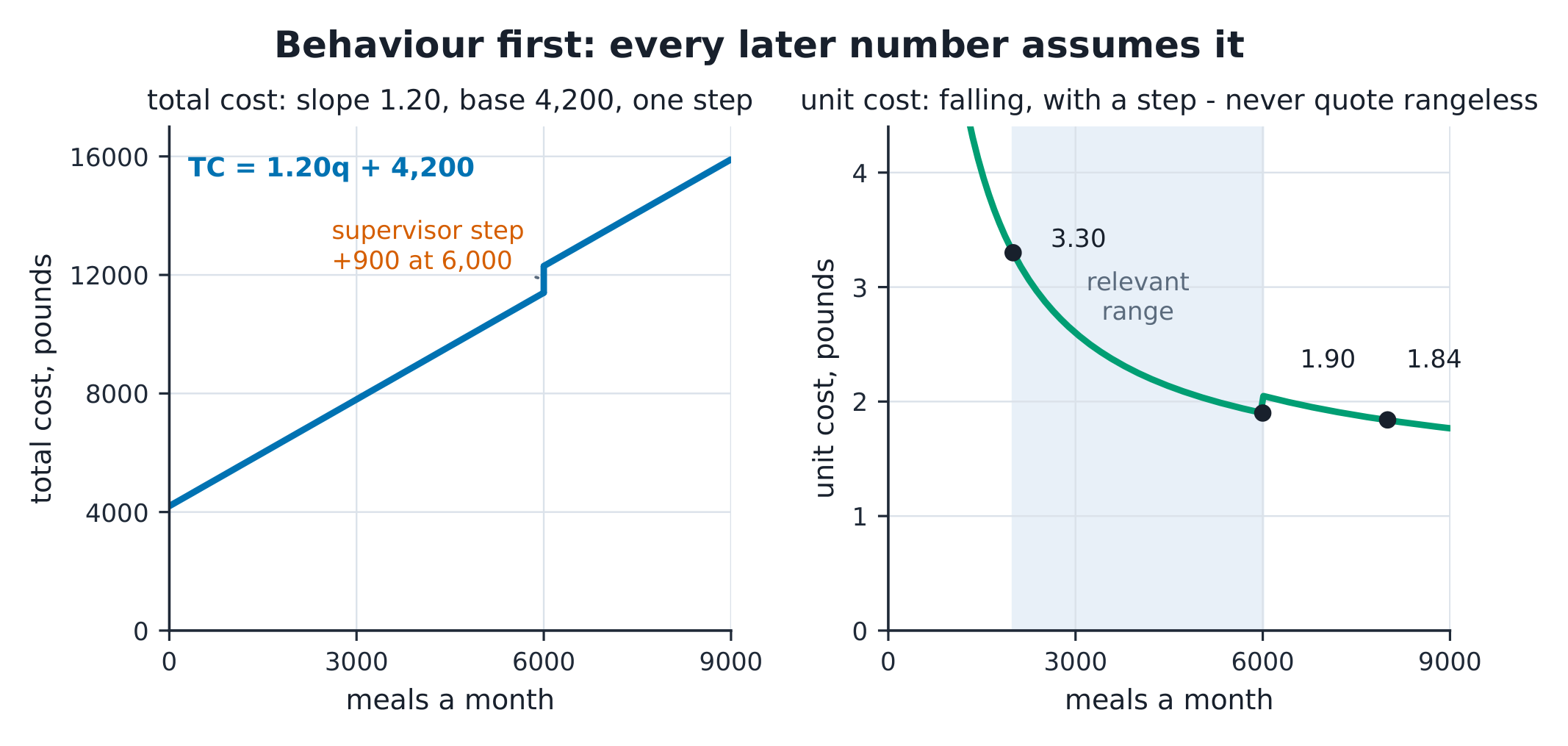
- At 2,000 meals, one Nimbus Kitchen meal "costs" £3.30; at 8,000 it costs £1.84. Same meal, same kitchen — the number changed because the volume did.
- Cost behaviour is the first model in managerial accounting: get it wrong and every downstream number is right about the wrong world.
Three behaviours, one curve
- Variable cost 变动成本: £1.20 a meal (ingredients, packaging) — moves with volume. Fixed cost 固定成本: £4,200 a month (rent 2,400 + supervisor 1,800) — still within the range.
- Past 6,000 meals the supervisor steps +£900: a step cost. The relevant range 相关范围 is the band where each claim holds — behaviour statements expire at thresholds.
Match each cost to its behaviour.
Сложность 2/5 · 140 монет + небольшой бонус за первое завершение сегодня
Behaviour is about HOW a cost moves, not how large it is.
Total and unit — different animals
- Total cost $= 1.20q + 4{,}200$ up to 6,000: £6,600 at 2,000 ✓, £11,400 at 6,000 ✓.
- Unit cost $= 1.20 + 4{,}200/q$: £3.30 → £1.90 → £1.84 ✓ — the fixed £4,200 spreads over more meals. The cost of ONE MORE meal is £1.20, never the unit cost.
How does this cost behave?
Classify each Nimbus Kitchen cost by behaviour and traceability, and catch the range violations.
At 3,000 meals with v = 1.20 and F = 4,200: the unit cost, to two decimals?
Сложность 2/5 · 140 монет + небольшой бонус за первое завершение сегодня
$1.20 + 4{,}200/3{,}000 = 1.20 + 1.40 = £2.60$. The marginal cost of one more meal is only £1.20.
Quoting the 2.60 unit cost as the cost of producing one more meal is correct at 3,000 meals.
Сложность 1/5 · 100 монет + небольшой бонус за первое завершение сегодня
One more meal costs £1.20 - the variable part. Unit cost carries a share of fixed cost that exists whether or not the meal is made.
Estimate the function honestly
- Four months: (2,400, £7,080), (3,300, £8,160), (4,500, £9,600), (5,200, £10,440). High-low: slope £1.20/meal ✓, fixed £4,200 ✓.
- The estimate is an assumption you CHECK: a scatter confirms linearity within the range. Across the step (2,000–8,000), high-low returns £1.35 — a step cost laundered into a variable one.
High-low on (2,400, 7,080) and (5,200, 10,440): the variable cost per meal?
Сложность 2/5 · 140 монет + небольшой бонус за первое завершение сегодня
$(10{,}440 - 7{,}080)/(5{,}200 - 2{,}400) = 3{,}360/2{,}800 = £1.20$; the fixed part follows as $7{,}080 - 1.20 \times 2{,}400 = £4{,}200$.
High-low computed across the step (2,000 and 8,000 meals) returns 1.35 a meal. What happened?
Сложность 1/5 · 100 монет + небольшой бонус за первое завершение сегодня
Crossing a threshold mixes the step into the slope. High-low is only honest within one relevant range.
A scatter inspection before accepting a high-low estimate is optional decoration.
Сложность 1/5 · 100 монет + небольшой бонус за первое завершение сегодня
High-low assumes linearity within the range; the scatter is the check that the assumption earned its keep.
July crosses the step
- July plans 6,400 meals: fixed becomes £5,100, total $= 1.20 \times 6{,}400 + 5{,}100 = £12{,}780$ ✓.
- The unit cost quoted to retailers must say WHICH range: £1.98 at 6,400 — not June's arithmetic blindly extrapolated.
July plans 6,400 meals (the supervisor has stepped). Total cost, to the nearest pound?
Сложность 2/5 · 140 монет + небольшой бонус за первое завершение сегодня
$1.20 \times 6{,}400 + (2{,}400 + 2{,}700) = 7{,}680 + 5{,}100 = £12{,}780$. Past 6,000 the fixed base is 5,100, not 4,200.
A retailer asks for a unit price based on 7,000 meals a month. Which fixed base applies?
Сложность 1/5 · 100 монет + небольшой бонус за первое завершение сегодня
At 7,000 meals the supervisor tier is the 2,700 one: fixed 5,100, unit cost 1.20 + 5,100/7,000 = £1.93. Range first, then arithmetic.
Three behaviour slips
- Quoting unit fixed cost as the cost of one more unit. Marginal is £1.20.
- Extrapolating past the relevant range. Steps break the function.
- Forcing step costs into fixed-or-variable because the spreadsheet prefers it.
Recap
- $TC = vq + F$ within the range; steps break the range.
- Marginal cost is v; unit cost is $v + F/q$.
- Date behaviour claims like milk: they expire.