Probability: match the model to the question
Введено| English | Значение |
|---|---|
| binomial distribution/baɪˈnəʊmɪəl ˌdɪstrɪˈbjuːʃn/ | A probability model for the number of successes in a fixed number of independent trials with the same success probability. |
| normal distribution/ˈnɔːml ˌdɪstrɪˈbjuːʃn/ | A continuous, symmetric bell-shaped probability distribution specified by its mean and standard deviation. |
What are the chances?
- "Chance this order is late?" "Chance at least 4 of the next 20 are?" "Chance one takes over 35 minutes?" Three questions, three models — and the model is part of the answer.
- Probability is bookkeeping for uncertainty. The rules are few; the discipline is matching them to the question.
The rules
- $P(A \cup B) = P(A) + P(B) - P(A \cap B)$ — subtract the overlap or count it twice.
- Independence: $P(A \mid B) = P(A)$. Orders arriving in different hours are (roughly) independent; two orders from the same rush are not.
P(late) = 0.2 and P(big order) = 0.3; both together 0.06. P(late or big)?
Сложность 1/5 · 100 монет + небольшой бонус за первое завершение сегодня
$0.2 + 0.3 - 0.06 = 0.44$. Without the overlap subtraction the answer double-counts the big late orders.
Orders placed during the same Friday rush are safely treated as independent events.
Сложность 1/5 · 100 монет + небольшой бонус за первое завершение сегодня
A shared rush loads every order at once - lateness correlates. Independence is an assumption to check, not a default.
Counts: the binomial
- If each order is late with probability 0.2, the number late in 5 follows the binomial distribution 二项分布: $\binom{5}{2} = 10$ arrangements, each worth $0.2^2 \times 0.8^3 = 0.0205$.
- So $P(X = 2) = \mathbf{0.2048}$ ✓, and $P(X \le 1) = 0.3277 + 0.4096 = \mathbf{0.7373}$ ✓.
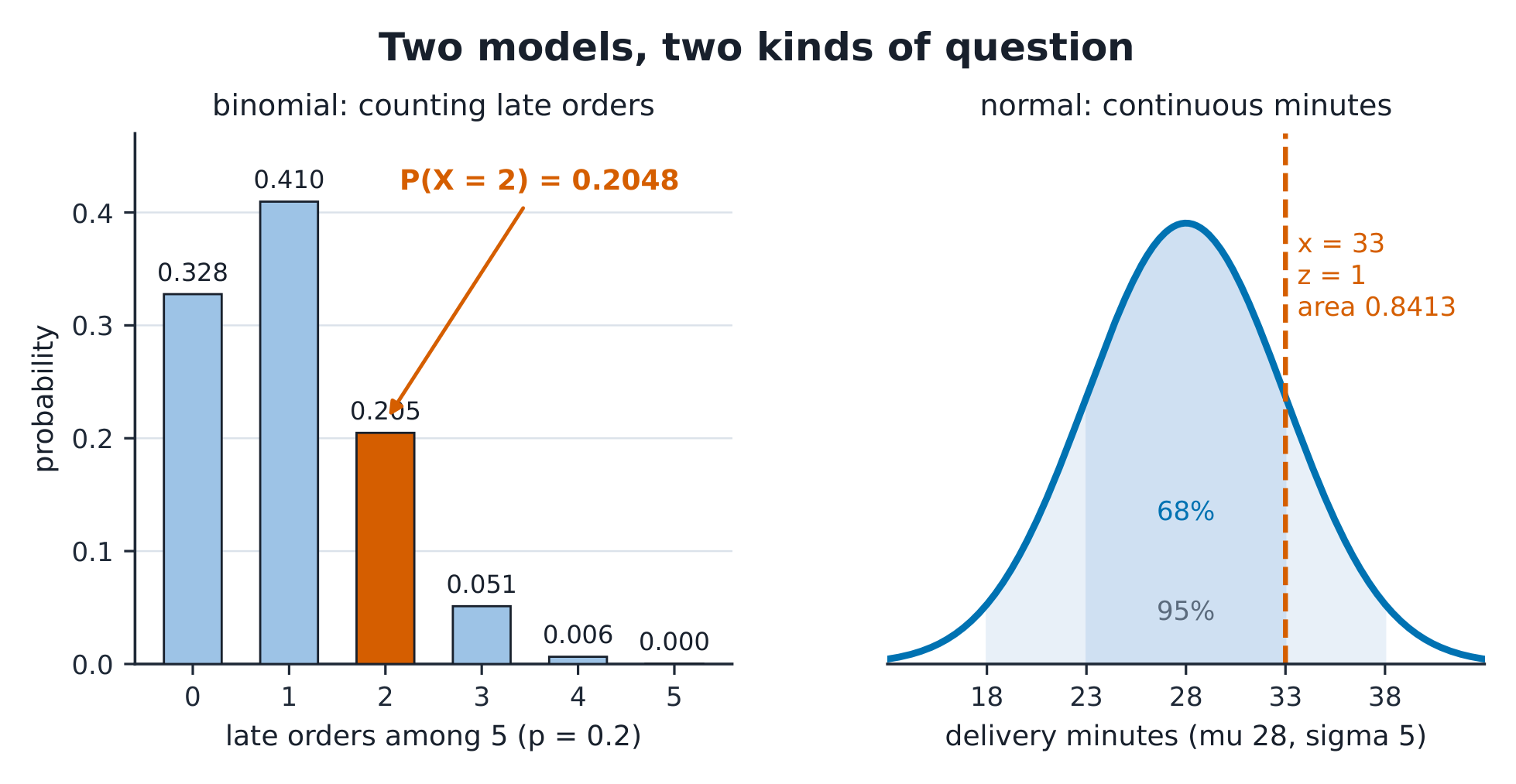
n = 5, p = 0.2. P(exactly 2 late), to four decimals?
Сложность 2/5 · 140 монет + небольшой бонус за первое завершение сегодня
$\binom{5}{2} \times 0.2^2 \times 0.8^3 = 10 \times 0.02048 = 0.2048$.
n = 5, p = 0.2. P(at most 1 late), to four decimals?
Сложность 2/5 · 140 монет + небольшой бонус за первое завершение сегодня
$0.8^5 + 5(0.2)(0.8^4) = 0.3277 + 0.4096 = 0.7373$ - so P(at least 2) is 0.2627.
Continuous: the normal
- Delivery minutes cluster around 28 with symmetric tails — the normal distribution 正态分布 model with $\mu = 28$, $\sigma = 5$: 68% within one sd, 95% within two.
- Standardise: $z = (x - \mu)/\sigma$. A 33-minute order is $z = 1$: $\Phi(1) = 0.8413$ of orders finish faster ✓ — the table's most-used entry.
Which model answers this question?
Match each probability question to binomial, normal, or direct counting - and state why.
mu = 28, sigma = 5. P(an order under 33 minutes)?
Сложность 2/5 · 140 монет + небольшой бонус за первое завершение сегодня
$z = (33-28)/5 = 1$; the standard normal table gives 0.8413 below z = 1.
Match each quantity to its distribution.
Сложность 2/5 · 140 монет + небольшой бонус за первое завершение сегодня
Counts, measurements, means and assignments - one distribution each, and the CLT makes means normal even when the data are only roughly so.
The service promise
- Promise "30 minutes or free dessert" at $\mu = 28$, $\sigma = 5$: $P(X > 30) = P(z > 0.4) = \mathbf{0.345}$ — a third of orders claim!
- Speed the kitchen to $\mu = 26$: still 0.212. The promise's cost is a probability, and only a smaller $\mu$ — not a longer promise — reshapes the tail.
The promise is 30 minutes; mu = 28, sigma = 5. P(an order claims the free dessert)?
Сложность 2/5 · 140 монет + небольшой бонус за первое завершение сегодня
$z = (30-28)/5 = 0.4$; above z = 0.4 is $1 - 0.6554 = 0.3446$ - about a third of orders.
The kitchen speeds up to mu = 26 (sigma still 5). Now P(over 30 minutes)?
Сложность 2/5 · 140 монет + небольшой бонус за первое завершение сегодня
$z = (30-26)/5 = 0.8$; the tail above 0.8 is 0.2119 - better, but still one order in five.
Three probability slips
- Adding non-exclusive events without subtracting the intersection.
- Normal for counts. Late-order counts are binomial; minutes may be normal — say which and why.
- Table without a picture. Draw the curve and shade the region before looking anything up.
Recap
- Counts of successes → binomial; symmetric continuous → normal.
- $z = (x-\mu)/\sigma$ translates any normal to the standard curve.
- The model choice is part of the arithmetic — justify it.