Exponential growth and decay
Введено 29:53
Число
Два автобуса выезжают из одной остановки в девять часов. Один ходит каждые двенадцать минут, другой — каждые восемнадцать. Когда они снова выедут вместе? Не в тридцать…
Озвучивание на английском · переключаемые субтитры на английском и китайском языках
In this lesson
| English | Значение |
|---|---|
| exponential growth/ˌekspəˈnenʃl ɡrəʊθ/ | экспоненциальный рост |
| compound/ˈkɒmpaʊnd/ | сложный |
| decay/dɪˈkeɪ/ | убывание |
| depreciation/dɪˌpriːʃɪˈeɪʃn/ | амортизация |
| half-life/hɑːf laɪf/ | период полураспада |
One bacterium becomes a billion
- A bacterium divides every 20 minutes. After 10 hours (30 divisions), one cell becomes $2^{30} \approx 1\,073\,741\,824$ — over a billion.
- That's exponential growth 指数增长: the same percentage increase every period, compounding 复利.
- Linear growth adds a fixed amount; exponential growth multiplies — and it always wins in the end.
The compound formula
- When a quantity changes by the same percentage each period:
- $P$ = starting value, $r$ = percentage rate per period, $t$ = number of periods.
- Growth: $r > 0$; decay 衰减: $r < 0$ (or use a multiplier below 1).
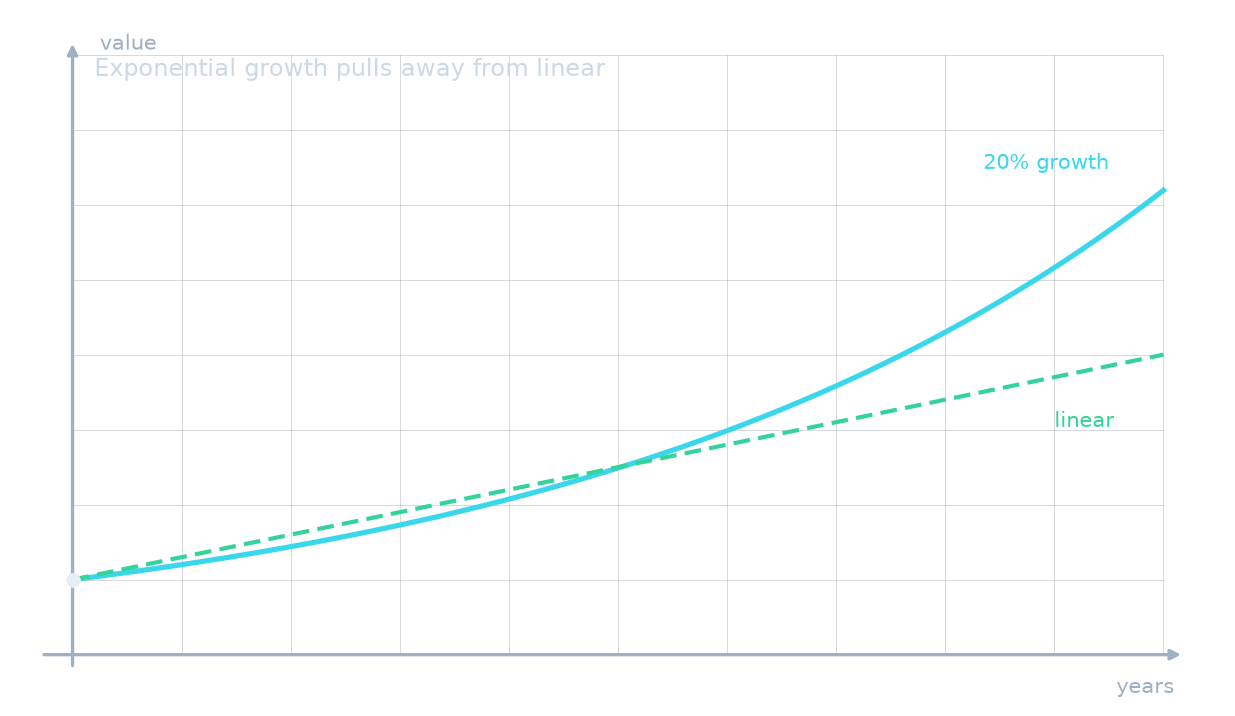
Exponential growth (curve) starts slowly but eventually pulls far ahead of linear growth (straight line).
Compound interest
Money grows by (1 + r) every year, so compound interest curves above simple interest. Drag the rate and the number of years.
Exponential growth & decay
y = a·bˣ
Change the основанием b: b > 1 grows, 0 < b < 1 распадается — useful for interest and populations.
A car loses 15% of its value each year. What yearly multiplier do you use?
Сложность 2/5 · 140 монет + небольшой бонус за первое завершение сегодня
Losing 15% leaves 85%, so the multiplier is 0.85.
Depreciation of a car's value each year is an example of:
Сложность 1/5 · 100 монет + небольшой бонус за первое завершение сегодня
Losing a fixed percentage each year is exponential decay (multiplier < 1, applied repeatedly).
The compound growth formula is: final = P × (1 + ______)^t, where r is the percentage rate.
Сложность 1/5 · 100 монет + небольшой бонус за первое завершение сегодня
The rate r% must be converted to a decimal: r/100. So the multiplier is (1 + r/100).
Exponential decay and depreciation 折旧
- Decay works the same way with a multiplier below 1.
- A car worth 20 000 loses 15% each year → multiplier $0.85$.
- After 4 years: $20\,000 \times 0.85^4 = 20\,000 \times 0.5220 \approx 10\,440$.
Half-life 半衰期. A radioactive isotope decays 10% per year. Its "half-life" (time to halve) is $\dfrac{\ln 2}{\ln(1/0.9)} \approx 6.6$ years — you can find it by solving $0.9^t = 0.5$.
A car worth 20000 depreciates 15% per year. Its value after 4 years (to the nearest 10) is:
Сложность 2/5 · 140 монет + небольшой бонус за первое завершение сегодня
20000 × 0.85⁴ = 20000 × 0.5220 ≈ 10440.
Worked example
- Population of 5000 grows 8% per year. After 6 years:
- $5000 \times 1.08^6 = 5000 \times 1.5869 \approx 7934$.
Compound ≠ simple. 8% per year for 6 years is not $8 \times 6 = 48\%$ total (that would give $5000 \times 1.48 = 7400$). Compounding gives $58.7\%$ total — almost 11% more, because each year's growth earns growth too.
A population of 5000 grows 8% per year. What is the population after 6 years (nearest whole number)?
Сложность 2/5 · 140 монет + небольшой бонус за первое завершение сегодня
5000 × 1.08⁶ = 5000 × 1.5869 ≈ 7934.
8% growth per year for 6 years gives a total increase of exactly 48%.
Сложность 1/5 · 100 монет + небольшой бонус за первое завершение сегодня
Compounding gives 1.08⁶ ≈ 1.587, a 58.7% increase — more than 48% because growth earns growth.
Worked examples: work backwards
1. Find the original. After 3 years of 5% growth an investment is worth 5788.13. What was invested?
- Divide by the multiplier, do not subtract: $P = \dfrac{5788.13}{1.05^3} = \dfrac{5788.13}{1.157625} = 5000$.
2. How long? A machine worth 12 000 loses 20% of its value each year. After how many whole years is it first worth less than 5000?
- Multiply by 0.8 each year: 9600, 7680, 6144, 4915.20. So after 4 years.
3. Find the rate. A price goes from 400 to 484 in 2 years with the same percentage rise each year.
- Multiplier$^2 = \dfrac{484}{400} = 1.21$, so multiplier $= \sqrt{1.21} = 1.1$: a 10% rise each year.
After 2 years of 10% growth, a population is 7260. What was it at the start?
Сложность 2/5 · 140 монет + небольшой бонус за первое завершение сегодня
7260 ÷ 1.1² = 7260 ÷ 1.21 = 6000.
A car worth 10 000 loses 25% of its value each year. After how many whole years is it first worth less than 4000?
Сложность 2/5 · 140 монет + небольшой бонус за первое завершение сегодня
7500, 5625, 4218.75, 3164.06: first below 4000 after 4 years.
You've got it
- exponential change uses the compound formula $P(1 + r/100)^t$
- growth = multiplier $> 1$; decay/depreciation = multiplier $< 1$
- a 15% yearly loss → multiplier $0.85$; after 4 years: $20\,000 \times 0.85^4 \approx 10\,440$
- exponential always beats linear eventually — compounding earns growth on growth
Write from the data: find the multiplier
- A value falls by 10 percent each year.
- State the yearly multiplier.
A value loses 10 percent each year. What number do you multiply by each year?
90 percent as a decimal is 0.9.
What is the yearly multiplier?
Сложность 1/5 · 100 монет + небольшой бонус за первое завершение сегодня
A 10 percent loss keeps 90 percent. Other options — 0.85 (the lesson multiplier for a 15 percent loss); 1.1 (the multiplier for 10 percent growth).