Ваш учебный план · Продолжить · Обзор →
将 (a formal 把)
ВведеноВаше сохранённое положение остаётся в этом браузере. Возобновление не завершает урок и не отвечает на его вопросы.
 2:41
HSK 5 Грамматика 9: Предложные конструкции — Акцент и существование
要不是 означает «если бы не». То, что произошло на самом деле, стоит первым, а плохой результат, которого не случилось, — вторым. 要不是你提醒我,我就忘了带钥匙. Если бы ты не напомнил…
Английские объяснения + примеры на мандаринском · субтитры следуют за звучащим текстом
Signs and instructions
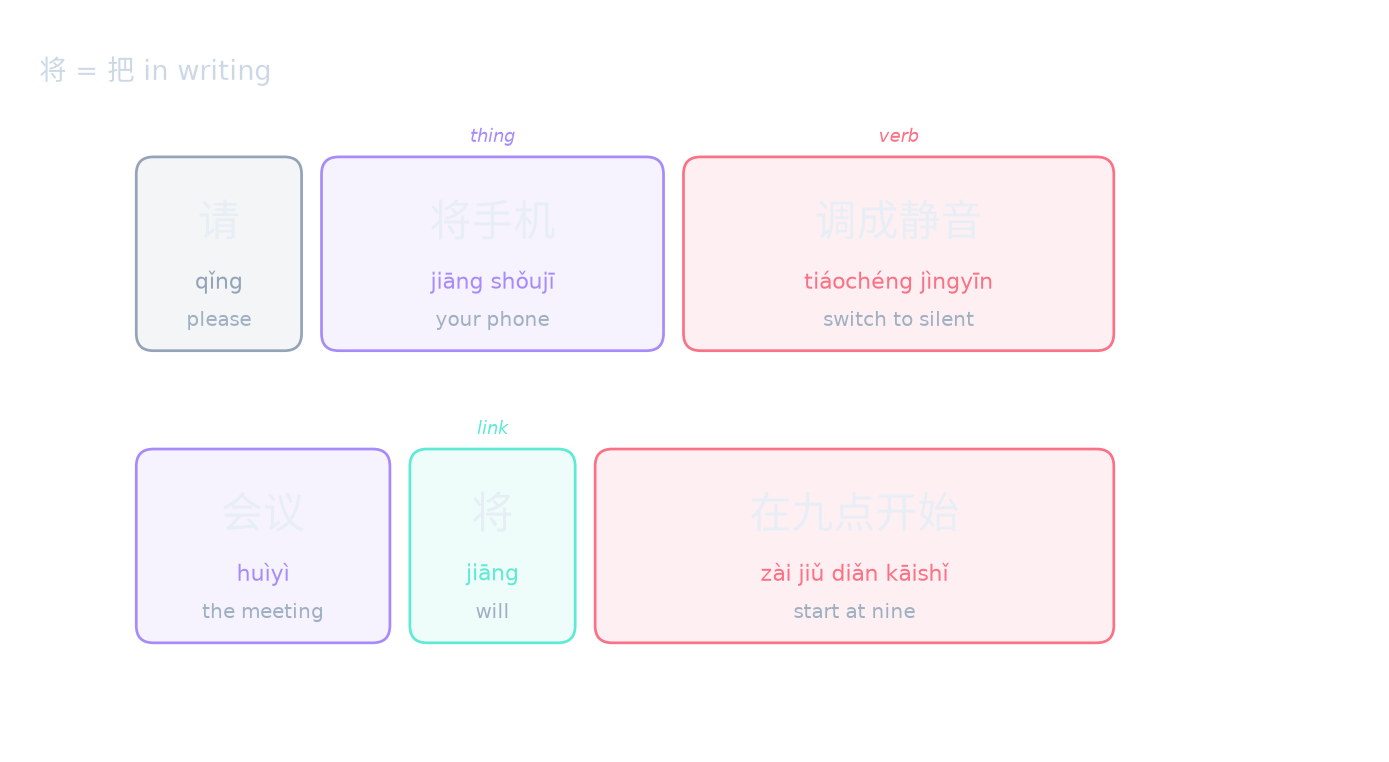
- A sign in the library says: please请(formal 把)将your phone手机to adjust / set调to become / into成silent静音。 — "Please put your phone on silent."
- Goal: read and write (formal 把)将 as the formal, written form of (把: marks the object)把 (subject + (formal 把)将 + object + verb + result).
(formal 把)将 + object + verb + result = (把: marks the object)把, in writing
- (Subject) + (formal 把)将 + object + verb + result / place: exactly like (把: marks the object)把, but for signs, notices, instructions and news.
- please请(formal 把)将door门close关上。 — "Please close the door." please请(formal 把)将trash垃圾to put into放进rubbish bin垃圾桶。 — "Please put rubbish in the bin."
please请(formal 把)将your phone手机switch to调成silent静音。
A notice: “Please put rubbish in the bin.” 请____垃圾放进垃圾桶。
Сложность 1/5 · 100 монет + небольшой бонус за первое завершение сегодня
将 + object + verb + place = written 把.
Build the sign: “Please put your phone on silent.”
Сложность 3/5 · 200 монет + небольшой бонус за первое завершение сегодня
请 + 将 + object + verb + result.
Spoken (把: marks the object)把, written (formal 把)将
- Speech: (把) + door把门close关上。 Sign: please请(formal 把)将door门close关上。 Same meaning: "Please close the door."
- News: company公司(formal 把)将price价格to raise / improve提高(completed / change)了百分之十。 — "The company raised prices by 10%."
The other (formal 把)将: "will"
- Before a verb with no object in between, (formal 把)将 means will (formal): meeting会议(formal 把)将at / in在九点to start开始。 — "The meeting will start at nine."
- Ask: is there an object between (formal 把)将 and the verb? Yes → = (把: marks the object)把. No → = will.
Match each 将 to its job.
Сложность 2/5 · 140 монет + небольшой бонус за первое завершение сегодня
Object between 将 and the verb → 把; no object → will.
Same rules as (把: marks the object)把
- The verb needs a result, place or (completed / change)了: ✓ please请(formal 把)将door门close关上 ✗ please请(formal 把)将door门to close关.
- Don't use it in a casual chat: ✗ you你(formal 把)将cup杯子to / for / give给I / me我 — say you你(把: marks the object)把cup杯子to / for / give给I / me我。
You ask a friend at dinner to pass the salt. Which is natural?
Сложность 1/5 · 100 монет + небольшой бонус за первое завершение сегодня
将 is for writing; in a chat, use 把.
请将门关 is a complete, correct sign.
Сложность 1/5 · 100 монет + небольшой бонус за первое завершение сегодня
Like 把, the verb needs a result: 请将门关上.
Recap
- (formal 把)将 + object + verb + result = written (把: marks the object)把 (signs, notices, news).
- (formal 把)将 + verb (no object) = will.
Read the full reference: HSK 5 grammar — Sentence patterns.
Write three short rules for a school computer room, each with 将.
Your answer need not copy the model. A partner or teacher must hear the spoken response to comment on pronunciation.