Ваш учебный план · Продолжить · Обзор →
难 + Глагол (неприятно …)
ВведеноВаше сохранённое положение остаётся в этом браузере. Возобновление не завершает урок и не отвечает на его вопросы.
 4:29
Грамматика HSK 3 3: Глаголы, способность и дополнения
Эта тема о том, что сообщают глаголы. «着» удерживает состояние. «了» в конце предложения объявляет об изменении: теперь это правда. Результативные дополнения сообщают о…
Английские объяснения + примеры на мандаринском · субтитры следуют за звучащим текстом
В этом уроке
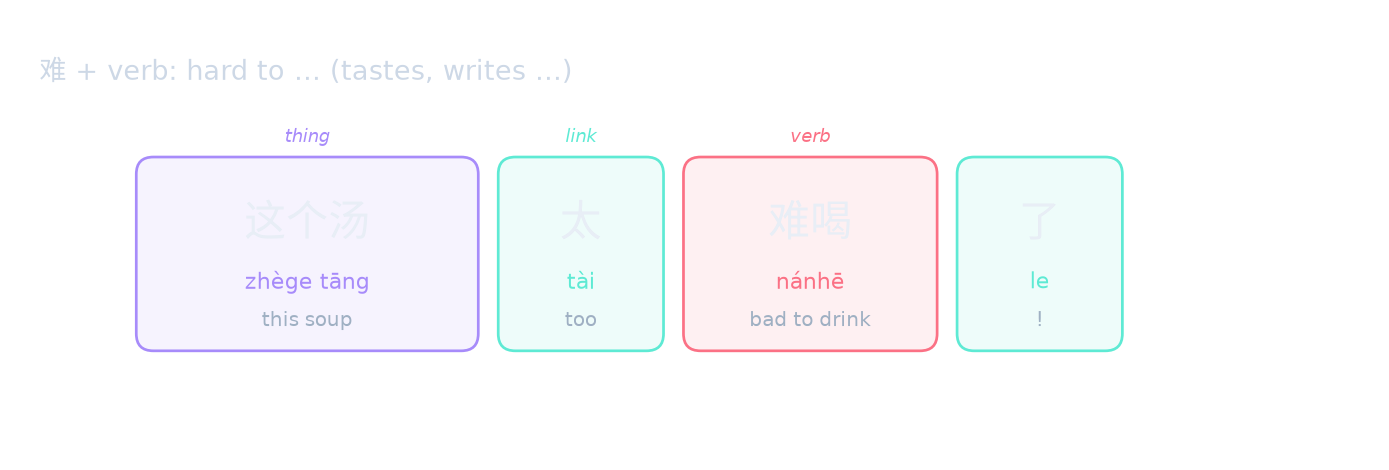
The canteen's new dish
- You try the canteen's new soup. It is salty and cold.
- this这个the soup汤too太hard to难to drink喝(completed / change)了! Zhè ge tāng tài nánhē le! — "This soup tastes awful!" hard to难 + a sense verb = unpleasant to …
- Goal: use good好 + verb and hard to难 + verb for "nice / easy to …" and "awful / hard to …", and say it politely.
hard to难 + sense verb
- unpalatable难吃, hard to难to drink喝, bad-looking; ugly难看, unpleasant to hear难听, unpleasant smell难闻 = bad-tasting (food), bad-tasting (drinks), ugly, unpleasant to hear, bad-smelling.
- They work like adjectives: very很bad-looking; ugly难看, too太unpleasant to hear难听(completed / change)了. The opposites start with good好: tasty好吃, nice to drink好喝, good-looking好看, pleasant to hear好听, 好闻.
this这(measure word)首song歌very很unpleasant to hear难听。
Complete: “This colour is ugly.” 这个颜色很____。
Сложность 1/5 · 100 монет + небольшой бонус за первое завершение сегодня
难看 = unpleasant to look at, ugly.
hard to难 + other verbs: hard to …
- With most other verbs, hard to难 means "difficult to": this这个Chinese character字very很hard to难to write写。 — "This character is hard to write."
- his他(modifier / structural particle)的question问题very很hard to难answer回答。 — "His question is hard to answer."
his他的question问题very很hard to难answer回答。
Match each word to its meaning.
Сложность 2/5 · 140 монет + небольшой бонус за первое завершение сегодня
With sense verbs 难 means unpleasant; with other verbs it means hard to do; 难受 is a feeling.
Build: “His question is hard to answer.”
Сложность 3/5 · 200 монет + небольшой бонус за первое завершение сегодня
Topic + 很 + 难 + verb.
good好 and hard to难 side by side
| good好 + verb | hard to难 + verb |
|---|---|
| tasty好吃 — tasty | unpalatable难吃 — tastes awful |
| good-looking好看 — good-looking; good (a film) | bad-looking; ugly难看 — ugly |
| pleasant to hear好听 — nice to hear | unpleasant to hear难听 — unpleasant to hear |
| good好to write写 — easy to write | hard to难to write写 — hard to write |
| 好找 — easy to find | hard to难to look for; to give change找 — hard to find |
- With a sense verb, good好 / hard to难 = pleasant / unpleasant. With other verbs, good好 / hard to难 = easy / hard.
“His home is easy to find.” 他家很____找。
Сложность 1/5 · 100 монет + небольшой бонус за первое завершение сегодня
With a verb that is not a sense, 好 + verb = easy to …: 好找.
Saying it politely
- At a friend's home, unpalatable难吃 is too strong. Soften it: not不too太tasty好吃 — "not very tasty", or a bit有点儿salty咸 — "a bit salty".
- Say the good side first: the soup汤very很nice to drink好喝,the food菜a bit有点儿spicy辣。 — "The soup is nice; the food is a bit spicy."
the soup汤very很nice to drink好喝,the food菜a bit有点儿spicy辣。
Your friend's mum asks how her soup is. It is too salty for you. What is the kindest answer?
Сложность 1/5 · 100 монет + небольшой бонус за первое завершение сегодня
Start with the good side and soften the problem with 有点儿.
Unpleasant versus difficult
- unpalatable难吃 means it tastes bad, not that it is hard to eat; bad-looking; ugly难看 means ugly, not hard to see.
- to feel unwell难受 is a feeling: "feel unwell, upset": I / me我headache头疼,very很to feel unwell难受.
hard to难 + Verb versus no good不好 + Verb
- not不tasty好吃 is milder: "not tasty". unpalatable难吃 is stronger: "awful".
- no good不好to write写 (not easy to write) is similar to very很hard to难to write写, but softer.
this这(measure word)个dish菜not不tasty好吃。
Which is the mildest way to say the food is not good?
Сложность 1/5 · 100 монет + небольшой бонус за первое завершение сегодня
不好吃 is milder than 难吃.
Recap
- hard to难 + sense verb (unpalatable难吃, bad-looking; ugly难看, unpleasant to hear难听, unpleasant smell难闻, hard to难to drink喝) = unpleasant to that sense; opposite good好 + verb.
- hard to难 + other verbs = hard to do: hard to难to write写, hard to难answer回答. to feel unwell难受 = feel bad.
Read the full reference: HSK 3 grammar — Verb phrases.
You try the canteen's new soup. It is salty and cold. Close the examples. Say a Mandarin response, then write it in Chinese. Explain briefly in English what the lesson’s pattern adds. Compare with the model, then change one detail and try again.
This is supported productive practice. Compare meaning and structure; your answer need not copy the model. A partner or teacher must hear the spoken response to comment on pronunciation.
Что пошло не так? Это увидит только команда сайта.