Ваш учебный план · Продолжить · Обзор →
多 + Прилагательное + 啊! (какой …!)
ВведеноВаше сохранённое положение остаётся в этом браузере. Возобновление не завершает урок и не отвечает на его вопросы.
 4:59
HSK 3 Грамматика 1: Описание и степень
Как китайский описывает вещи. Максимальная степень (极了), теплые двойные формы, наречие (-ly 地), слова со значением «так», рамка восприятия и сравнения через 一样. Шесть инструментов описания, шесть чистых правил.…
Английские объяснения + примеры на мандаринском · субтитры следуют за звучащим текстом
In this lesson
The view from the top
- You reach the top of a mountain and the whole city lies below you.
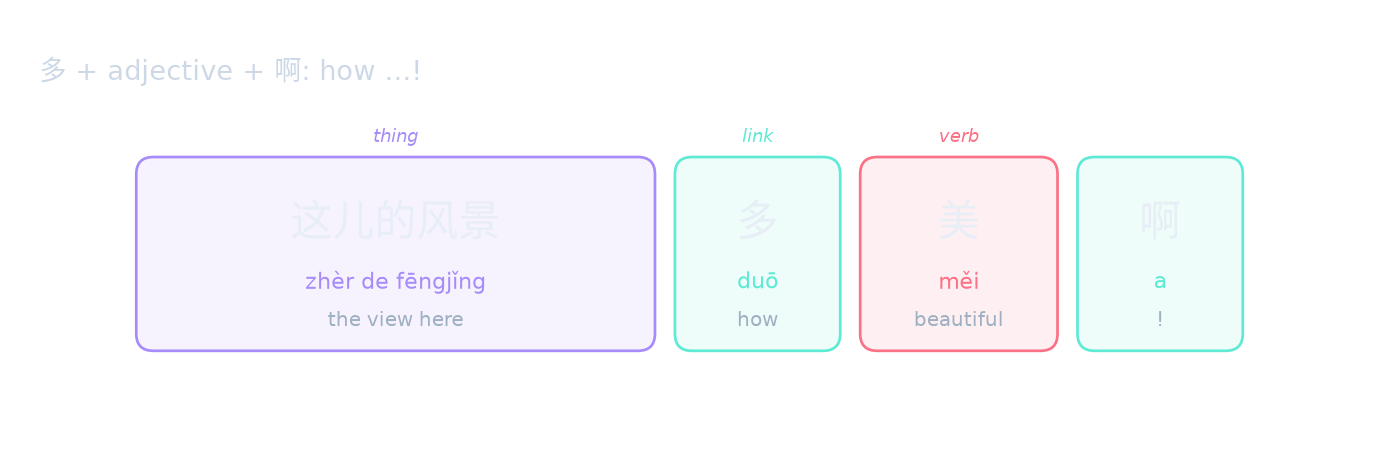
- here这儿(modifier / structural particle)的scenery风景how多beautiful美(exclamation)啊! Zhèr de fēngjǐng duō měi a! — "How beautiful the view is here!"
- Goal: exclaim "How …!" with how多 + adjective + (exclamation)啊, and tell it apart from the question how多 + adjective? ("how far / how old?").
how多 + Adjective + (exclamation)啊!
- how多 + Adj + (exclamation)啊 is an exclamation: "How … !" how多 goes before the adjective and (exclamation)啊 closes the sentence.
- The adjective stands alone: how多good好(exclamation)啊, how多fast; soon快(exclamation)啊, how多cute可爱(exclamation)啊.
your你的daughter女儿how多cute可爱啊!
Exclaim: “How nice the weather is!” 天气____好啊!
Сложность 1/5 · 100 монет + небольшой бонус за первое завершение сегодня
多 + Adj + 啊 = “How … !”
Sharing a feeling
- Admiring: your你(modifier / structural particle)的Chinese language中文to speak说(degree marker)得how多good好(exclamation)啊! — "How well you speak Chinese!"
- Complaining works too: today今天how多hot热(exclamation)啊! — "How hot it is today!"
today今天how多hot热啊!
Build: “How well you speak Chinese!”
Сложность 3/5 · 200 монет + небольшой бонус за первое завершение сегодня
Verb + 得 + 多 + Adj + 啊.
Exclaim, do not ask
- No degree / adjective linker很 inside: how多beautiful美(exclamation)啊, not how多degree / adjective linker很beautiful美(exclamation)啊; how多 already carries the degree.
- Keep (exclamation)啊 and the exclamation mark. Without them, how多 + Adj often becomes a question: how多far远? — "How far is it?"
Which one asks a question instead of exclaiming?
Сложность 1/5 · 100 монет + небольшой бонус за первое завершение сегодня
Without 啊 and the exclamation mark, 多大? asks “How big is it?”
多很漂亮啊! is correct.
Сложность 1/5 · 100 монет + небольшой бонус за первое завершение сегодня
多 already gives the degree, so the adjective stays bare: 多漂亮啊!
The same how多 in questions
| Question | Answer |
|---|---|
| your你how多big大? — How old are you? | I / me我十六岁。 |
| school学校away from离here这儿how多far远? — How far is the school? | 两公里。 — Two kilometres. |
| he / him他to have / there is有how多tall; high高? — How tall is he? | 一米eight八。 — 1.8 metres. |
- In a question, how多 asks how much of the adjective; to have / there is有 before how多 is optional: he / him他(to have / there is有)how多tall; high高?
- Same words, different job: how多tall; high高(exclamation)啊! (wow, so tall) vs how多tall; high高? (how tall?). The (exclamation)啊 and the ! tell you.
Match each sentence to its meaning.
Сложность 2/5 · 140 монет + небольшой бонус за первое завершение сегодня
With 啊 and ! it is an exclamation; with ? it asks how much.
how多…(exclamation)啊 versus too太…(completed / change)了
- too太 + Adj + (completed / change)了 also reacts strongly: too太beautiful美(completed / change)了! It is common and often means "too": too太expensive贵(completed / change)了.
- how多 + Adj + (exclamation)啊 is warmer and more admiring; it suits praise and wonder.
this这(measure word)件clothes衣服too太expensive贵了!
Recap
- how多 + Adj + (exclamation)啊! = How … ! An exclamation of admiration or strong feeling.
- Bare adjective, no degree / adjective linker很; without (exclamation)啊 and "!", how多 + Adj can be a question about amount.
Read the full reference: HSK 3 grammar — how多 + Adj..
You reach the top of a mountain and the whole city lies below you. Close the examples. Say a Mandarin response, then write it in Chinese. Explain briefly in English what the lesson’s pattern adds. Compare with the model, then change one detail and try again.
This is supported productive practice. Compare meaning and structure; your answer need not copy the model. A partner or teacher must hear the spoken response to comment on pronunciation.