Ваш учебный план · Продолжить · Обзор →
Future forms review
ВведеноВаше сохранённое положение остаётся в этом браузере. Возобновление не завершает урок и не отвечает на его вопросы.
 4:44
English B1 · Повторение форм будущего
Вы знаете четыре входа из A2. B1 добавляет правило, которое отличает хороший английский от переведенного китайского: в придаточном времени используйте настоящее простое, никогда will.
Озвучивание на английском · переключаемые субтитры на английском и китайском языках
В этом уроке
| English |
|---|
| future/ˈfjuːtʃə/ |
| intention/ɪnˈtenʃn/ |
| arrangement/əˈreɪndʒmənt/ |
| schedule/ˈʃedjuːl/ |
| offer/ˈɒfə/ |
Говоря о будущем — повторение
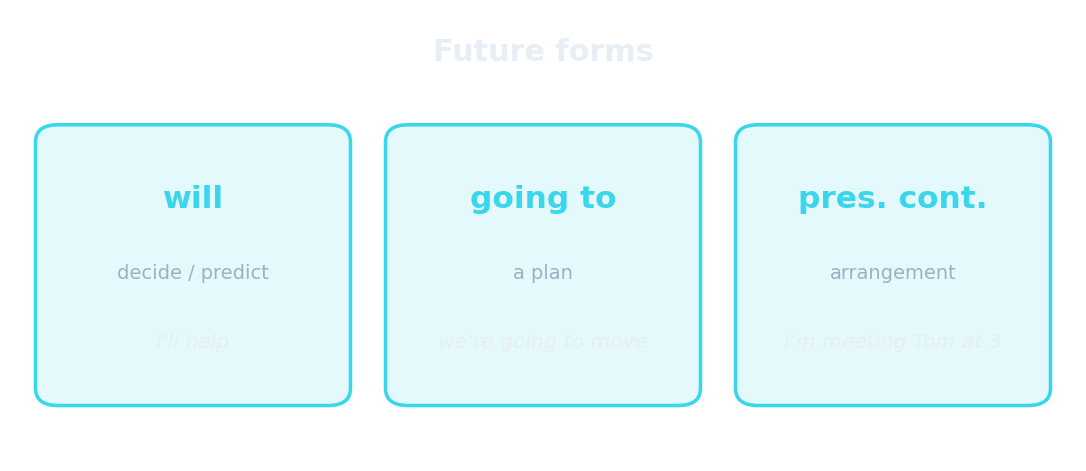
- Английский язык использует несколько форм для выражения будущего: will, be going to, Present Continuous и Present Simple. Их значения могут пересекаться.
- Результат: объясните будущий выбор исходя из смысла говорящего и контекста. Начните с будущих планов. Проверка начала: указывает ли слово tomorrow само по себе на нужную форму? Нет.
I am meeting my friend tomorrow; my calendar insists on a time. → Я встречаюсь с другом завтра; мой календарь настаивает на конкретном времени.
will vs be going to
- Will может обозначать решение, принятое в момент речи, обещание или предсказание: Кресла выглядят тяжелыми. Я помогу вам. Конструкция be going to выражает уже существующее намерение: Мы собираемся перекрасить комнату.
- Обе конструкции могут использоваться для предсказаний: Я думаю, что команда выиграет; Посмотри на эту расшатанную полку — она сейчас упадет. Наличие видимых признаков может обосновывать использование going to, но это не делает каждое предсказание с will ошибочным.
Use the base verb “carry” after will: “Those boxes look heavy. I’ll ___ one for you.”
Сложность 1/5 · 100 монет + небольшой бонус за первое завершение сегодня
Carry completes will + base verb in this offer. Carrying would need another frame, such as will be carrying.
Complete the stated intention with the present form of be: “She ___ going to study design next year.”
Сложность 1/5 · 100 монет + небольшой бонус за первое завершение сегодня
She is going to study is the complete intention frame. The subject she takes is.
Настоящее продолженное для договоренностей
- Настоящее продолженное может описывать будущее мероприятие: Я встречаюсь с врачом в три часа. Мы улетаем в пятницу. Бронирование или соглашение помогают объяснить выбор формы; сам по себе указатель времени не создает договоренности.
- Фраза We're going to fly on Friday также может описывать тот же план. Ни одна из форм не гарантирует, что событие обязательно состоится. Расписания часто используют настоящее простое время: Поезд отправляется в шесть.
Which form is shown?
Identify the displayed verb frame; the same future situation can allow other frames.
Complete the requested future arrangement frame with “am” or “will”: “I ___ meeting the doctor at three.”
Сложность 1/5 · 100 монет + небольшой бонус за первое завершение сегодня
Am completes the requested present-continuous frame am meeting. Will meeting is incomplete: will would need be before meeting or a base verb such as meet. Other complete future frames can describe arrangements too.
A printed museum schedule says the doors open at nine tomorrow. Choose the sentence using the present simple for that schedule.
Сложность 1/5 · 100 монет + небольшой бонус за первое завершение сегодня
Open is the present-simple frame requested for the published schedule. Opening alone lacks a finite verb here; will opening needs a different full frame.
Придаточные времени: when, as soon as
- В обычном придаточном времени будущего используется форма настоящего: Я позвоню тебе, когда приеду. Подожди, пока дождь не прекратится. Настоящее совершенное может обозначать завершенность действия: Я отправлю файл, когда проверю его.
- Косвенный вопрос отличается: Я не знаю, когда приедет поезд. Здесь when вводит неизвестное время прибытия, а не момент, когда произойдет другое действие. Не убирайте will только потому, что перед ним стоит when.
In this ordinary future-time clause, choose: “I’ll call you when I ___ home.”
Сложность 1/5 · 100 монет + небольшой бонус за первое завершение сегодня
Get locates the promised call at the future arrival time. This is a time clause, not an indirect question. Compare I don’t know when I will get home, where will is natural inside the unknown-time question.
For the ordinary future-time meaning “we will eat immediately after his arrival”, is this standard form correct? “As soon as he will arrive, we will eat.”
Сложность 1/5 · 100 монет + небольшой бонус за первое завершение сегодня
Use As soon as he arrives, we will eat for this ordinary time clause. This does not ban will from every clause containing a time word: I wonder when he will arrive is an indirect question.
Translate into English: 我到了就给你打电话。
Сложность 3/5 · 200 монет + небольшой бонус за первое завершение сегодня
I’ll call you when I arrive is one natural promise. The ordinary time clause uses arrive. Another appropriate future main-clause frame can fit; the translation does not test will only.
Compare “I’ll wait until the lift arrives” and “I don’t know when the lift will arrive”. Which reading fits?
Сложность 1/5 · 100 монет + небольшой бонус за первое завершение сегодня
Until the lift arrives gives a future-time boundary. When the lift will arrive is the unknown-time content of don’t know. Classify the clause’s job before changing the verb.
Распространенные ошибки
- Используйте полную грамматическую конструкцию: I will meet him или I am meeting him, а не I will meeting him. I will be meeting him — это еще одна грамматическая конструкция с глаголом be.
- Вопрос What are you doing tonight? естественно спрашивает о планах; What are you going to do tonight? также подходит. Будущее время не выбирает только одну форму.
- В обычном придаточном времени в предложении I'll wait until she arrives используйте arrives. В предложении Do you know when she will arrive? всё предложение является запросом информации; will грамматически верен внутри косвенного вопроса.
Match each guided situation to the conventional teaching form in this exercise. These are model pairings, not the only possible future wording.
Сложность 2/5 · 140 монет + небольшой бонус за первое завершение сегодня
The model pairings highlight a decision now (will), an arrangement (present continuous), an intention (going to) and a timetable (present simple). Their uses overlap. A booking can also be described as an intention, and a future time alone does not prove which form is required.
Use the present simple of “arrive” in this future-time clause: “I’ll call you as soon as I ___ .”
Сложность 1/5 · 100 монет + небольшой бонус за первое завершение сегодня
Arrive is the requested present simple and fits the ordinary future-time clause. Other present frames can fit other contexts, such as as soon as I have arrived; the supplied frame here asks for the simple form.
“We’re having lunch together on Friday.” guarantees that illness or a cancellation cannot change the arrangement.
Сложность 1/5 · 100 монет + небольшой бонус за первое завершение сегодня
An arrangement presents a plan as arranged, not as immune to change. The verb form does not provide a guarantee.
- Выбирайте между намерением, предсказанием, договоренностью или расписанием; эти значения полезны для различения, но не являются исчерпывающими категориями.
- Прочитайте, какую функцию выполняет придаточное when. Обычное придаточное времени будущего отличается от косвенного вопроса о времени.
Write one English sentence about an agreed future arrangement, using “am/is/are + -ing”. You may invent a person and arrangement.
Сложность 3/5 · 200 монет + небольшой бонус за первое завершение сегодня
Example: “I am seeing my friends on Saturday.”
Разбор контрастных примеров: анализируйте доказательства
- Предложение помощи сейчас: коллега роняет стопку папок. I'll pick those up представляет собой решение, принятое в момент речи. I'm going to pick those up также может выражать намерение; это не доказывает автоматически, что оно было принято вчера.
- Одна и та же бронь, два взгляда: вы забронировали столик на четверг. We're eating there on Thursday представляет собой договоренность; We're going to eat there on Thursday представляет ваш план. Оба варианта подходят. Ни одно из этих предложений не доказывает, что ресторан не может отменить бронь.
- Два случая для when: I'll text you when the gate opens связывает ваше сообщение во времени. I wonder when the gate will open спрашивает о неизвестном времени открытия ворот. Во втором случае нет обещания написать сообщение, а первое не является косвенным вопросом.
Mina has booked a study room for Tuesday. She says either “We’re meeting there on Tuesday” or “We’re going to meet there on Tuesday.” Which interpretation fits?
Сложность 1/5 · 100 монет + небольшой бонус за первое завершение сегодня
The booking supports an arrangement, and the intended meeting is also a plan. The two forms can overlap; neither guarantees a future event. Repair: separate what the speaker plans from what is certain to happen. Fresh check: explain a reason that a booked event could still be cancelled.
Применение и повторение
- Напишите оригинальное сообщение о договоренности. Сохраните ясность самой договоренности, отсылки к будущему и полной грамматической конструкции; не полагайтесь на один указатель времени.
- Разделяйте agreed time and place от missing information. Составьте English message перед показом model, затем проверьте arrangement frame и embedded statement order. Не придумывайте room, чтобы сделать message complete.
A ferry has no announced departure time. Your friend says, “I don’t know when it will leave.” What does the when-clause do?
Сложность 1/5 · 100 монет + небольшой бонус за первое завершение сегодня
The friend is uncertain about the departure time: this is an indirect question about when. It does not locate a promised action at that time. Will can remain. Repair: contrast I’ll wave when it leaves, where the when-clause locates the waving. Fresh check: write an indirect question about a future opening time.
Facts: you and a classmate have agreed to meet at the library at four tomorrow. The room number is not known yet. Write a 2–3 sentence English message using the present continuous for the meeting and an indirect question with when or where about missing information. Do not invent a room number or guarantee that nothing can change. Compare, then revise one verb frame or unsupported detail.
Compare the stated facts, your English forms and the intended meaning. Revise one actual mismatch, or explain why no change is needed. This written self-review does not award correctness or certify proficiency.
Принятие решений на основе сообщения
- Выполните двадцать новых письменных решений, не копируя примеры. Отделяйте требуемую рамку от свободного выбора: несколько полных форм могут описывать один и тот же план, но задание может требовать демонстрации конкретной рамки.
- Прочитайте все придаточное предложение целиком перед его исправлением. Оно задает время для другого действия или указывает на неизвестное время? Present Perfect может подчеркивать завершенность до следующего действия. Предсказание не становится обещанием только потому, что использует will.
Complete with the base verb “send”: “I promise I will ___ the receipt tonight.”
Сложность 1/5 · 100 монет + небольшой бонус за первое завершение сегодня
Will takes send in this promise. The complete frame preserves both the promised action and its future time.
Use the present continuous for this agreed visit: “We ___ visiting the workshop on Thursday.”
Сложность 1/5 · 100 монет + небольшой бонус за первое завершение сегодня
We are visiting gives the requested present-continuous arrangement. A future time alone would not establish agreement, but this task explicitly supplies it.
Complete the intention with the base verb “learn”: “Omar is going to ___ sign language next term.”
Сложность 1/5 · 100 монет + небольшой бонус за первое завершение сегодня
Learn follows is going to. Learning would not complete this going-to + base-verb intention frame.
Use the present simple of “finish” for this ordinary future-time condition: “I’ll tidy the bench after I ___ the repair.”
Сложность 1/5 · 100 монет + небольшой бонус за первое завершение сегодня
After I finish sets the time for tidying. This ordinary future-time clause uses a present form, although the repair is still in the future.
Use the present perfect with “have” and “check” to emphasise completion before sending: “I’ll send the form when I ___ it.”
Сложность 1/5 · 100 монет + небольшой бонус за первое завершение сегодня
Have checked is the requested present-perfect frame: sending follows completion of the checking. When I check can fit other phrasing, but the task specifically asks for the perfect.
Sana says “I’m going to join a ceramics class next month.” Nothing else is known. Which conclusion is supported?
Сложность 1/5 · 100 монет + небольшой бонус за первое завершение сегодня
Going to join expresses an intention. It does not itself prove payment or confirmation. Separate a stated plan from additional evidence.
A weather presenter says “I think the wind will weaken tomorrow.” What does will express here?
Сложность 1/5 · 100 монет + небольшой бонус за первое завершение сегодня
Will can express a prediction; it is not restricted to decisions made now. The speaker is forecasting weather, not arranging it.
A glass is wobbling at the edge of a table. A speaker says “It’s going to fall.” Which reading fits?
Сложность 1/5 · 100 монет + небольшой бонус за первое завершение сегодня
The visible wobble motivates this going-to prediction. That explains this choice without banning other prediction frames.
The word “tomorrow” alone proves that a sentence must use the present continuous.
Сложность 1/5 · 100 монет + небольшой бонус за первое завершение сегодня
Tomorrow gives a future reference. An intention, prediction, timetable or arrangement can all concern tomorrow. Check the message, not just the time word.
A team has agreed a future inspection. Which sentence uses the complete will be + -ing frame?
Сложность 1/5 · 100 монет + небольшой бонус за первое завершение сегодня
Will be inspecting is a complete future-continuous frame. Will inspecting omits be; will are inspecting combines incompatible auxiliary forms. A different complete frame can also describe the visit.
Luca asks “Do you know when the replacement part will arrive?” Which response about the grammar is accurate?
Сложность 1/5 · 100 монет + небольшой бонус за первое завершение сегодня
This is an indirect question about the delivery time. It does not locate Luca’s promised action at that time, so the ordinary future-time-clause pattern is not the reason to remove will.
The start time of an online course has not been announced. Choose the embedded question with statement order.
Сложность 1/5 · 100 монет + небольшой бонус за первое завершение сегодня
When the course will start has subject before will and a base verb. The embedded clause does not use direct-question inversion; will starts also has the wrong verb form.
A volunteer will wait for a message and leave after receiving it. Choose the ordinary future-time clause.
Сложность 1/5 · 100 монет + небольшой бонус за первое завершение сегодня
Until I receive supplies the time boundary in this ordinary reading. Will receive is not the target future-time frame, and receiving alone lacks a finite verb.
A notice reads “The shuttle leaves at 7:15 tomorrow.” Which account fits?
Сложность 1/5 · 100 монет + небольшой бонус за первое завершение сегодня
Leaves is present simple with future schedule reference. A clock time does not require present continuous, and the schedule does not guarantee punctual departure.
After booking a campsite, a person may describe the trip with either “We’re camping there this weekend” or “We’re going to camp there this weekend”.
Сложность 1/5 · 100 монет + небольшой бонус за первое завершение сегодня
The booking supports an arrangement and the trip is also an intention. Both complete frames can fit; neither is a guarantee. Read how each presents the plan.
Two friends are discussing Saturday plans. Which pair contains two possible plan questions?
Сложность 1/5 · 100 монет + небольшой бонус за первое завершение сегодня
Both questions in the first pair have complete, natural plan frames. The other pairs have missing auxiliaries, inversion or verb-frame errors. This is not a claim that only one plan form is possible.
An exhibition organiser writes “We are opening the exhibition next week, but the date could still change.” Is the message internally consistent?
Сложность 1/5 · 100 монет + небольшой бонус за первое завершение сегодня
The present continuous can present the opening as arranged without making it certain. The qualification does not contradict that frame.
Read “Tell me when the rehearsal will finish” as a request for the unknown finishing time. What should the listener supply?
Сложность 1/5 · 100 монет + небольшой бонус за первое завершение сегодня
On the expressly stated unknown-time reading, when introduces the information requested. A different reading could locate the telling in time; the instruction specifies the intended reading here.
For an ordinary future-time clause, “I’ll pack the tools when I have cleaned them” is grammatical; present simple is not the only possible present frame.
Сложность 1/5 · 100 монет + небольшой бонус за первое завершение сегодня
Have cleaned emphasises completed cleaning before packing. Present forms include this perfect frame as well as the simple in suitable contexts.
Передача без выдумывания фактов
- В обновлении визита и ремонтах сохраняйте согласованный день, недостающую информацию и любое требование завершения. Грамматическая рамка с выдуманным часом или переставленным днем всё равно изменяет смысл сообщения.
- Излагайте планы с соответствующей уверенностью. Договоренность является доказательством планирования, а не подтверждением того, что отмена невозможна. Используйте запрошенную полную рамку, сохраняя при этом эту границу ясной.
Facts: Nia and Ben have agreed to visit a garden on Sunday, the opening time is unknown, and the visit could be cancelled. Choose the faithful English update.
Сложность 1/5 · 100 монет + небольшой бонус за первое завершение сегодня
The first keeps Sunday, a complete arrangement, a genuine unknown time and possible change. The other versions invent a time/guarantee, reverse the day or break the verb/question frame.
A technician must test a repair completely before releasing a machine. Which update explicitly uses a present perfect time clause for that completion?
Сложность 1/5 · 100 монет + небольшой бонус за первое завершение сегодня
Have tested is the requested present-perfect time clause, locating release after completed testing. Have testing is not a present-perfect frame.
Извлечение контраста позже
- Завтра напишите обновление велосипеда до повторного чтения и сравните его со скрытой моделью. Проверьте всю рамку и функцию вложенного предложения; скорректируйте одно несоответствие или объясните, почему оно уже подходит.
- Продолжайте изучение условных предложений первого и второго типа. Время обучения является временным и меняется между занятиями. Письменные проверки и самопроверка не формируют навыки устной речи или уровень владения языком; независимая проверка грамматики/ключей, доступности и отзывов обучающихся остается незавершенной.
Руководство по употреблению проверено 21 октября 2026: British Council, формы будущего времени, Cambridge, when, формы будущего времени и будущее время и рамки. Местные источники проверены; независимая проверка языка, ответов и отзывов обучающихся пока не проведена.
Write 2–3 English sentences for this later review before showing the model. Facts: you and Eva have agreed to collect a repaired bicycle on Tuesday; the repair completion time is not known. Use a present-continuous arrangement and an indirect question about the unknown completion time. Add no invented hour or guarantee. Compare and revise one mismatch.
Compare your agreed collection day, complete continuous frame and question about the unknown time separately. A model is one possible response, not an automatic correctness judgment.