Independent Events
Введено| English | Значение |
|---|---|
| independent events/ˌɪndɪˈpendənt ɪˈvents/ | Независимые события |
When knowing one tells you nothing
- Two events are independent 独立事件 if one happening doesn't change the other's probability.
- Formally: $P(A \mid B) = P(A)$ — the condition makes no difference.
- Coin tosses are independent: the first result tells you nothing about the second.
- If knowing $B$ does shift $P(A)$, the events are dependent.
The multiplication shortcut
- For independent events, the multiplication rule simplifies:
-
$$P(A \cap B) = P(A)\,P(B)$$
- Since $P(A \mid B) = P(A)$, the condition drops out — just multiply.
- This "and = multiply" only holds when events are independent.
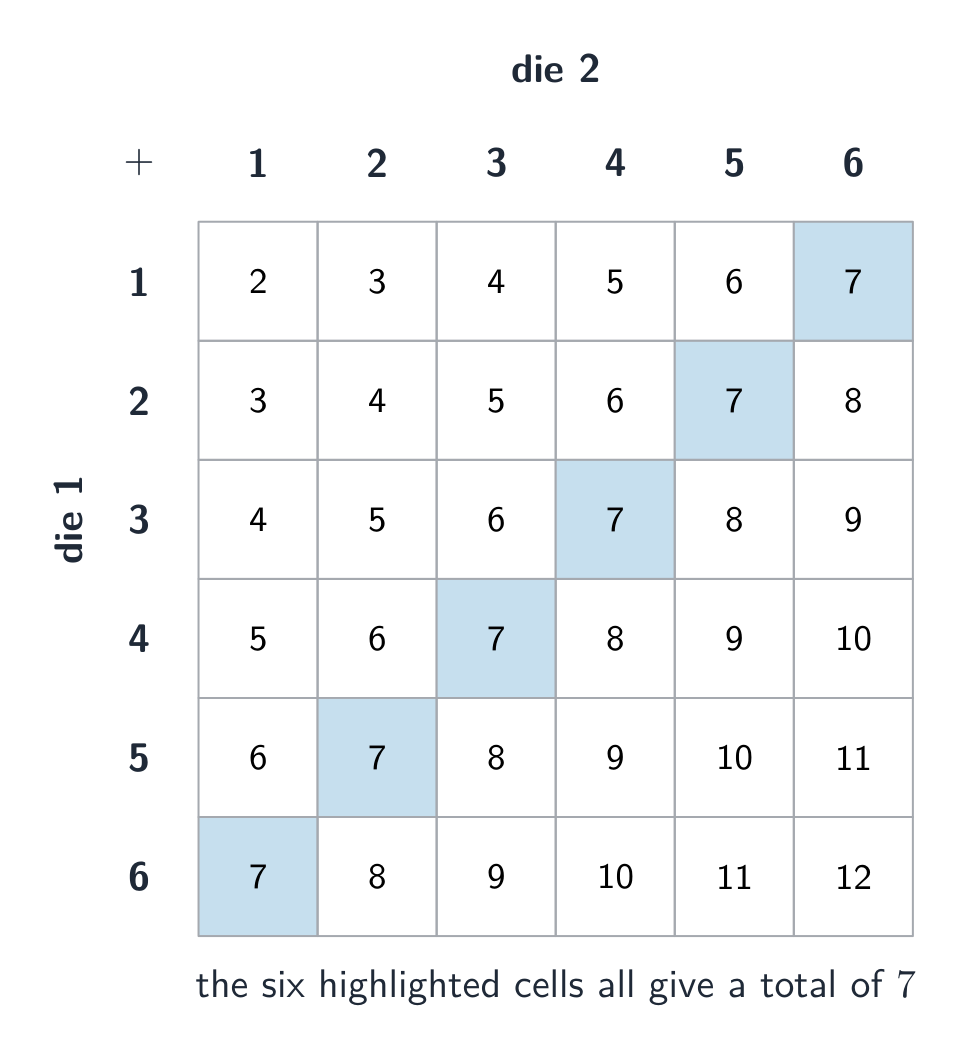
A sample space diagram lists every equally likely outcome
Independent ≠ mutually exclusive
- These two ideas are opposites, not synonyms — a classic mix-up.
- Mutually exclusive: they can't both happen ($P(A \cap B) = 0$).
- Independent: they can both happen, and one doesn't affect the other.
- In fact, two events with nonzero probability that are disjoint are always dependent.
Combining rules
- Compound problems chain the addition and multiplication rules.
- "At least one" is often easiest via the complement: $1 - P(\text{none})$.
- $P(\text{none}) = P(\text{not }A)\,P(\text{not }B)\cdots$ for independent events.
- Break the event into "and"s (multiply) and "or"s (add), step by step.
Independent and mutually exclusive are not the same — they're opposites. Disjoint events can't co-occur, so learning one happened tells you the other didn't — that's maximal dependence. Only use $P(A\cap B)=P(A)P(B)$ after you've checked independence; never assume it just because the problem gives you $P(A)$ and $P(B)$.
Flip a fair coin twice (independent flips).
- $P(\text{two heads}) = P(H)\,P(H) = 0.5 \times 0.5 = 0.25$.
- $P(\text{at least one head}) = 1 - P(\text{no heads}) = 1 - 0.5 \times 0.5 = 0.75$.
- The complement turns a messy "or" into a clean "and."
Events are independent when $P(A \mid B) = P(A)$; then $P(A \cap B) = P(A)\,P(B)$ (multiply). This is not the same as mutually exclusive (which means $P(A\cap B)=0$) — they're opposites. Combine the addition and multiplication rules for compound events, often using the complement for "at least one."
Write from a joint probability of 0.08
- Events A and B are independent.
- P of A is 0.2 and P of B is 0.4. The lesson values 0.25 and 0.75 are another pair.
What is the probability of A and B?
Independent events multiply.
What is P of A and B?
Сложность 1/5 · 100 монет + небольшой бонус за первое выполнение сегодня
0.2 times 0.4 is 0.08.
Independent events branch by branch
For independent events, multiply along the branches.
Two independent events have P(A)=0.5 and P(B)=0.5. Find P(A and B).
Сложность 2/5 · 140 монет + небольшой бонус за первое выполнение сегодня
Independent → multiply: 0.5 × 0.5 = 0.25.
Independent events and mutually exclusive events are the same thing.
Сложность 1/5 · 100 монет + небольшой бонус за первое выполнение сегодня
They're opposites: disjoint events are actually dependent.
Flip a fair coin twice. Find P(at least one head).
Сложность 2/5 · 140 монет + небольшой бонус за первое выполнение сегодня
1 − P(no heads) = 1 − 0.5×0.5 = 0.75.
Events A and B are independent means...
Сложность 1/5 · 100 монет + небольшой бонус за первое выполнение сегодня
Independence: the condition doesn't change A's probability.
For 'at least one', it is often easiest to use the ___ rule (1 minus P(none)).
Сложность 1/5 · 100 монет + небольшой бонус за первое выполнение сегодня
P(at least one) = 1 − P(none).