Departures from Linearity
Введено| English | Значение |
|---|---|
| influential/ˌɪnfluːˈenʃl/ | Влияющий |
| outlier/ˈaʊtlaɪə/ | Выброс |
| high-leverage point/haɪ ˈliːvərɪdʒ pɔɪnt/ | Точка с высоким杠杆ом (высокой leverage) |
| transformation/trænsfɔːˈmeɪʃn/ | Преобразование |
Points that pull the line
- Not every point matters equally — some are influential 有影响的.
- An influential point noticeably changes the slope, intercept, or correlation if removed.
- The test is practical: fit the line with and without it and see if the answer moves.
- Two special kinds drive most of this: outliers and high-leverage points.
Outliers vs. high leverage
- An outlier 离群值 has a large residual — it's far from the line in the $y$-direction.
- A high-leverage point 高杠杆点 has an extreme $x$-value — far out along the horizontal.
- Leverage is about horizontal extremeness; an outlier is about vertical miss.
- A point that is both (extreme $x$ and off the trend) is the most influential of all.
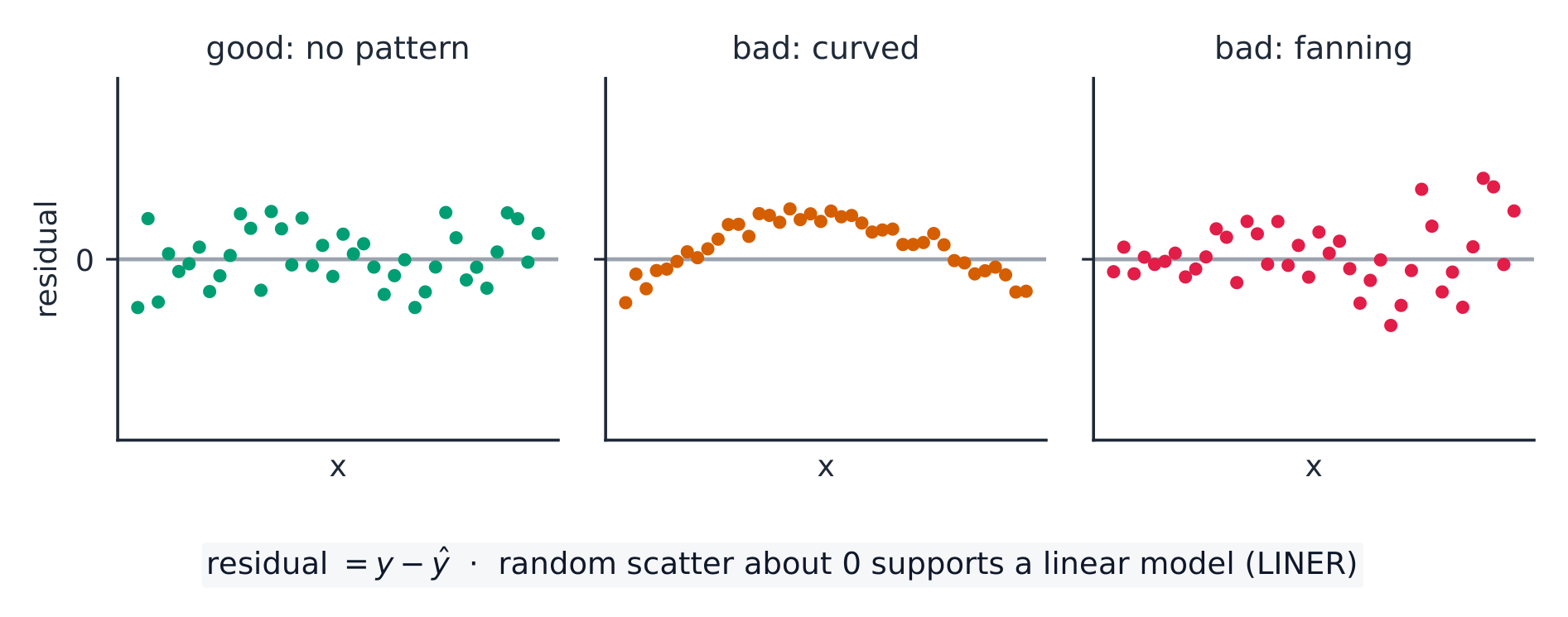
A residual plot with no pattern supports a linear model; a curve or a fan does not
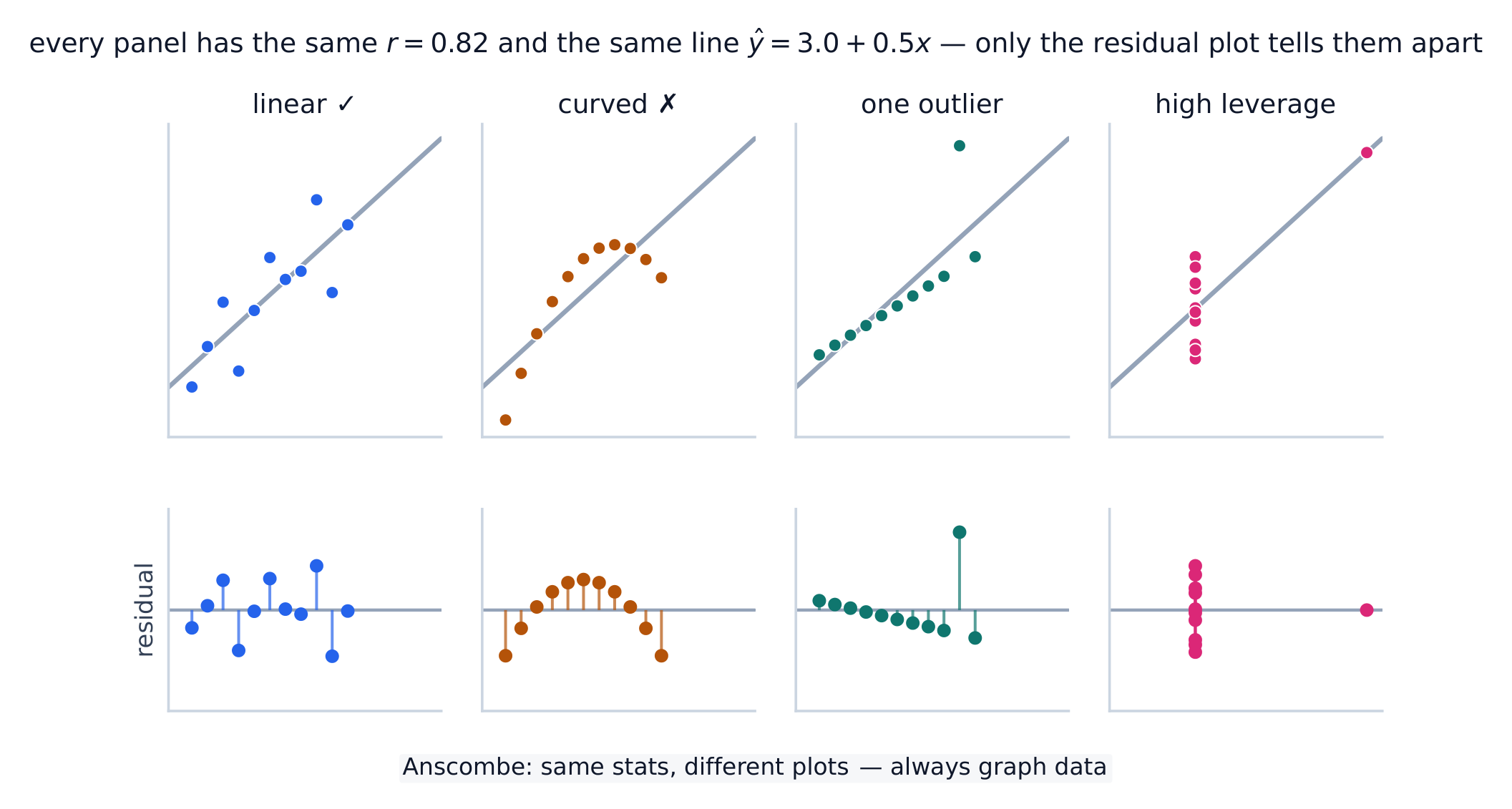
Anscombe's quartet: the same r and line with very different scatterplots
How one point distorts
- A high-leverage point acts like a lever: it can swing the slope toward itself.
- Removing an influential point can flip a slope's steepness — or even its sign.
- It can also inflate or deflate $r$, making a relationship look stronger or weaker than it is.
- Always ask whether your conclusion rests on one stubborn point.
Transformations for curves
- When the pattern is genuinely non-linear, a straight line is the wrong tool.
- A transformation 变换 (e.g. take logs, or square-root) can straighten a curved pattern.
- Fit the line to the transformed data, then transform predictions back.
- The limitation is real: forcing a line onto a curve gives biased, misleading predictions.
Leverage and outlier are not the same thing. Leverage is about an extreme $x$ (horizontal); an outlier is about a large residual (vertical). A point can be high-leverage yet sit near the line (little influence), or a mild outlier with ordinary $x$. The dangerous one is extreme in $x$ and off the pattern — it can single-handedly swing the slope and $r$.
A tidy line has slope $\approx 2$. Then one data point at a far-right $x$, sitting well below the trend, is added.
- That point has high leverage (extreme $x$) and a big residual.
- It drags the right end of the line down → the slope falls from $2$ toward $0.5$.
- Remove it and the slope springs back — it was influential.
An influential point changes the slope, intercept, or correlation when removed. An outlier has a large residual (vertical); a high-leverage point has an extreme $x$ (horizontal) — points that are both are most influential. For a truly non-linear pattern, a transformation can straighten the data; forcing a line on a curve is a real limitation.
Write from a high-leverage point
- One x value is far to the right of the other x values.
- The point sits near the line but can still swing it.
What influence does this x value have?
Leverage comes from an unusual explanatory value.
What is a point with an extreme x called?
Сложность 1/5 · 100 монет + небольшой бонус за первое выполнение сегодня
Extreme x gives the point leverage on the line.
An influential point swings the line
A far-out point off the trend can tilt the whole line.
A high-leverage point is one with an extreme value of...
Сложность 1/5 · 100 монет + небольшой бонус за первое выполнение сегодня
Leverage is about an extreme x-value; an outlier is a large residual.
A point is called influential if removing it noticeably changes the slope, intercept, or correlation.
Сложность 1/5 · 100 монет + небольшой бонус за первое выполнение сегодня
That with/without comparison is the definition of influence.
Match each special point to what makes it extreme.
Сложность 2/5 · 140 монет + небольшой бонус за первое выполнение сегодня
Outlier = vertical miss; leverage = horizontal extreme.
The scatterplot shows a clear curve. A good next step is to...
Сложность 1/5 · 100 монет + небольшой бонус за первое выполнение сегодня
A transformation (e.g. logs) can straighten a curved pattern.
Forcing a straight line onto a truly ___ relationship gives biased, misleading predictions.
Сложность 1/5 · 100 монет + небольшой бонус за первое выполнение сегодня
A line can't model a genuinely non-linear relationship well.