Нахождение рядов Тейлора или Маклорена для функции
Введено| English | Значение |
|---|---|
| Taylor series/ˈteɪlə ˈsɪəriːz/ | ряд Тейлора |
| Maclaurin series/məˈklɔːrɪn ˈsɪəriːz/ | ряд Маклорена |
The polynomial that never stops
- A Taylor polynomial stops at degree $n$. Let it run forever and you get a Taylor series 泰勒级数.
- $\displaystyle\sum_{n=0}^{\infty}\frac{f^{(n)}(a)}{n!}(x-a)^{n}$ — the infinite version, exactly representing $f$ where it converges.
- Centered at $0$, it's a Maclaurin series 麦克劳林级数.
- A handful of these are worth knowing by heart.
Ряд Тейлора с центром в $0$ называется ____ рядом.
Сложность 1/5 · 100 монет + небольшой бонус за первое выполнение сегодня
Маклорен = Тейлор с центром в $0$.
The must-know Maclaurin series
- $\displaystyle e^{x}=\sum_{n=0}^{\infty}\frac{x^{n}}{n!}=1+x+\frac{x^2}{2!}+\frac{x^3}{3!}+\cdots$
- $\displaystyle \sin x=\sum_{n=0}^{\infty}\frac{(-1)^n x^{2n+1}}{(2n+1)!}=x-\frac{x^3}{3!}+\frac{x^5}{5!}-\cdots$
- $\displaystyle \cos x=\sum_{n=0}^{\infty}\frac{(-1)^n x^{2n}}{(2n)!}=1-\frac{x^2}{2!}+\frac{x^4}{4!}-\cdots$
- $\displaystyle \frac{1}{1-x}=\sum_{n=0}^{\infty}x^{n}=1+x+x^2+\cdots$ (the geometric series, $|x|<1$).
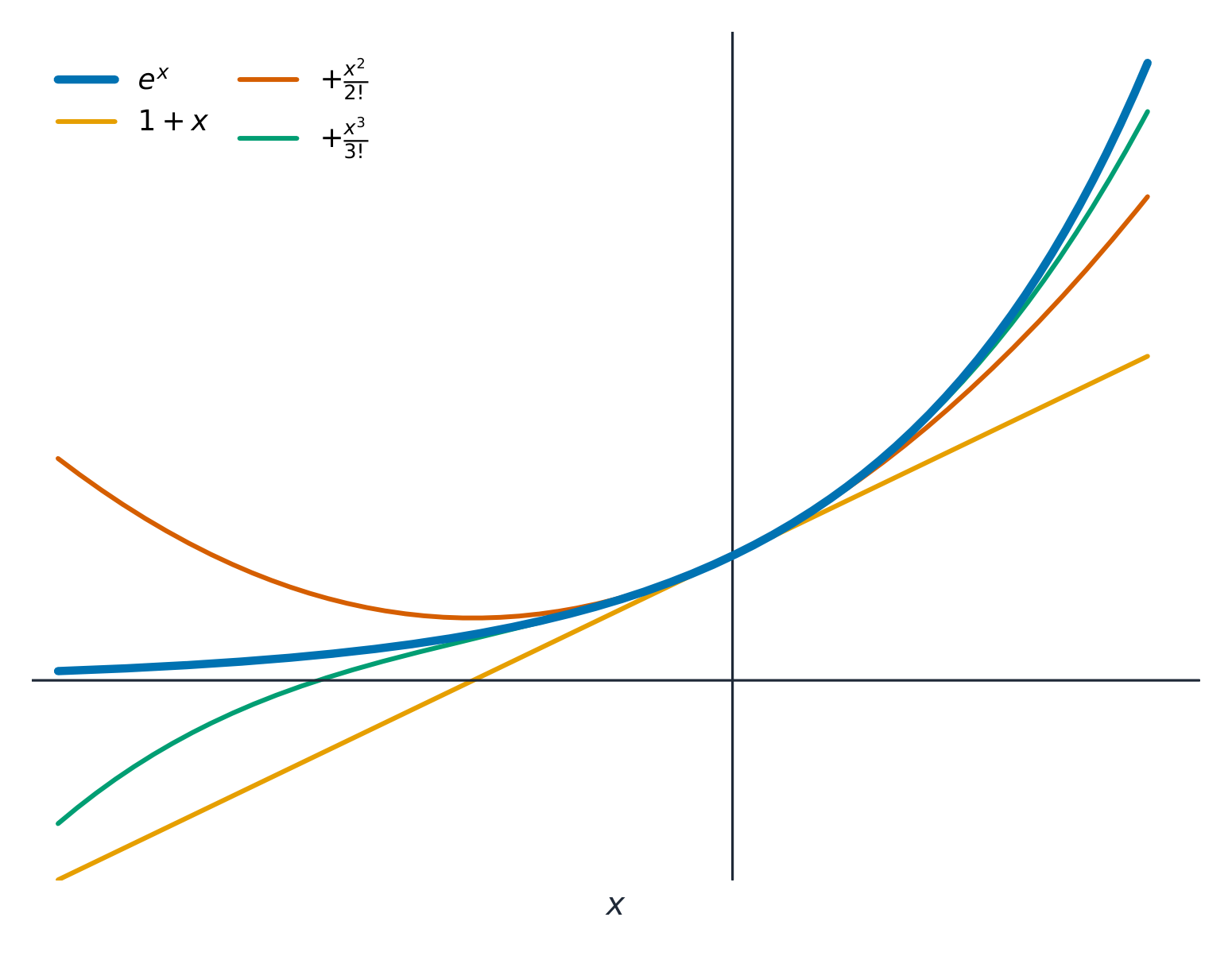
Each extra Maclaurin term hugs the function over a wider range
cos x из его ряда
$\cos x=1-\tfrac{x^2}{2!}+\tfrac{x^4}{4!}-\cdots$ — четные степени, чередующиеся знаки, знаменатели — факториалы.
Ряд Маклорена для $e^x$ равен...
Сложность 1/5 · 100 монет + небольшой бонус за первое выполнение сегодня
Все степени, коэффициенты $\tfrac1{n!}$, без чередования.
Ряд для $\dfrac{1}{1-x}$ (с $|x|<1$) равен...
Сложность 1/5 · 100 монет + небольшой бонус за первое выполнение сегодня
Геометрический ряд $1+x+x^2+\cdots$.
Building one from scratch
- Compute $f(a),f'(a),f''(a),\dots$ and plug into $\frac{f^{(n)}(a)}{n!}(x-a)^n$, term by term.
- Look for the pattern in the derivatives to write the general $n$th term.
- The known series above are usually derived once then reused — memorize them.
- The general term is what makes it a series, not just a few terms.
Используя $\cos x\approx1-\tfrac{x^2}{2}$, оцените $\cos(0.2)$.
Сложность 2/5 · 140 монет + небольшой бонус за первое выполнение сегодня
$1-\tfrac{0.04}{2}=0.98$.
$\sin$ and $\cos$ share a family
- Notice $\sin x$ uses odd powers and $\cos x$ uses even powers — and both alternate sign.
- $e^x$ has every power with all-positive coefficients $\tfrac1{n!}$.
- These patterns let you write out terms quickly and spot which series a problem wants.
- Recognizing the family is half the battle on the exam.
Ряд Маклорена для $\sin x$ использует...
Сложность 1/5 · 100 монет + небольшой бонус за первое выполнение сегодня
$\sin x=x-\tfrac{x^3}{3!}+\cdots$ (нечетные, чередование).
Знаменатели в этих стандартных рядах — факториалы.
Сложность 1/5 · 100 монет + небольшой бонус за первое выполнение сегодня
Член порядка $n$ содержит $n!$ (или $(2n)!$, $(2n+1)!$).
Keep the factorials and the sign pattern straight: $\sin x$ has odd powers $x^{2n+1}$ (starts with $x$), $\cos x$ has even powers $x^{2n}$ (starts with $1$), both alternating; $e^x$ has all powers, no alternation. Mixing up odd/even or dropping the $(-1)^n$ is the classic slip.
Write the Maclaurin series for $\cos x$ and use it to approximate $\cos(0.2)$ to two terms.
- $\cos x=1-\dfrac{x^2}{2!}+\dfrac{x^4}{4!}-\cdots$
- Two terms at $x=0.2$: $1-\dfrac{0.04}{2}=1-0.02=0.98$.
- True $\cos 0.2\approx0.980$. ✓
A Taylor series is the infinite $\sum\frac{f^{(n)}(a)}{n!}(x-a)^n$; centered at $0$ it's a Maclaurin series. Memorize $e^x$, $\sin x$, $\cos x$, and $\frac{1}{1-x}$. Watch the factorials and sign patterns: $\sin$ = odd powers, $\cos$ = even powers, both alternating; $e^x$ = all powers, no alternation.