Работа с геометрическими рядами
Введено| English | Значение |
|---|---|
| geometric series/ˌdʒiːəʊˈmetrɪk ˈsɪəriːz/ | геометрический ряд |
| common ratio/ˈkɒmən ˈreɪʃɪəʊ/ | общий множитель |
The one series you can sum exactly
- Most series are hard to add up. The geometric series 几何级数 is the friendly exception — it has a formula.
- Each term is the previous one times a fixed common ratio 公比 $r$: $a+ar+ar^2+ar^3+\cdots$.
- It's the infinite version of the geometric sequences you already know.
- And there's a clean rule for exactly when it converges and to what.
Геометрическая прогрессия
Геометрический ряд складывает члены, умноженные на $r$ каждый раз — он сходится (к $a/(1-r)$) тогда и только тогда, когда $|r|<1$.
Converges only when $|r|<1$
- A geometric series converges exactly when $|r|<1$ (the ratio is a fraction).
- If $|r|\ge1$, the terms don't shrink to $0$, so it diverges.
- $\tfrac12+\tfrac14+\tfrac18+\cdots$ ($r=\tfrac12$) converges; $1+2+4+\cdots$ ($r=2$) diverges.
- The single number $|r|$ decides everything.
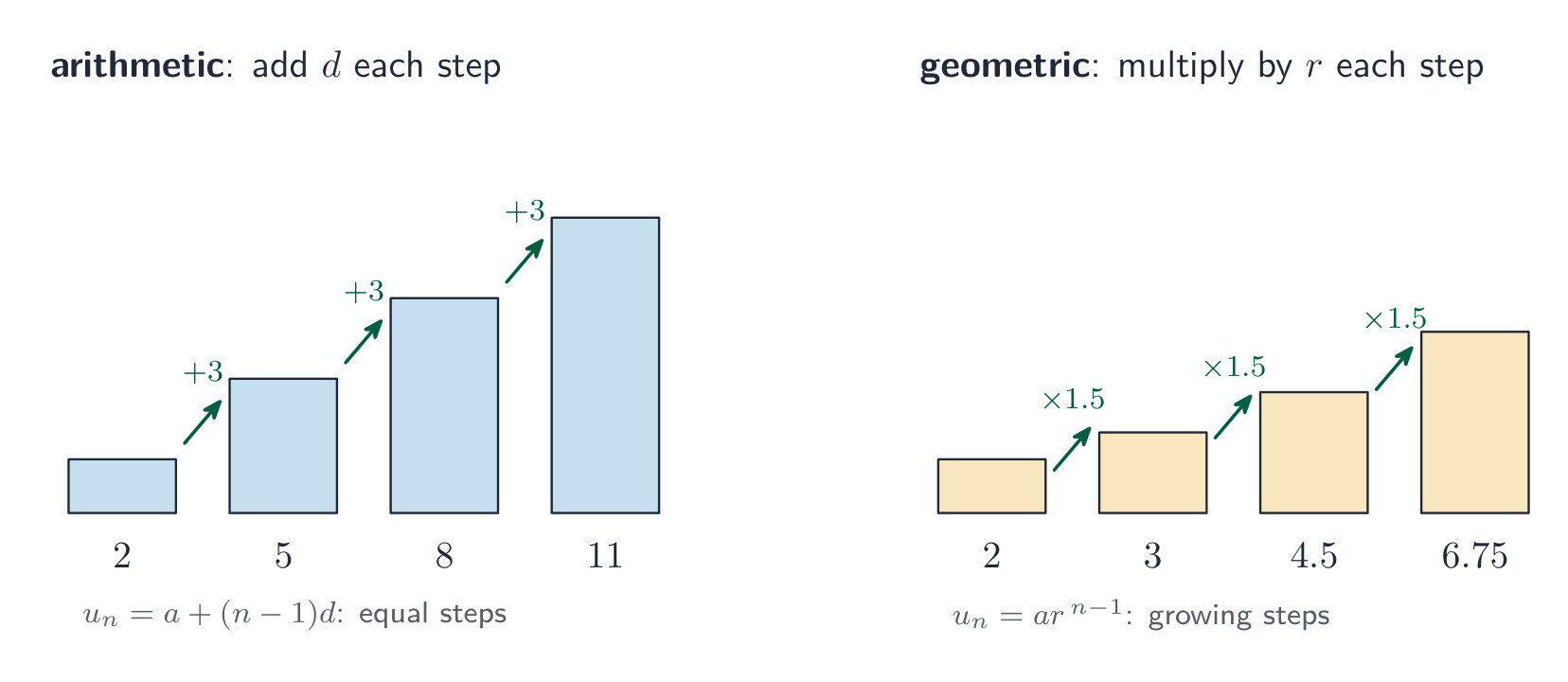
A geometric sequence multiplies by the same ratio at each step
Геометрический ряд $\sum a r^n$ сходится тогда и только тогда, когда...
Сложность 1/5 · 100 монет + небольшой бонус за первое выполнение сегодня
Сходится тогда и только тогда, когда знаменатель — дробь, $|r|<1$.
Какой геометрический ряд расходится?
Сложность 1/5 · 100 монет + небольшой бонус за первое выполнение сегодня
$r=2$ имеет $|r|\ge1$ → расходится.
The sum formula
- When it converges ($|r|<1$), the sum is
-
$$\sum_{n=0}^{\infty} a\,r^{n}=\frac{a}{1-r}$$
- $a$ is the first term and $r$ the common ratio.
- Plug in and you get the exact infinite sum — no limits to compute by hand.
Сумма сходящегося геометрического ряда равна...
Сложность 1/5 · 100 монет + небольшой бонус за первое выполнение сегодня
$\sum a r^n=\frac{a}{1-r}$ для $|r|<1$.
Формулу $\tfrac{a}{1-r}$ можно применять даже когда $|r|\ge1$.
Сложность 1/5 · 100 монет + небольшой бонус за первое выполнение сегодня
Только когда $|r|<1$ (сходящийся).
Getting $a$ and $r$ right
- $a$ is the actual first term of the series (whatever it starts at), not necessarily $1$.
- $r$ is the ratio between consecutive terms — divide any term by the one before it.
- If a series starts at $n=1$ instead of $n=0$, adjust $a$ to be that first term.
- With the right $a$ and $r$, the formula $\tfrac{a}{1-r}$ does the rest.
Найдите $\displaystyle\sum_{n=0}^\infty 5\left(\tfrac13\right)^n$ (десятичное число).
Сложность 2/5 · 140 монет + небольшой бонус за первое выполнение сегодня
$\frac{5}{1-1/3}=\frac{5}{2/3}=7.5$.
В формуле $\tfrac{a}{1-r}$, $a$ — это ____ член ряда.
Сложность 1/5 · 100 монет + небольшой бонус за первое выполнение сегодня
$a$ — это фактический первый член.
The formula $\frac{a}{1-r}$ applies only when $|r|<1$ — using it on a divergent geometric series gives a meaningless number. And $a$ is the first term as written, not always $1$: for $\sum_{n=1}^\infty 3\cdot 2^{-n}=\tfrac32+\tfrac34+\cdots$, the first term is $\tfrac32$, not $3$.
Find the sum of $\displaystyle\sum_{n=0}^{\infty} 5\left(\tfrac13\right)^{n}$.
- First term $a=5$, common ratio $r=\tfrac13$. Since $|r|<1$, it converges.
- $\displaystyle\sum=\frac{a}{1-r}=\frac{5}{1-\tfrac13}=\frac{5}{\tfrac23}=\frac{15}{2}$.
A geometric series $\sum a\,r^n$ converges iff $|r|<1$, and then sums to $\frac{a}{1-r}$ (with $a$ the first term, $r$ the common ratio). If $|r|\ge1$ it diverges. It's the one series with an exact, easy sum.