Проверка решений дифференциальных уравнений
Введено| English | Значение |
|---|---|
| solution/səˈluːʃn/ | решение |
Is this function actually a solution?
- Before solving a differential equation, you should be able to check a proposed answer.
- A solution 解 of a differential equation is a function that makes the equation true.
- The test is purely mechanical: differentiate the candidate and substitute.
- If both sides match for all $x$, it's a solution; if not, it isn't.
The verification recipe
- 1. Take the candidate function and compute its derivative(s).
- 2. Substitute the function and its derivatives into the differential equation.
- 3. Simplify both sides and check that they are equal (as identities in $x$).
- No integration needed — verifying is just differentiating and plugging in.
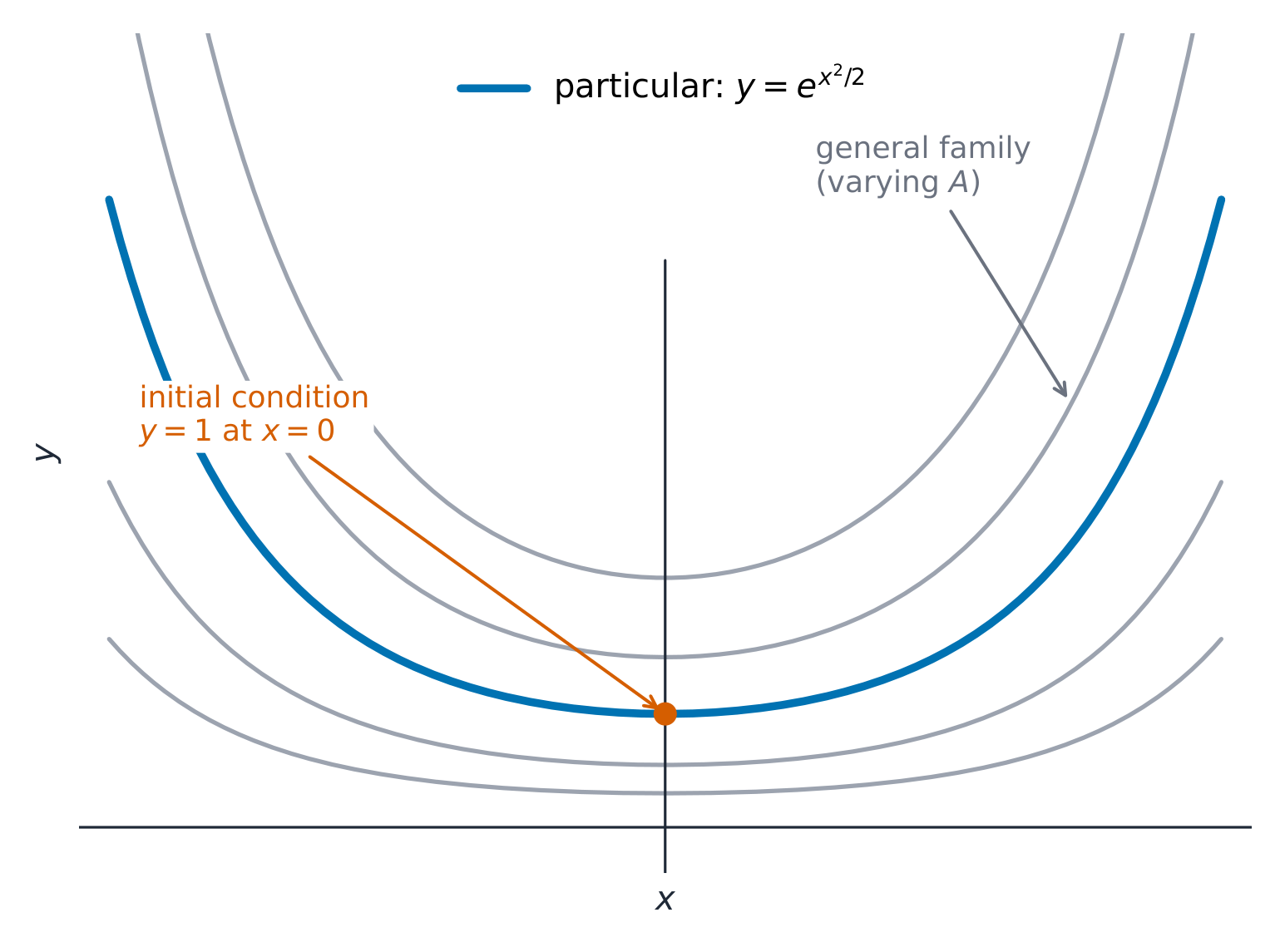
The constant gives a family of curves; an initial condition picks out one
Чтобы проверить предполагаемое решение, вам нужно...
Сложность 1/5 · 100 монет + небольшой бонус за первое выполнение сегодня
Продифференцируйте предполагаемое решение, подставьте, проверьте совпадение обеих частей.
A worked check
- Does $y=e^{3x}$ solve $\dfrac{dy}{dx}=3y$?
- Differentiate: $\dfrac{dy}{dx}=3e^{3x}$.
- Substitute into the right side: $3y=3e^{3x}$.
- Left $=$ right ($3e^{3x}=3e^{3x}$), so yes, $y=e^{3x}$ is a solution. ✓
Решения dy/dx = ky
Каждая экспонента $y=Ce^{kx}$ проходит через поле направлений — проверка одного решения лишь подтверждает, что его производная совпадает с $ky$.
$y=e^{3x}$ является решением $\dfrac{dy}{dx}=3y$.
Сложность 1/5 · 100 монет + небольшой бонус за первое выполнение сегодня
$\frac{dy}{dx}=3e^{3x}=3y$. ✓
Обе части должны быть равны для ____ значений $x$, а не только для одного, чтобы подтвердить решение.
Сложность 1/5 · 100 монет + небольшой бонус за первое выполнение сегодня
Решение удовлетворяет уравнению тождественно.
General vs. particular solutions
- $y=Ce^{3x}$ (with any constant $C$) also solves $\dfrac{dy}{dx}=3y$ — the whole family is the general solution.
- Pick a specific $C$ and you get a particular solution.
- Verifying works the same for either: differentiate and check the equation holds.
- The constant carries through the differentiation, so the check still balances.
Проверка данного решения требует интегрирования дифференциального уравнения.
Сложность 1/5 · 100 монет + небольшой бонус за первое выполнение сегодня
Проверка — это дифференцирование и подстановка; интегрирование не требуется.
При каких константах $C$ функция $y=Ce^{3x}$ решает $\dfrac{dy}{dx}=3y$?
Сложность 1/5 · 100 монет + небольшой бонус за первое выполнение сегодня
$\frac{dy}{dx}=3Ce^{3x}=3y$ для всех $C$ — общее решение.
Является ли $y=x^2+C$ решением $\dfrac{dy}{dx}=2x$?
Сложность 1/5 · 100 монет + небольшой бонус за первое выполнение сегодня
$\frac{dy}{dx}=2x$ независимо от $C$.
Verifying is not solving — you're only checking a given candidate, so no integration is involved. Substitute the function and its derivative into the equation and confirm both sides are identical for all $x$, not just at one point. A match at a single $x$ isn't enough.
Verify that $y=x^2+C$ solves $\dfrac{dy}{dx}=2x$.
- Differentiate: $\dfrac{dy}{dx}=2x$ (the $+C$ vanishes).
- The differential equation says $\dfrac{dy}{dx}=2x$.
- Both sides equal $2x$, so $y=x^2+C$ is a solution for every constant $C$. ✓
To verify a solution of a differential equation, differentiate the candidate and substitute it (with its derivatives) into the equation; it's a solution iff both sides are equal for all $x$. No integration required — verifying is differentiate-and-check. A family with a constant $C$ is the general solution.