Построение полей направлений
Введено| English | Значение |
|---|---|
| slope field/sləʊp fiːld/ | поле направлений |
A map of slopes across the plane
- A differential equation $\dfrac{dy}{dx}=F(x,y)$ gives a slope at every point.
- Draw a short segment with that slope at each point of a grid, and you get a slope field 斜率场.
- It's a "map" showing which way solution curves must travel everywhere.
- You don't need to solve the equation to draw it — just evaluate the slope.
Поле направлений для dy/dx = ay
Каждый штрих имеет наклон $\tfrac{dy}{dx}$ в своей точке — пологий около $y=0$ и круче вдали для $\tfrac{dy}{dx}=ay$.
Поле направлений показывает в каждой точке...
Сложность 1/5 · 100 монет + небольшой бонус за первое выполнение сегодня
Каждый штрих — это направление касательной в данной точке.
Для построения поля направлений вычисляют только наклоны — вам ____ не нужно решать уравнение.
Сложность 1/5 · 100 монет + небольшой бонус за первое выполнение сегодня
Уравнение дает наклон непосредственно.
Compute the slope at each point
- At a grid point $(x,y)$, plug into $\dfrac{dy}{dx}=F(x,y)$ to get the number — that's the segment's slope.
- Slope $0$ → a horizontal dash; large positive → a steep upward dash; negative → downward.
- Repeat over a lattice of points to fill the field.
- The equation tells you the slope directly; no antiderivative needed.
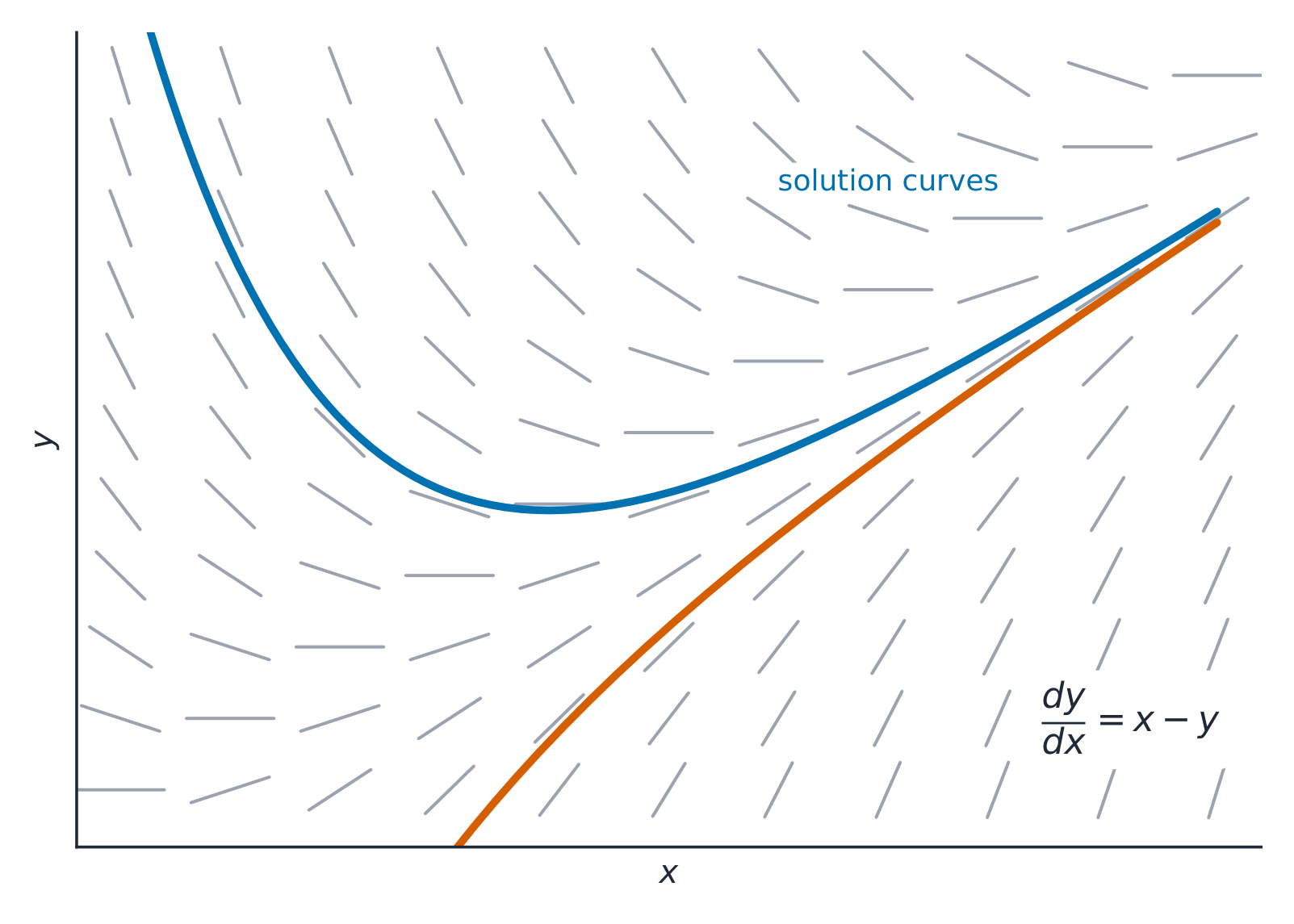
A slope field shows the gradient everywhere; solution curves follow it
Для $\dfrac{dy}{dx}=x+y$ найдите наклон штриха в точке $(2,3)$.
Сложность 2/5 · 140 монет + небольшой бонус за первое выполнение сегодня
$2+3=5$.
Для $\dfrac{dy}{dx}=xy$ наклон в точке $(3,2)$ равен...
Сложность 1/5 · 100 монет + небольшой бонус за первое выполнение сегодня
$xy=3\cdot2=6$ (используйте обе координаты).
Spotting patterns quickly
- If $F$ depends only on $x$: the slope is the same all along a vertical line (columns look identical).
- If $F$ depends only on $y$: the slope is the same all along a horizontal line (rows look identical).
- For $\dfrac{dy}{dx}=y$: slopes grow with height — flat near $y=0$, steep far away.
- Recognizing these patterns speeds up sketching enormously.
Если $\dfrac{dy}{dx}$ зависит только от $x$, то штрихи в каждом вертикальном столбце параллельны.
Сложность 1/5 · 100 монет + небольшой бонус за первое выполнение сегодня
Одинаковый $x$ → одинаковый наклон вдоль столбца.
Equilibrium lines
- Where $F(x,y)=0$, the slope is $0$ — a row (or curve) of horizontal dashes.
- For $\dfrac{dy}{dx}=y$, that happens at $y=0$: a whole horizontal line of flat segments.
- These lines often mark equilibrium behavior — solutions can level off there.
- They're the easiest points to plot, so start with them.
Для $\dfrac{dy}{dx}=y$ штрихи горизонтальны вдоль линии...
Сложность 1/5 · 100 монет + небольшой бонус за первое выполнение сегодня
Наклон $=y=0$ вдоль $y=0$.
A slope field shows the differential equation's slopes, not the solution curves themselves. The little segments are tangent directions; a solution is a curve that stays tangent to them. And compute the slope with the point's $(x,y)$, using $y$ too when $F$ depends on it — not just $x$.
Sketch a few slopes for $\dfrac{dy}{dx}=x$.
- At $(1,0)$: slope $=1$. At $(2,5)$: slope $=2$. At $(-1,3)$: slope $=-1$.
- Since $F=x$ (no $y$), every point in a vertical column has the same slope.
- Columns of parallel dashes: flat at $x=0$, tilting more as $|x|$ grows.
A slope field draws a short segment of slope $\frac{dy}{dx}=F(x,y)$ at each grid point — a map of tangent directions, no solving needed. Compute the slope at each $(x,y)$; look for patterns (columns match if $F$ depends only on $x$, rows if only on $y$) and horizontal dashes where $F=0$.