Skip to content · ⁨Перейти к содержанию⁩
Subjects · ⁨Предметы⁩

English Grammar · A1 · ⁨Англійська граматика · A1⁩

  • 1 The verb to be · ⁨Глагол to be⁩
    1.1

    am / is / are

    English

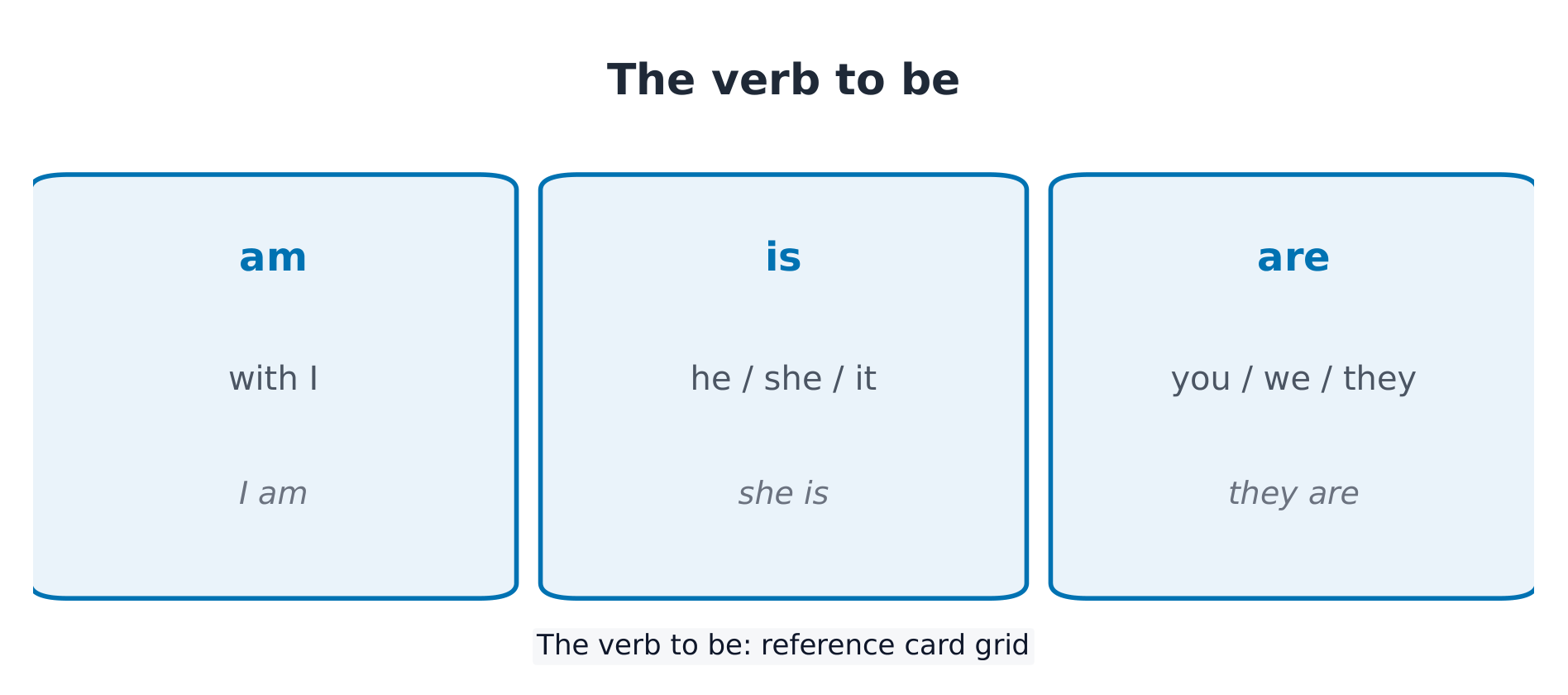
    The verb "to be" means "is / am / are." It changes according to the subject and has three forms:

    • I → am
    • he / she / it → is
    • you / we / they → are

    我I 是am 一名a 学生student.

    I am a student.

    她She 是is 开心happy.

    She is happy.

    他们They (是)are 来自from 中国China.

    They are from China.

    Note: Common spoken contractions: I'm, you're, he's, she's, it's, we're, they're.

    Русский
    Глагол to be: am / is / are изменяется по подлежащему

    Глагол to be (be verb) обозначает «быть / находиться». Он изменяется по подлежащему и имеет три формы:

    • I → am
    • he / she / it → is
    • you / we / they → are

    我I 是am 一名a 学生student.

    Я студент.

    她She 是is 开心happy.

    Она счастлива.

    他们They (是)are 来自from 中国China.

    Они из Китая.

    Примечание: В разговорной речи часто используются сокращения: I'm, you're, he's, she's, it's, we're, they're.
    1.2

    Отрицания и вопросы

    English

    Negation: Add not after the be verb (often contracted).

    他He 不是is not 一名a 老师teacher.

    He is not a teacher. (= He isn't a teacher.)

    Interrogative: Place the be verb before the subject.

    (是吗)Are 你you 准备好ready?

    Are you ready?

    Short answers: Yes, I am. / No, I'm not.

    Note: Negative contractions: is not → isn't, are not → aren't; but am not is only contracted to I'm not (there is no ~~amn't~~).

    Common Errors

    • ❌ ~~He busy.~~ → ✓ He is busy. — In Chinese, "He is very busy" can exist without a verb, but an English sentence must have a verb. Use be to link when the predicative is an adjective or noun and there are no other verbs in the sentence (He is busy); do not add be if the sentence already contains an ordinary verb (I go to school).
    • ❌ ~~I am go to school.~~ → ✓ I go to school. — Do not use be and ordinary verbs together; "go" alone suffices for "to go."
    • ❌ ~~They is my friends.~~ → ✓ They are my friends. — Plural subjects (you / we / they) take are.
    • ❌ ~~I am agree.~~ → ✓ I agree. — agree is itself a verb; do not add am before it.
    • ❌ ~~Are you ready? — Yes, I'm.~~ → ✓ Yes, I am. — Contractions cannot be used at the end of affirmative short answers (say Yes, I am); however, negative short answers typically end with a negative contraction (No, he isn't / No, I can't; first person is No, I'm not, as there is no amn't).
    Русский

    Отрицание: Добавьте not после глагола to be (часто используется сокращение).

    他He 不是is not 一名a 老师teacher.

    Он не учитель. (= He isn't a teacher.)

    Вопрос: Поставьте глагол to be перед подлежащим.

    (是吗)Are 你you 准备好ready?

    Ты готов?

    Краткие ответы: Yes, I am. / No, I'm not.

    Примечание: Сокращения отрицания: is not → isn't, are not → aren't; но am not сокращается только как I'm not (нет ~~amn't~~).

    Частые ошибки

    • ❌ ~~He busy.~~ → ✓ He is busy. — В китайском языке предложение «Он занят» может быть без глагола, но в английском предложении обязательно нужен глагол. Когда сказуемое является прилагательным или существительным, а в предложении нет других глаголов, используется be для связи (He is busy); если в предложении уже есть обычный глагол, то be не добавляется (I go to school).
    • ❌ ~~I am go to school.~~ → ✓ I go to school. — Глагол be и обычный глагол не могут сочетаться; «идти» выражается только глаголом go.
    • ❌ ~~They is my friends.~~ → ✓ They are my friends. — Для множественного числа подлежащего (you / we / they) используется are.
    • ❌ ~~I am agree.~~ → ✓ I agree. — Agree (соглашаться) само по себе является глаголом, поэтому перед ним не ставится am.
    • ❌ ~~Are you ready? — Yes, I'm.~~ → ✓ Yes, I am. — В конце краткого утвердительного ответа нельзя использовать сокращение (говорят Yes, I am); но в кратком отрицательном ответе обычно используется отрицательное сокращение (No, he isn't / No, I can't; для первого лица — No, I'm not, так как формы amn't не существует).
  • 2 Subject pronouns · ⁨Местительные местоимения (подлежащее)⁩
    2.1

    I, you, he, she, it, we, they

    English

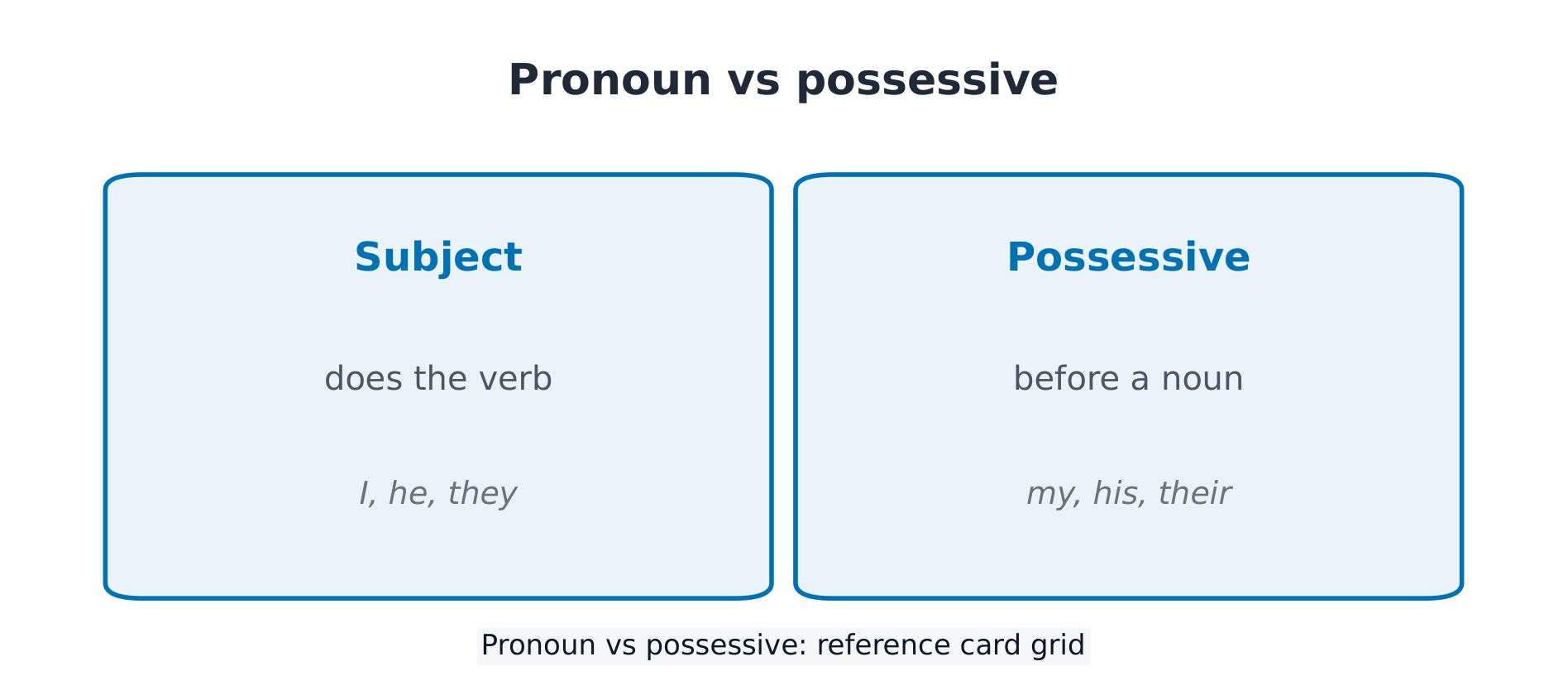
    Subject pronouns replace the subject and are placed before the verb:

    • I(I), you(you), he(he), she(she)
    • it(it), we(we), they(they)

    他He 是is 我的my 哥哥brother.

    He is my brother.

    我们We 喜欢like 音乐music.

    We like music.

    Key Usage Points:

    • I is always capitalized, regardless of its position in the sentence.
    • Things and animals commonly use it: This is my bag. It is new.(This is my bag. It is new.)*
    • Plural people or things both use they: The books are here. They are mine.(The books are here. They are mine.)*

    Note: Subject pronouns are followed by verbs; do not confuse them with object pronouns (me, him, her...) which will be learned later.

    Common Errors

    • ❌ ~~My mother is a doctor. He is very kind.~~ → ✓ She is very kind. — In colloquial Chinese, "he/she" sounds identical, but in English, he and she must be clearly distinguished.
    • ❌ ~~Me am a student.~~ → ✓ I am a student. — Use I for the subject, not me.
    • ❌ ~~My friend he is tall.~~ → ✓ My friend is tall. — The subject needs to be mentioned only once; avoid repeating "noun + pronoun" (the Chinese habit of saying "my friend he..." does not apply in English).
    • ❌ ~~Is raining.~~ → ✓ It is raining. — English sentences must have a subject; weather, time, and dates begin with it.
    Русский
    Местоимения подлежащего и притяжательные

    Личные местоимения в именительном падеже (subject pronouns) используются для замены подлежащего и ставятся перед глаголом:

    • I(я), you(ты / вы), he(он), she(она)
    • it(它)、we(我们)、they(他们 / 它们)

    他He 是is 我的my 哥哥brother.

    Он мой брат.

    我们We 喜欢like 音乐music.

    Мы любим музыку.

    Ключевые моменты использования:

    • I всегда пишется с большой буквы, где бы ни стоял в предложении.
    • Для обозначения предметов и животных часто используется it: This is my bag. It is new. (Это моя сумка. Она новая.)
    • Для множественного числа людей и предметов используется they: The books are here. They are mine. (Книги здесь. Они мои.)

    Внимание После местоимений в именительном падеже следует глагол; не путайте их с местоимениями в винительном падеже (me, him, her...), которые изучатся позже.

    Частые ошибки

    • ❌ ~~My mother is a doctor. He is very kind.~~ → ✓ She is very kind. — В устной речи китайского языка «он/она» произносятся одинаково, но в английском he / she нужно строго различать.
    • ❌ ~~Me am a student.~~ → ✓ I am a student. — Для роли подлежащего используется I, а не me.
    • ❌ ~~My friend he is tall.~~ → ✓ My friend is tall. — Подлежащее упоминается один раз, не нужно дублировать его в конструкции «существительное + местоимение» (привычку из китайского «мой друг он высокий» нельзя переносить на английский).
    • ❌ ~~Is raining.~~ → ✓ It is raining. — В английском предложении обязательно должно быть подлежащее; для описания погоды, времени и даты используется it в начале предложения.
  • 3 Possessive adjectives · ⁨Притяжательные прилагательные⁩
    3.1

    my, your, his, her, our, their

    English

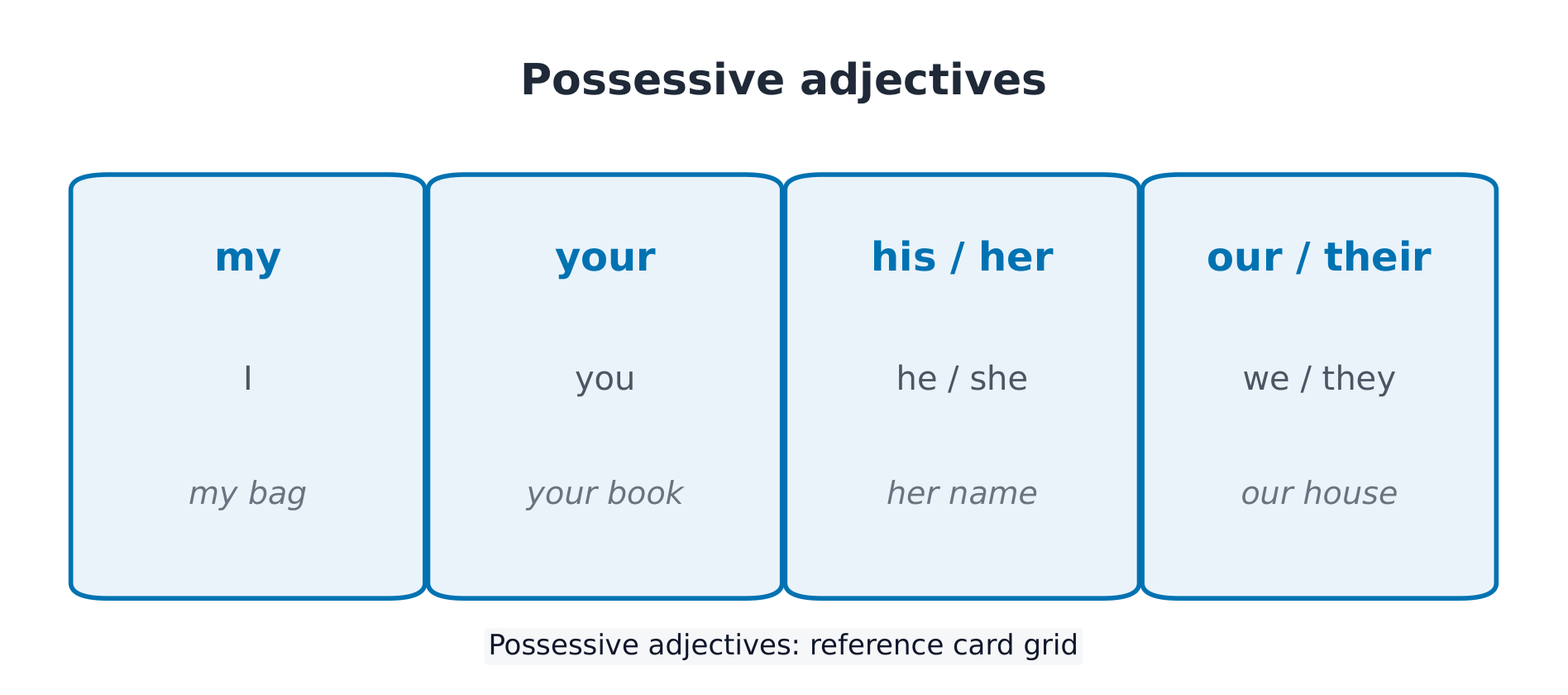
    Possessive adjectives indicate "whose" and are placed before the noun:

    • I → my(my), you → your(your), he → his(his)
    • she → her(her), it → its(its), we → our(our), they → their(their)

    这This 是is 我的my 包bag.

    This is my bag.

    她的Her 名字name 是is 露西Lucy.

    Her name is Lucy.

    Key Usage Points:

    • Possessive adjectives are always followed by a noun: my book, their house.
    • They do not change with noun number: my book, my books(my remains unchanged).

    Note: Be careful to distinguish its (its, no apostrophe) and it's (= it is). For example: The dog wags its tail.(The dog wags its tail.)*

    Common Errors

    • ❌ ~~This is she book.~~ → ✓ This is her book. — A possessive form must precede a noun: he → his, she → her.
    • ❌ ~~He is me friend.~~ → ✓ He is my friend. — The possessive form of I is my.
    • ❌ ~~The dog wags it's tail.~~ → ✓ …wags its tail. — it's = it is; "its" (possessive) has no apostrophe.
    • ❌ ~~Their is a park near here.~~ → ✓ There is a park near here. — their (their) and there (there/here) sound identical; do not mix them up in writing.
    Русский
    Притяжательные местоимения: my / your / his / her

    Притяжательные местоимения (possessive adjectives) обозначают «чей/чья/чье» и ставятся перед существительным:

    • I → my(мой), you → your(твой/ваш), he → his(его/его)
    • she → her(她的)、it → its(它的)、we → our(我们的)、they → their(他们的)

    这This 是is 我的my 包bag.

    Это моя сумка.

    她的Her 名字name 是is 露西Lucy.

    Её зовут Люси.

    Ключевые моменты использования:

    • За притяжательными местоимениями обязательно должно идти существительное: my book, their house.
    • Они не изменяются по числу существительного: my book, my books (my остается неизменным).

    Внимание Аккуратно различайте its (его/её/ее, без апострофа) и it's (= it is). Например: The dog wags its tail. (Собака виляет хвостом.)

    Частые ошибки

    • ❌ ~~This is she book.~~ → ✓ This is her book. — Перед существительным нужна притяжательная форма: he → his, she → her.
    • ❌ ~~He is me friend.~~ → ✓ He is my friend. — Притяжательная форма от I — это my.
    • ❌ ~~The dog wags it's tail.~~ → ✓ …wags its tail. — it's = it is; «его/её хвост» пишется как its, без апострофа.
    • ❌ ~~Their is a park near here.~~ → ✓ There is a park near here. — Their (их) и there (там/есть) произносятся одинаково, при написании не путайте их.
  • 4 this, that, these, those
    4.1

    this и that

    English

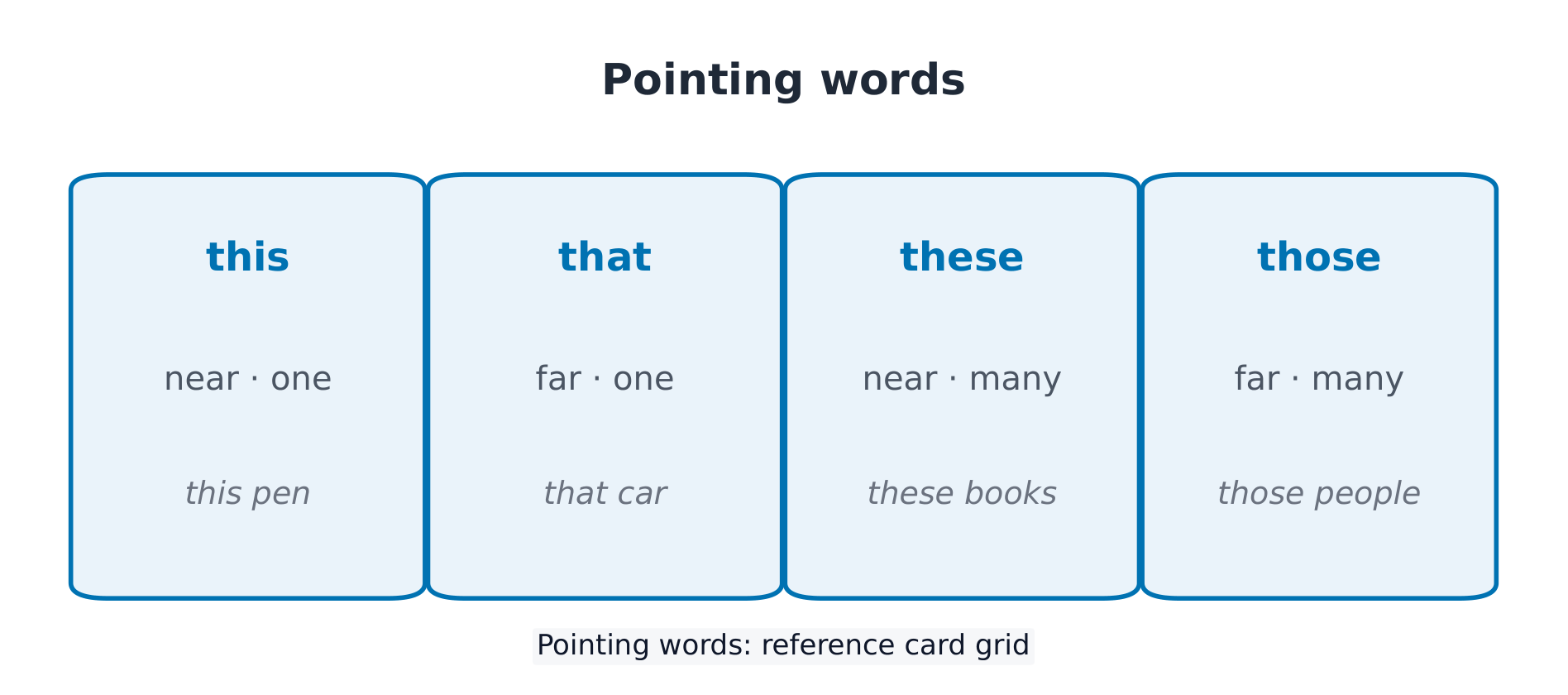
    Demonstratives point out "which one." Use this and that for singular:

    • this(this): Close to the speaker.
    • that(that): Far from the speaker.

    这This 是is 我的my 手机phone.

    This is my phone. (Close)

    那That 是is 你的your 车car.

    That is your car. (Far)

    Русский
    Близко/далеко × Единственное/множественное число: this / that / these / those

    Указательные местоимения (demonstratives) указывают на «который». Для единственного числа используются this и that:

    • this(этот): находится близко к говорящему.
    • that(тот): находится далеко от говорящего.

    这This 是is 我的my 手机phone.

    Это мой телефон. (близко)

    那That 是is 你的your 车car.

    Это твоя машина. (далеко)

    4.2

    these и those

    English

    Use these and those for plural:

    • these(these): Close. those(those): Far.

    这些These 是are 我的my 书books.

    These are my books.

    那些Those 是are 她的her 朋友friends.

    Those are her friends.

    Contrastive Memory:

    • Near → this (singular) / these (plural).
    • Far → that (singular) / those (plural).

    Note: These / those are followed by plural nouns: these books, not ~~these book~~.

    Common Errors

    • ❌ ~~these book~~ → ✓ these books — Plural nouns must follow these / those.
    • ❌ ~~This books are mine.~~ → ✓ These books are mine. — If the noun is plural, the demonstrative must also be plural.
    • ❌ When introducing yourself on the phone, say ~~I am Tom.~~ → ✓ This is Tom. — In English, introduce yourself on the phone using this is.
    • Remember pairs: Near this / these are often used with here; far that / those are often used with there.
    Русский

    Для множественного числа используются these и those:

    • these(эти): близко. those(те): далеко.

    这些These 是are 我的my 书books.

    Это мои книги.

    那些Those 是are 她的her 朋友friends.

    Это её друзья.

    Для запоминания:

    • Близко → this (ед.ч.) / these (мн.ч.).
    • Далеко → that (ед.ч.) / those (мн.ч.).

    Внимание После these / those должно идти существительное во множественном числе: these books, а не ~~these book~~.

    Частые ошибки

    • ❌ ~~these book~~ → ✓ these books — После these / those обязательно должно идти существительное во множественном числе.
    • ❌ ~~This books are mine.~~ → ✓ These books are mine. — Если существительное стоит во множественном числе, указательное местоимение также должно быть во множественном числе.
    • ❌ При разговоре по телефону ~~I am Tom.~~ → ✓ This is Tom. — В английском при представлении себя по телефону используется конструкция this is.
    • Запомните пары: nearby this / these часто используются вместе с here, distant that / those часто используются вместе с there.
  • 5 a, an and plurals · ⁨a, an и множественное число⁩
    5.1

    a и an

    English

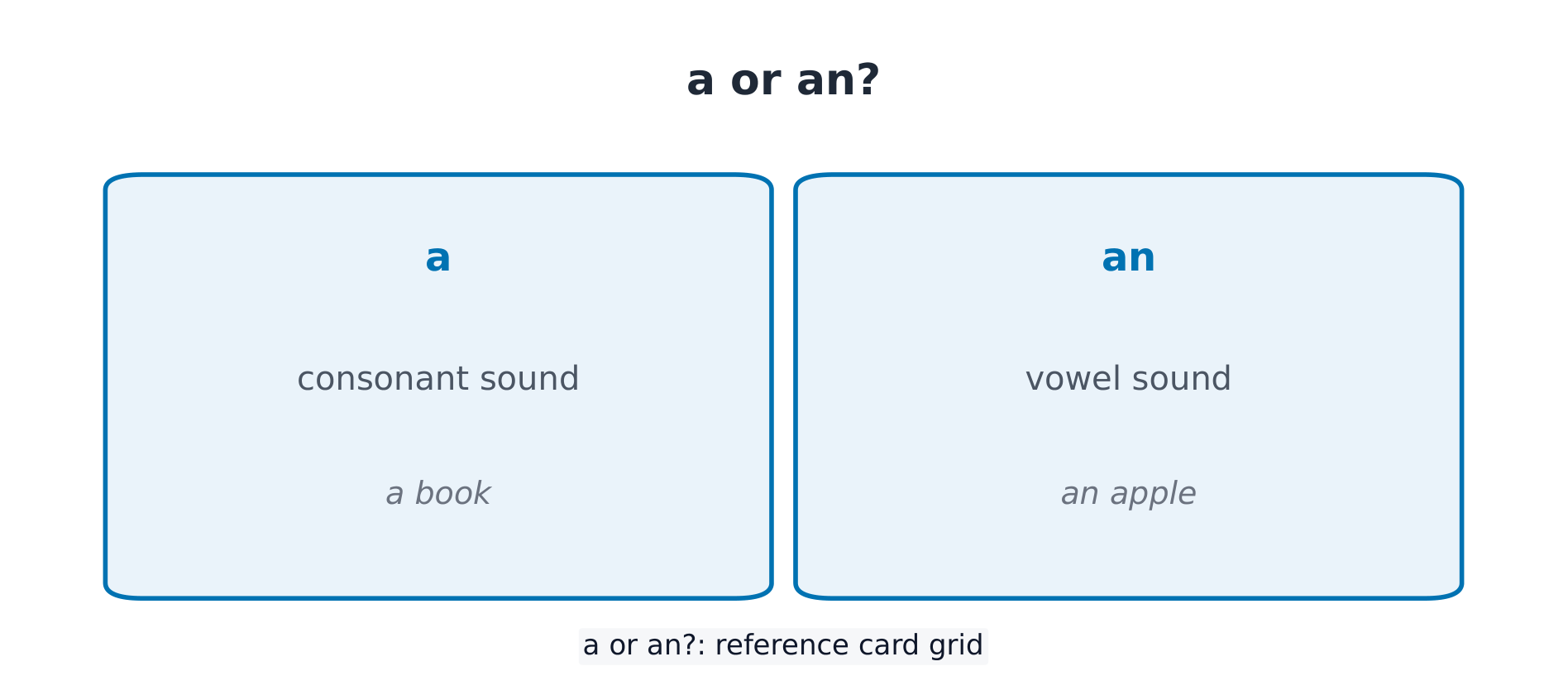
    a and an mean "one" and are used before singular countable nouns. How to choose depends on pronunciation:

    • a + consonant sound: a book, a dog, a cat.
    • an + vowel sound: an apple, an egg, an orange.

    我I 有have 一个a 笔pen.

    I have a pen.

    她She 吃eats 一个an 苹果apple.

    She eats an apple.

    Note: Look at the sound, not the letter: an hour (h is silent), a university (pronounced "yu-").

    Русский
    a / an: зависит от звучания (согласный vs гласный)

    a и an означают «один», используются перед единственным исчисляемым существительным. Как выбрать, зависит от звука:

    • a + согласный звук: a book, a dog, a cat.
    • an + гласный звук: an apple, an egg, an orange.

    我I 有have 一个a 笔pen.

    У меня есть ручка.

    她She 吃eats 一个an 苹果apple.

    Она ест яблоко.

    Внимание Ориентируйтесь на звук, а не на букву: an hour (h не произносится), a university (читается «ю-»).

    5.2

    Множественное число существительных

    English

    To indicate "more than one," use the plural form of the noun, usually adding -s:

    • Generally add -s: book → books, car → cars.
    • Words ending in -s / -sh / -ch / -x add -es: bus → buses, box → boxes.
    • Consonant + y ending: change y to i and add -es: baby → babies, city → cities.

    我I 有have 两two 猫cats.

    I have two cats.

    Irregular plurals (must memorize):

    • man → men, woman → women, child → children.
    • foot → feet, tooth → teeth, person → people.

    Note: Do not use a / an before plural nouns: ~~a books~~ ✗ → books / two books ✓.

    Common Errors

    • ❌ ~~I have dog.~~ → ✓ I have a dog. — In Chinese you can say "I have dogs," but singular countable nouns in English must have a / an (or my, the, etc.) before them.
    • ❌ ~~an university~~ → ✓ a university; ❌ ~~a hour~~ → ✓ an hour — Look at pronunciation, not spelling: university starts with a consonant sound /j/, and h is silent in hour.
    • ❌ ~~two book~~ → ✓ two books — Chinese nouns do not change for plurality, but nouns after numbers in English require -s; this is easily forgotten.
    • ❌ ~~three childs~~ → ✓ three children — Irregular plurals must be memorized separately: men, women, children, feet, teeth, people.
    • ❌ ~~a people~~ → ✓ a person (one person) / people (many people) — people is inherently plural.
    Русский

    Когда означает «более одного», существительное используется во множественном числе, обычно добавляется -s:

    • Обычно добавляется -s: book → books, car → cars.
    • Слова, оканчивающиеся на -s / -sh / -ch / -x, получают окончание -es: bus → buses, box → boxes.
    • Согласная + y на конце, y меняется на i, добавляется -es: baby → babies, city → cities.

    我I 有have 两two 猫cats.

    У меня две кошки.

    Неправильные формы множественного числа (нужно выучить):

    • man → men, woman → women, child → children.
    • foot → feet, tooth → teeth, person → people.

    Внимание Перед существительным во множественном числе не ставится a / an: ~~a books~~ ✗ → books / two books ✓.

    Частые ошибки

    • ❌ ~~I have dog.~~ → ✓ I have a dog. — В китайском можно сказать «у меня собака», но в английском перед единственным исчисляемым существительным обязательно нужен a / an (или my, the и т.д.).
    • ❌ ~~an university~~ → ✓ a university; ❌ ~~a hour~~ → ✓ an hour — Ориентируйтесь на звук, а не на букву: university начинается со согласного звука /j/, h в слове hour не произносится.
    • ❌ ~~two book~~ → ✓ two books — В китайском существительные не имеют формы множественного числа, но в английском после числительных существительные должны иметь окончание -s, что最容易 forget (чаще всего забывается).
    • ❌ ~~three childs~~ → ✓ three children — Неправильные формы множественного числа нужно учить отдельно: men, women, children, feet, teeth, people.
    • ❌ ~~a people~~ → ✓ a person(один человек) / people(много людей) — People само по себе является формой множественного числа.
  • 6 there is and there are · ⁨there is и there are⁩
    6.1

    Единственное и множественное число

    English

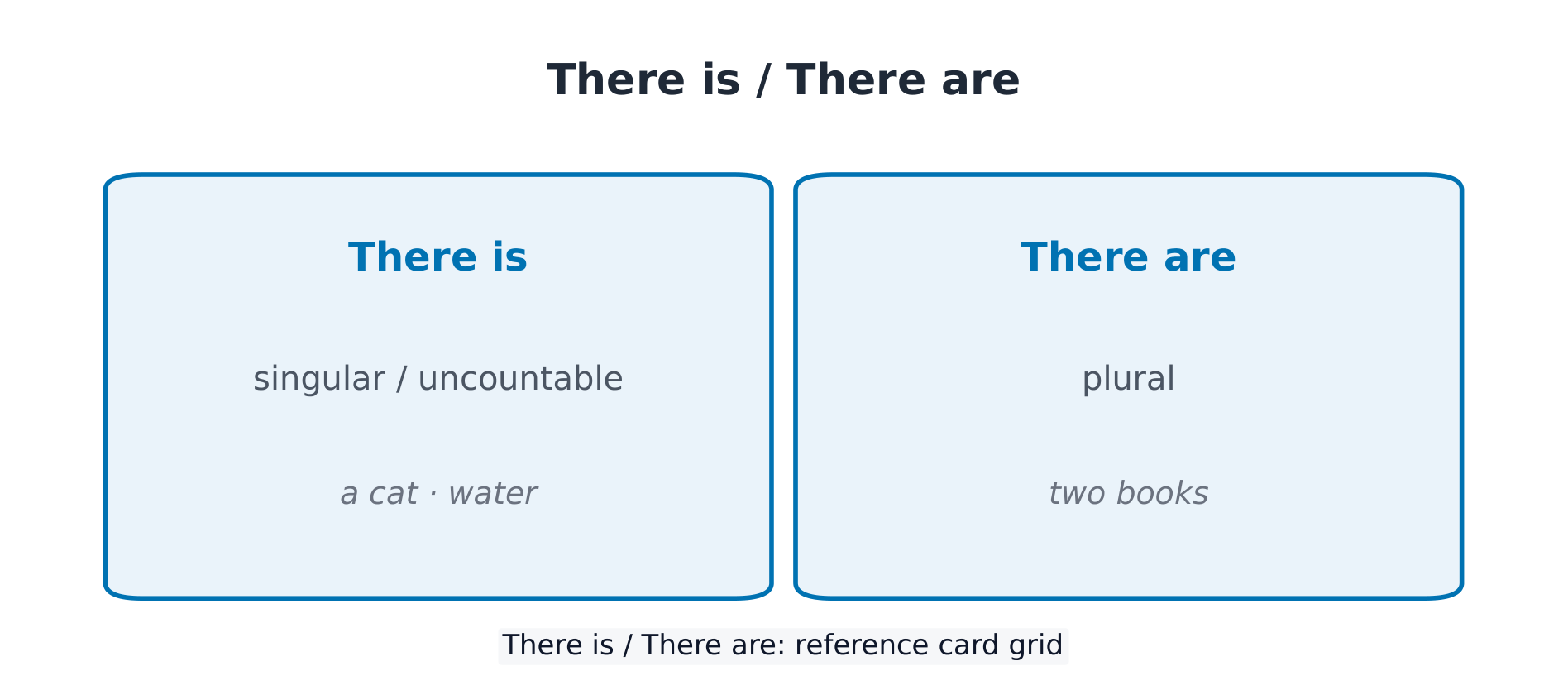
    there is / there are means "there exists" (something exists somewhere).

    • There is + singular / uncountable noun: There is a book.
    • There are + plural noun: There are two books.

    (有)There 有is 一只a 猫cat 在on (冠词)the 沙发上sofa.

    There is a cat on the sofa.

    (有)There 有are 三three 书books 在on (冠词)the 桌上desk.

    There are three books on the table.

    Note: In spoken English, there is is often contracted to there's: There's a problem.

    Русский
    There is (ед.ч.) / There are (мн.ч.)

    there is / there are обозначает «есть / имеются» (существование чего-либо в каком-либо месте).

    • There is + ед.ч. / неисчисляемое существительное: There is a book.
    • There are + мн.ч. существительное: There are two books.

    (有)There 有is 一只a 猫cat 在on (冠词)the 沙发上sofa.

    На диване одна кошка.

    (有)There 有are 三three 书books 在on (冠词)the 桌上desk.

    На столе три книги.

    Примечание: В устной речи there is часто сокращается до there's: There's a problem.

    6.2

    Отрицания и вопросы

    English

    Negative: there is not / there are not (contracted as there isn't / there aren't).

    (有)There 没有isn't 任何any 牛奶milk.

    There is no milk left.

    Question: Move is / are to the front of there.

    (有吗)Is (有)there 一家a 银行bank 附近near 这里here?

    Is there a bank nearby?

    Short answer: Yes, there is. / No, there isn't.

    Note: Use any frequently in negative / question sentences: Is there any water? (Is there any water?)

    Common Errors

    • ❌ ~~Here has many people.~~ → ✓ There are many people here. — The "have" in the Chinese "There are many people here" indicates existence; use there is / there are in English, do not translate literally as have.
    • ❌ ~~There have a book on the desk.~~ → ✓ There is a book on the desk. — Use is / are after there; there have does not exist.
    • ❌ ~~There is two cats.~~ → ✓ There are two cats. — If the following noun is plural, use are.
    • ❌ ~~There are a milk.~~ → ✓ There is some milk. — milk is uncountable: use there is + some, do not use a.
    Русский

    Отрицание: there is not / there are not (сокращения there isn't / there aren't).

    (有)There 没有isn't 任何any 牛奶milk.

    Молока нет.

    Вопрос: перенесите is / are перед there.

    (有吗)Is (有)there 一家a 银行bank 附近near 这里here?

    Здесь есть банк?

    Краткий ответ: Yes, there is. / No, there isn't.

    Примечание: В отрицательных и вопросительных предложениях обычно используется any: Is there any water? (Есть ли вода?)

    Частые ошибки

    • ❌ ~~Here has many people.~~ → ✓ There are many people here. — Русский глагол «есть» в предложении «Здесь много людей» обозначает существование; по-английски используется there is / there are, а не прямой перевод с have. Не переводите как have.
    • ❌ ~~There have a book on the desk.~~ → ✓ There is a book on the desk. — После there используются is / are; конструкции there have не существует.
    • ❌ ~~There is two cats.~~ → ✓ There are two cats. — Так как существительное во множественном числе, используется are. Не используйте is.
    • ❌ ~~There are a milk.~~ → ✓ There is some milk. — milk является неисчисляемым: используйте there is + some, артикль a不可用。
  • 7 have got
    7.1

    have got / has got

    English

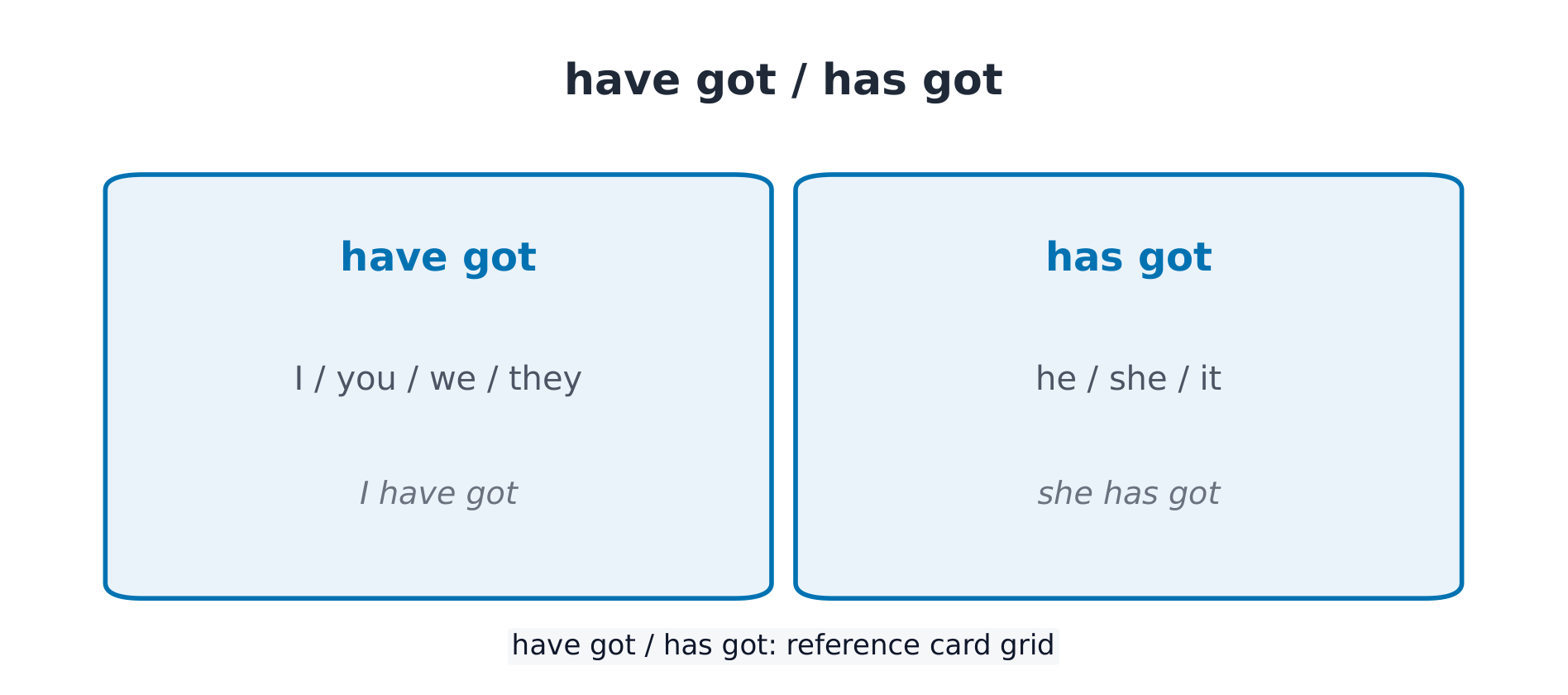
    have got means "to possess" (= have), common in British English.

    • I / you / we / they → have got
    • he / she / it → has got

    我I 有have got 一个a 兄弟brother.

    I have a brother. (= I have a brother.)

    她She 有has got 蓝色blue 眼睛eyes.

    She has blue eyes.

    Note: Often contracted in spoken language: I've got, she's got, they've got. Same meaning as have / has.

    Русский
    have got / has got

    have got означает «обладать» (= have) и очень распространено в британском английском.

    • I / you / we / they → have got
    • he / she / it → has got

    我I 有have got 一个a 兄弟brother.

    У меня есть брат. (= I have a brother.)

    她She 有has got 蓝色blue 眼睛eyes.

    У неё голубые глаза.

    Примечание: В устной речи часто используются сокращения: I've got, she's got, they've got. Они имеют то же значение, что и have / has. Не используйте полные формы в разговоре.

    7.2

    Отрицания и вопросы

    English

    Negative: haven't got / hasn't got.

    他He 没有hasn't got 一辆a 车car.

    He doesn't have a car.

    Question: Move Have / Has to the front of the subject.

    (有吗)Have 你you 有got 一支a 笔pen?

    Do you have a pen?

    Short answer: Yes, I have. / No, I haven't.

    Note: have got is mostly used for current possession; for past or habits, use regular have / had.

    Common Errors

    • ❌ ~~She have got long hair.~~ → ✓ She has got long hair. — Use has got for he / she / it.
    • ❌ ~~I have got not a car.~~ → ✓ I haven't got a car. — Place not after have / has, then contract.
    • ❌ ~~Do you have got a pen?~~ → ✓ Have you got a pen? / Do you have a pen? — Both question forms are correct, but never mix them.
    • ❌ ~~Yes, I have got.~~ → ✓ Yes, I have. — Short answers end at have / has, without got.
    Русский

    Отрицание: haven't got / hasn't got.

    他He 没有hasn't got 一辆a 车car.

    У него нет машины.

    Вопрос: поставьте Have / Has перед подлежащим.

    (有吗)Have 你you 有got 一支a 笔pen?

    У тебя есть ручка?

    Краткий ответ: Yes, I have. / No, I haven't.

    Примечание: Конструкция have got чаще используется для описания состояния обладания в настоящем; при рассказе о прошлом или привычках используйте обычное have / had. Не заменяйте на have got.

    Частые ошибки

    • ❌ ~~She have got long hair.~~ → ✓ She has got long hair. — Для he / she / it используется has got. Не используйте have got.
    • ❌ ~~I have got not a car.~~ → ✓ I haven't got a car. — Отрицательная частица not ставится после have / has, затем используется сокращение. Не ставьте not после got.
    • ~~Do you have got a pen?~~ → ✓ Have you got a pen? / Do you have a pen? — Оба варианта верны, но их нельзя смешивать в одном предложении. Не используйте Do you have got.
    • ❌ ~~Yes, I have got.~~ → ✓ Yes, I have. — В кратком ответе используется только have / has, без got. Не добавляйте got.
  • 8 Present simple
    8.1

    Привычки и третье лицо -s

    English

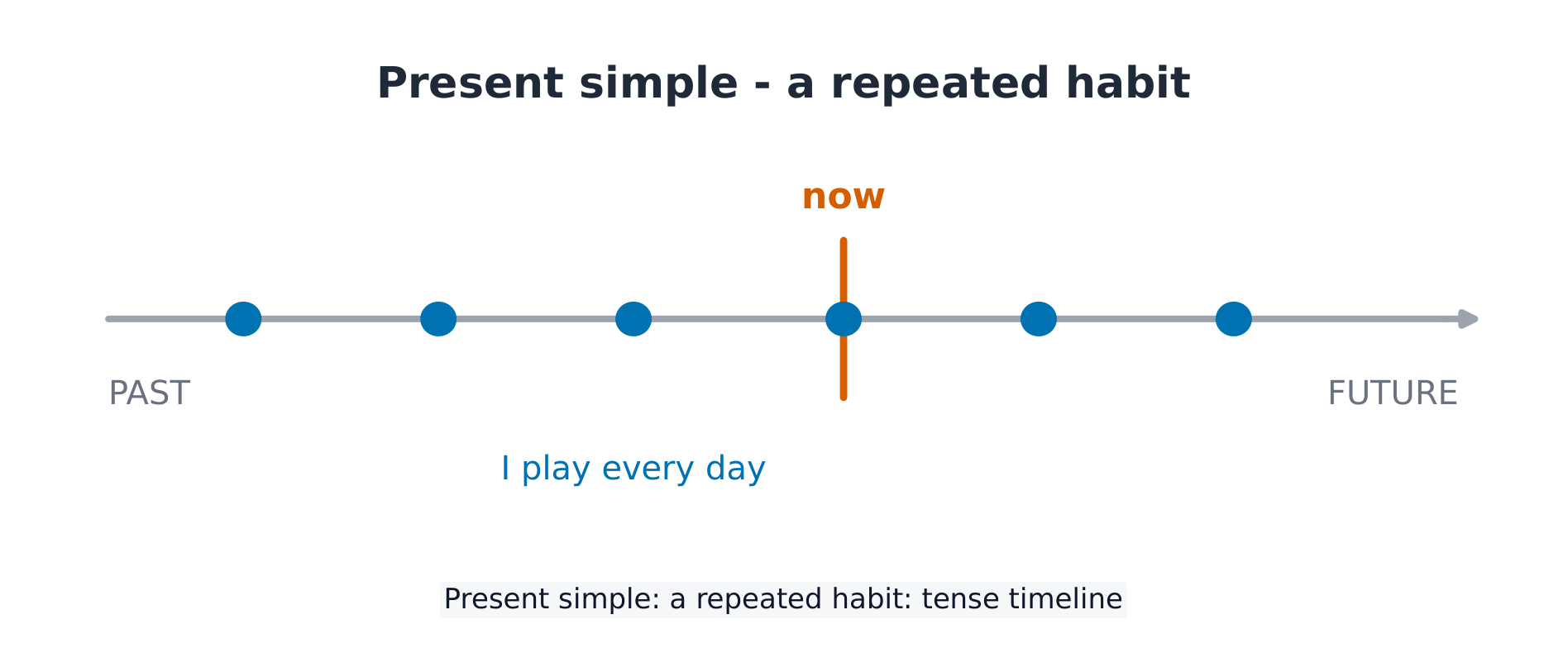
    Present simple (present simple) describes habits and facts. The base form is the infinitive (base verb).

    我I 喜欢like 茶tea.

    I like tea.

    When the subject is he / she / it, add -s to the verb:

    他He 踢plays 足球football.

    He plays football.

    Spelling rules:

    • Generally add -s: like → likes.
    • Words ending in -s / -sh / -ch / -x / -o add -es: go → goes, watch → watches.
    • Consonant + y ending: change y to i and add -es: study → studies.

    Note: Only he / she / it take -s; I / you / we / they use the base form: They like tea.

    Русский
    Настоящее простое: повторяющиеся привычки

    Настоящее простое время (present simple) используется для описания привычек и фактов. Основная форма глагола — это инфинитив (начальная форма). Не изменяйте форму глагола для всех лиц, кроме третьего единственного числа.

    我I 喜欢like 茶tea.

    Я люблю чай.

    Когда подлежащее — he / she / it, к глаголу добавляется окончание -s:

    他He 踢plays 足球football.

    Он играет в футбол.

    Правописание:

    • Обычно добавляется -s: like → likes.
    • Если глагол оканчивается на -s / -sh / -ch / -x / -o, добавляется -es: go → goes, watch → watches.
    • Согласная + y: y меняется на i, добавляется -es: study → studies.

    Примечание: Окончание -s добавляется только к he / she / it; для I / you / we / they используется начальная форма: They like tea. Не добавляйте -s к другим лицам.

    8.2

    Отрицания и вопросы

    English

    For negatives and questions, use auxiliary verbs do / does (does for he / she / it).

    Negative: Subject + don't / doesn't + base verb.

    我I 不don't 喜欢like 咖啡coffee.

    I don't like coffee.

    Question: Do / Does + Subject + base verb ?

    (助动词)Does 她she 住live 这里here?

    Does she live here?

    Note: When using do / does, the verb returns to its base form (no -s): ~~Does she lives~~ ✗ → Does she live ✓.

    Common Errors

    • ❌ ~~He go to school by bus.~~ → ✓ He goes to school by bus. — Forgetting to add -s in third person singular is the most frequent error; check your work afterwards.
    • ❌ ~~She doesn't likes coffee.~~ → ✓ She doesn't like coffee. — When using does / doesn't, the verb returns to its base form.
    • ❌ ~~I very like English.~~ → ✓ I like English very much. — "Very much" in Chinese cannot be translated literally; very cannot directly modify a verb.
    • ❌ ~~You like tea?~~ → ✓ Do you like tea? — Questions must start with do / does; rising intonation alone is insufficient.
    Русский
    日常习惯:I have breakfast every morning.

    Для построения отрицаний и вопросов используется вспомогательный глагол do / does (he / she / it использует does). Не опускайте вспомогательный глагол.

    Отрицание: подлежащее + don't / doesn't + начальная форма глагола.

    我I 不don't 喜欢like 咖啡coffee.

    Я не люблю кофе.

    Вопрос: Do / Does + подлежащее + начальная форма глагола ?

    (助动词)Does 她she 住live 这里here?

    Она живёт здесь?

    Примечание: При использовании do / does основной глагол возвращается в начальную форму (без -s): ~~Does she lives~~ ✗ → Does she live ✓. Не используйте -s после does.

    Частые ошибки

    • ❌ ~~He go to school by bus.~~ → ✓ He goes to school by bus. — Забывание окончания -s для третьего лица единственного числа — самая частая ошибка. Проверяйте себя после написания. Не пропускайте -s.
    • ❌ ~~She doesn't likes coffee.~~ → ✓ She doesn't like coffee. — При использовании does / doesn't глагол возвращается в начальную форму. Не добавляйте -s.
    • ~~I very like English.~~ → ✓ I like English very much. — Фразу «очень люблю» нельзя дословно переводить как very like; наречие very не может напрямую修饰动词. Используйте very much.
    • ❌ ~~You like tea?~~ → ✓ Do you like tea? — Вопросительные предложения должны начинаться с do / does, просто повышения тона недостаточно. Не стройте вопросы без do/does.
  • 9 can
    9.1

    Способности и просьбы

    English

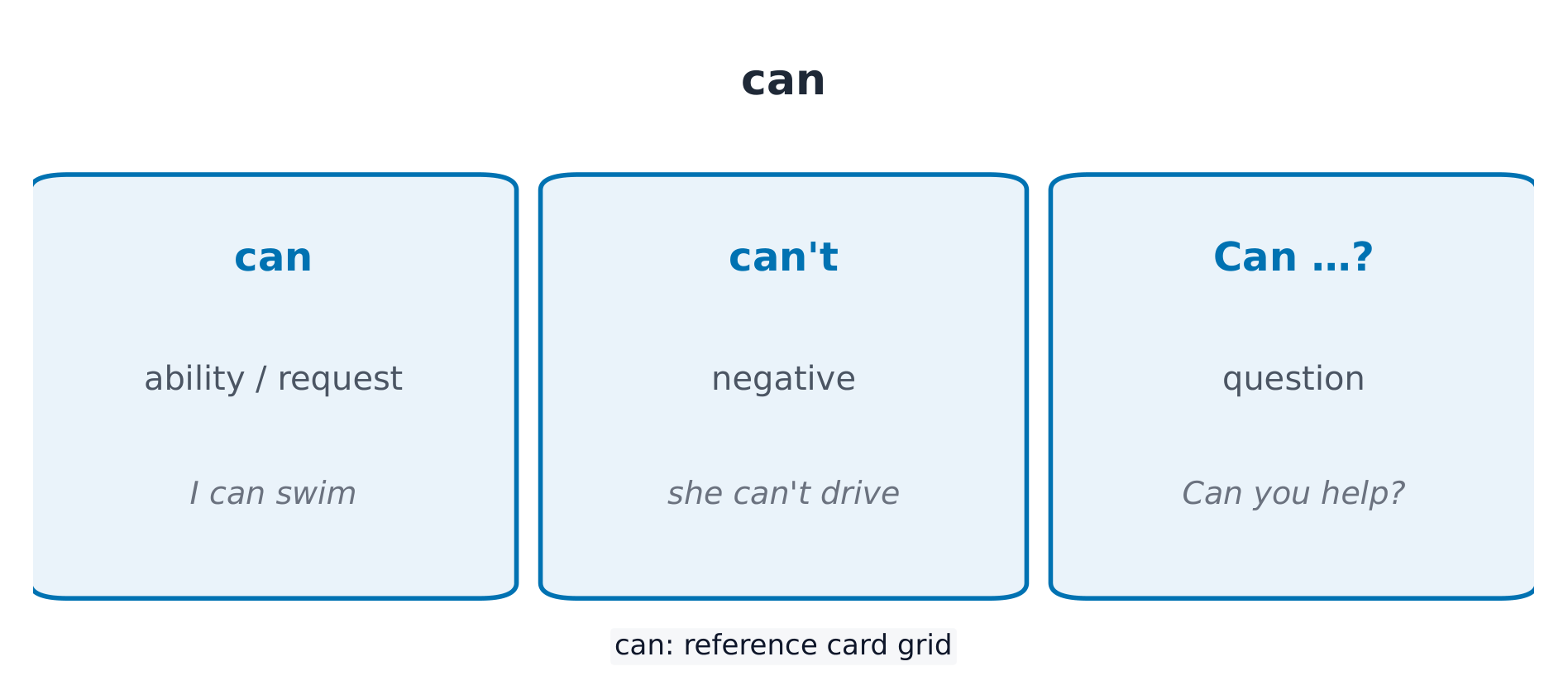
    can expresses ability ("know how to / be able to") or is used for requests. It is followed by the base form of the verb, and remains the same for all persons.

    我I 会can 游泳swim.

    I can swim.

    能Can 你you 帮help 我me?

    Can you help me?

    Note: Use the base form after can: ~~can to swim~~ ✗, ~~can swims~~ ✗ → can swim ✓.

    Русский
    can:能力、否定、疑问

    can обозначает способность («умею / могу») или используется для просьбы. После него всегда ставится начальная форма глагола; форма одинакова для всех лиц. Не добавляйте -s и не используйте инфинитив с to.

    我I 会can 游泳swim.

    Я умею плавать.

    能Can 你you 帮help 我me?

    Ты можешь мне помочь?

    Примечание: После can используется начальная форма: ~~can to swim~~ ✗、~~can swims~~ ✗ → can swim ✓. Не используйте to или -s после can.

    9.2

    Отрицания и вопросы

    English

    Negative: cannot (abbreviation can't) + base form of the verb.

    她She 不会can't 开车drive.

    She cannot drive.

    Question: Place Can before the subject.

    能Can 他he 做饭cook?

    Can he cook?

    Short answer: Yes, I can. / No, I can't.

    Note: can has no -s and does not use do/does: ask directly with Can he…?, not ~~Does he can…?~~

    Common Errors

    • ❌ ~~She cans drive.~~ → ✓ She can drive. — can has no third-person singular -s; it is the same for all persons.
    • ❌ ~~I don't can swim.~~ → ✓ I can't swim. — The negative of can is formed directly with not (can't), without using don't.
    • ❌ ~~He can sings very good.~~ → ✓ He can sing very well. — Use the base form of the verb after can; use the adverb well to modify a verb, not good.
    • ❌ ~~You can help me?~~ → ✓ Can you help me? — When making a request, place can before the subject.
    Русский

    Отрицание: cannot (сокращение can't) + начальная форма глагола.

    她She 不会can't 开车drive.

    Она не умеет водить машину.

    Вопрос: поставьте Can перед подлежащим.

    能Can 他he 做饭cook?

    Он умеет готовить?

    Краткий ответ: Yes, I can. / No, I can't.

    Примечание: У can нет окончания -s и он не требует do / does: вопрос строится как Can he…?, а не ~~Does he can…?~~ Не используйте do/does с can.

    Частые ошибки

    • ❌ ~~She cans drive.~~ → ✓ She can drive. — У can нет окончания -s для третьего лица; форма одинакова для всех лиц. Не добавляйте -s.
    • ❌ ~~I don't can swim.~~ → ✓ I can't swim. — Отрицание can образуется добавлением not (can't), вспомогательный don't не используется. Не используйте don't can.
    • ❌ ~~He can sings very good.~~ → ✓ He can sing very well. — После can используется начальная форма глагола; для修饰动词 используйте наречие well, а не прилагательное good. Не используйте sings или good.
    • ❌ ~~You can help me?~~ → ✓ Can you help me? — При просьбе перенесите can перед подлежащим. Не стройте вопросы без инверсии.
  • 10 Imperatives · ⁨Императивы⁩
    10.1

    Приказы и указания

    English

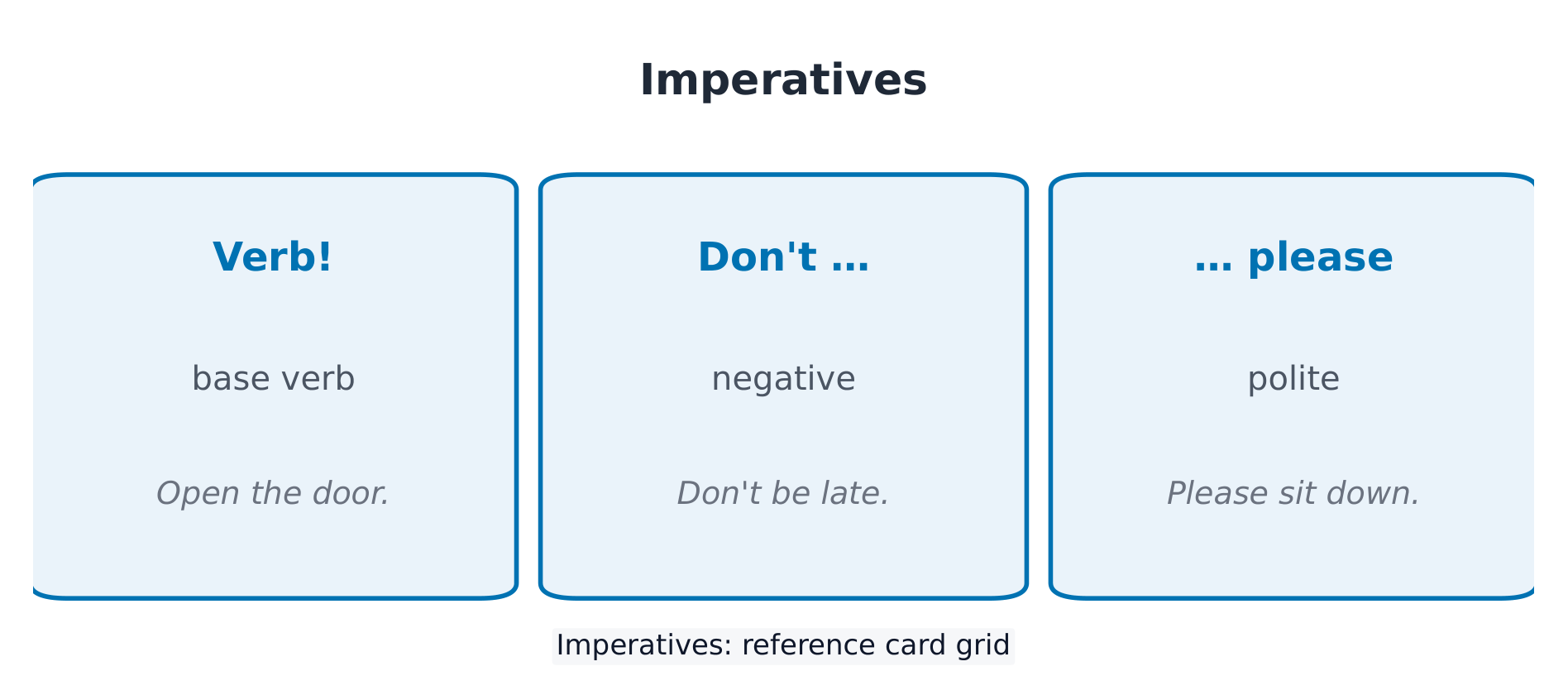
    Imperatives are used to give commands, provide instructions, or make requests. Start directly with the base form of the verb, without a subject.

    打开Open (冠词)the 门door 请, please.

    Please open the door.

    坐Sit 下down.

    Sit down.

    Negative: Add Don't at the beginning.

    不要Don't (是)be 迟到late.

    Don't be late.

    Key Usage Points:

    • Add please to be more polite: Please come in.
    • Also used for directions and instructions: Turn left. Mix the eggs.

    Note: Do not write a subject in imperatives: ~~You open the door~~ (for a command) → Open the door.

    Common Errors

    • ❌ ~~Please open door.~~ → ✓ Please open the door. — Articles must still be included in imperatives.
    • ❌ ~~Don't to touch it.~~ → ✓ Don't touch it. — Follow don't directly with the base form of the verb; do not add to.
    • ❌ ~~No talk in class!~~ → ✓ Don't talk in class! / No talking! — To prohibit an action, use don't + base form; after no, use -ing or a noun.
    • ❌ ~~You sit down!~~ → ✓ Sit down, please. — Adding you to a command sounds angry; add please for politeness, or change to Can you…?
    Русский
    Повелительное наклонение: приказы, отрицания, просьбы

    Повелительное наклонение (imperatives) используется для отдачи приказов, дачи указаний или выражения просьб. Начинайте предложение с начальной формы глагола, подлежащее не пишется. Не добавляйте you.

    打开Open (冠词)the 门door 请, please.

    Пожалуйста, открой дверь.

    坐Sit 下down.

    Сядь.

    Отрицание: перед глаголом ставится Don't.

    不要Don't (是)be 迟到late.

    Не опаздывай.

    Ключевые моменты использования:

    • Добавление please делает фразу более вежливой: Please come in. (Пожалуйста, войдите.)
    • Также используется в маршрутах и инструкциях: Turn left. (Поверните налево.) Mix the eggs. (Размешайте яйца.)

    Примечание: В повелительном наклонении не пишется подлежащее: ~~You open the door~~ (при приказе) → Open the door. Не добавляйте you.

    Частые ошибки

    • ❌ ~~Please open door.~~ → ✓ Please open the door. — Артикли также обязательны в повелительном наклонении. Не пропускайте артикли.
    • ❌ ~~Don't to touch it.~~ → ✓ Don't touch it. — После don't сразу ставится начальная форма глагола, частица to не нужна. Не используйте to.
    • ❌ ~~No talk in class!~~ → ✓ Don't talk in class! / No talking! — Для запрета действия используйте don't + начальная форма; после no требуется -ing-форма или существительное. Не используйте No + инфинитив.
    • ❌ ~~You sit down!~~ → ✓ Sit down, please. — Добавление you в повелительной форме звучит грубо; для вежливости добавьте please или переформулируйте как вопрос Can you…?. Избегайте You.
  • 11 Question words · ⁨Вопросительные слова⁩
    11.1

    what, where, who

    English

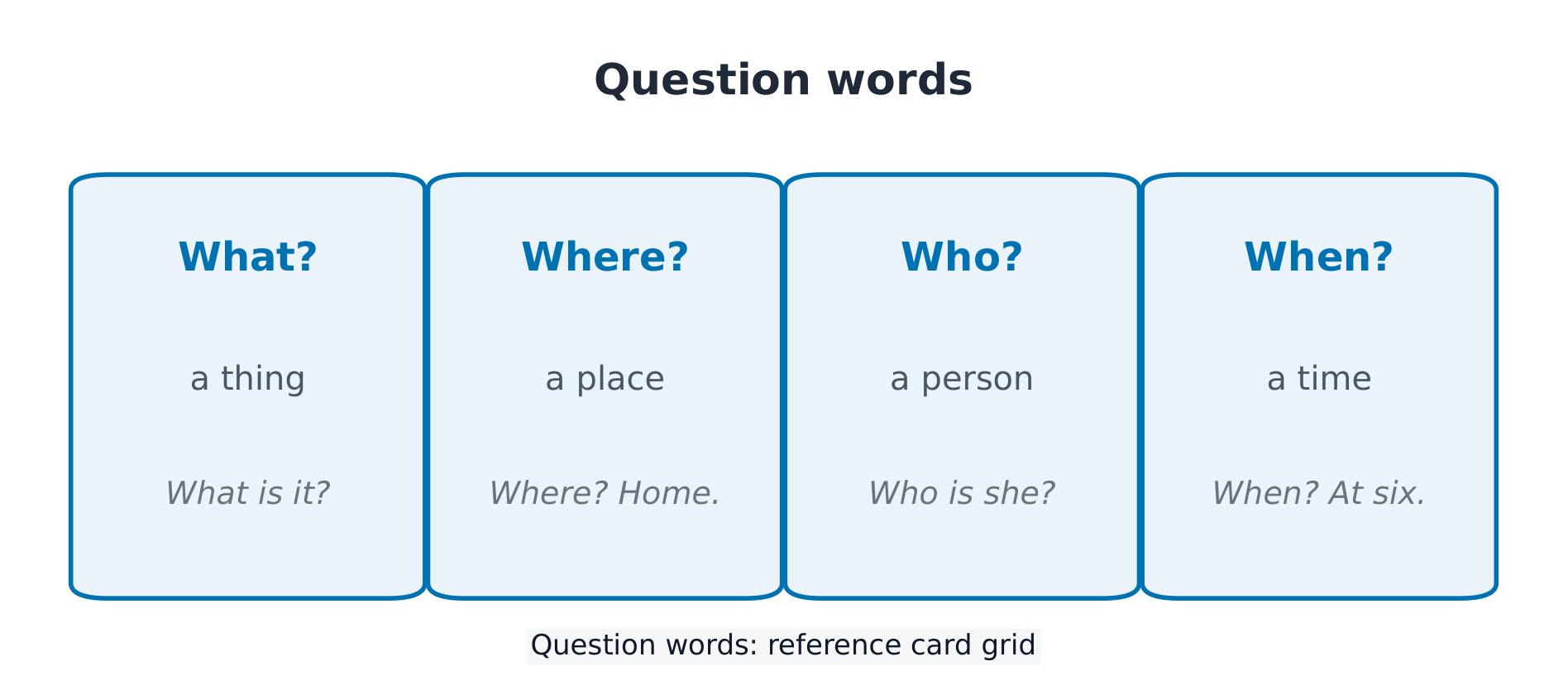
    Question words are placed at the beginning of a question to ask for specific information.

    • what (what), where (where), who (who)

    什么What 是is 你的your 名字name?

    What's your name?

    哪里Where (助动词)do 你you 住live?

    Where do you live?

    谁Who 是is 那个that 男人man?

    Who is that man?

    Note: A be verb or auxiliary do/does often follows the question word: Where do you work?

    Русский
    Вопросительные слова: вещи/места/люди/время

    Вопросительные слова (question words) ставятся в начало вопроса для уточнения конкретной информации.

    • what (что), where (где), who (кто)

    什么What 是is 你的your 名字name?

    Как тебя зовут?

    哪里Where (助动词)do 你you 住live?

    Где ты живёшь?

    谁Who 是is 那个that 男人man?

    Кто этот мужчина?

    Внимание После вопросительного слова часто ставятся глагол be или вспомогательный глагол do / does: Where do you work?

    11.2

    when, why, how

    English
    • when (when), why (why), how (how / in what way)

    什么时候When 是is (冠词)the 派对party?

    When is the party?

    为什么Why (是)are 你you 难过sad?

    Why are you sad?

    怎么How (助动词)do 你you 拼写spell 它it?

    How do you spell this?

    Note: how can also combine with adjectives to ask about degree: How old are you? How much is it?

    Common Errors

    • ❌ ~~Where you live?~~ → ✓ Where do you live? — After the question word, you still need do/does or be; you cannot follow directly with the subject.
    • ❌ ~~What means this word?~~ → ✓ What does this word mean? — mean is an ordinary verb: question word + does + subject + base form.
    • ❌ ~~Why you are late?~~ → ✓ Why are you late? — When there is a be verb in the sentence, move be before the subject.
    • ❌ ~~How to spell it?~~ → ✓ How do you spell it? — A literal translation of "How to spell?" loses the subject and auxiliary verb; these must be added.
    Русский
    • when(когда), why(почему), how(как / каким образом)

    什么时候When 是is (冠词)the 派对party?

    Когда вечеринка?

    为什么Why (是)are 你you 难过sad?

    Почему ты грустный?

    怎么How (助动词)do 你you 拼写spell 它it?

    Как пишется это слово?

    Внимание how также может сочетаться с прилагательным для вопроса о степени: How old are you?(Сколько тебе лет?) How much is it?(Сколько это стоит?)

    Частые ошибки

    • ❌ ~~Where you live?~~ → ✓ Where do you live? — После вопросительного слова также нужны do / does или be; нельзя ставить подлежащее сразу.
    • ❌ ~~What means this word?~~ → ✓ What does this word mean? — mean является обычным глаголом: вопросительное слово + does + подлежащее + начальная форма.
    • ❌ ~~Why you are late?~~ → ✓ Why are you late? — Если в предложении есть глагол be, его нужно вынести перед подлежащим.
    • ❌ ~~How to spell it?~~ → ✓ How do you spell it? — Прямой перевод «как написать?» на китайский упускает подлежащее и вспомогательный глагол, поэтому их необходимо добавить.
  • 12 Prepositions of place · ⁨Предлоги места⁩
    12.1

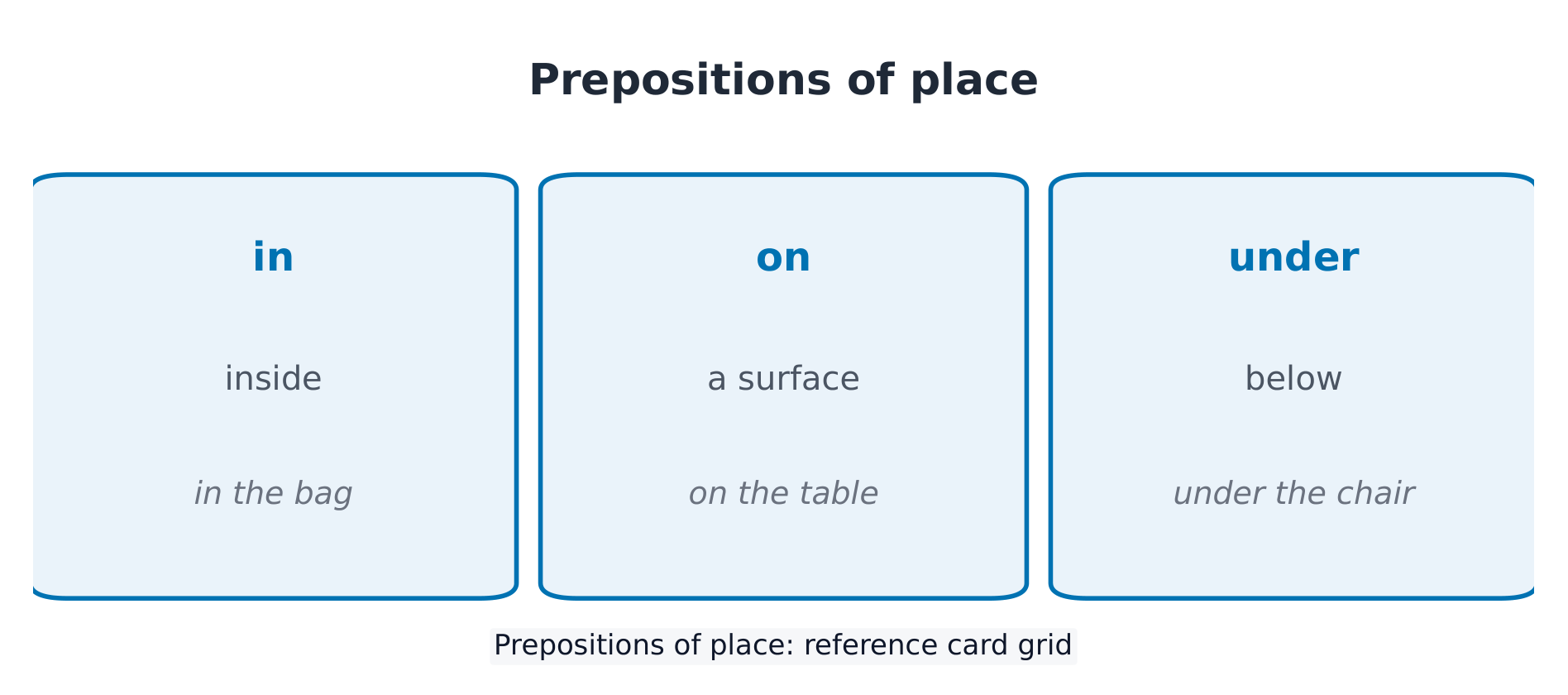
    in, on, under

    English

    Prepositions of place indicate where something is located.

    • in (inside...), on (on top of... / surface), under (below...)

    (冠词)The 钥匙keys 在are 在...里in (冠词)the 包里bag.

    The key is in the bag.

    (冠词)The 书book 在is 在...上on (冠词)the 桌上table.

    The book is on the table.

    (冠词)The 猫cat 在is 在...下under (冠词)the 椅子下chair.

    The cat is under the chair.

    Русский
    Предлоги места: in / on / under

    Предлоги места (prepositions of place) указывают, где находится предмет.

    • in(внутри), on(на поверхности / сверху), under(под чем-либо)

    (冠词)The 钥匙keys 在are 在...里in (冠词)the 包里bag.

    Ключи в сумке.

    (冠词)The 书book 在is 在...上on (冠词)the 桌上table.

    Книги на столе.

    (冠词)The 猫cat 在is 在...下under (冠词)the 椅子下chair.

    Кошка под стулом.

    12.2

    next to, between, behind

    English
    • next to (beside...), between (between...), behind (behind...), in front of (in front of...)

    (冠词)The 商店shop 在is 旁边next to (冠词)the 银行bank.

    The shop is next to the bank.

    她She 坐sits 之间between 汤姆Tom 和and 萨姆Sam.

    She sits between Tom and Sam.

    Note: between means "between two," and is usually followed by A and B: between the door and the window.

    Common Errors

    • ❌ ~~The picture is in the wall.~~ → ✓ The picture is on the wall. — Hanging "on" the wall involves surface contact, so use on.
    • ❌ ~~I read it on the book.~~ → ✓ ...in the book. — Content "inside" a book uses in; people in photos also use in the photo.
    • ❌ ~~The shop is next the bank.~~ → ✓ next to the bank — next to is two words; to cannot be omitted.
    • ❌ ~~between the door with the window~~ → ✓ between the door and the window — between takes the fixed collocation A and B.
    Русский
    • next to(рядом с), between(между), behind(за), in front of(перед)

    (冠词)The 商店shop 在is 旁边next to (冠词)the 银行bank.

    Магазин рядом с банком.

    她She 坐sits 之间between 汤姆Tom 和and 萨姆Sam.

    Она сидит между Томом и Сэмом.

    Внимание between означает «между двумя», после него обычно используется конструкция A and B: between the door and the window.

    Частые ошибки

    • ❌ ~~The picture is in the wall.~~ → ✓ The picture is on the wall. — Картина висит на стене («сверху»), то есть происходит контакт с поверхностью, используется on.
    • ❌ ~~I read it on the book.~~ → ✓ …in the book. — Содержание книги обозначается in; люди на фотографии также обозначаются как in the photo.
    • ❌ ~~The shop is next the bank.~~ → ✓ next to the bank — next to состоит из двух слов, частицу to нельзя опускать.
    • ❌ ~~between the door with the window~~ → ✓ between the door and the window — между является устойчивым сочетанием A and B.

Log in or create account · ⁨Войти или создать аккаунт⁩

IGCSE, A-Level & AP