The Solar System · O Sistema Solar
| English | Português |
|---|---|
| Solar System/ˈsəʊlə ˈsɪstəm/ | Sistema Solar |
| planets/ˈplænɪts/ | planetas |
| asteroids/ˈæstərɔɪdz/ | asteroides |
| comets/ˈkɒmɪts/ | cometas |
| rocky/ˈrɒki/ | rochosos |
| gas giants/ɡæs ˈdʒaɪənts/ | gigantes gasosos |
| satellites/ˈsætəlaɪts/ | satélites |
| ellipses/ɪˈlɪpsɪz/ | elipses |
| accretion/əˈkreʃn/ | acréscão |
The Sun's family
- At the centre of the Solar System 太阳系 is one star — the Sun.
- Around it move eight planets 行星, plus moons, asteroids 小行星 and comets 彗星.
- Gravity holds the whole family together.
A família do Sol
- No centro do Sistema Solar 太阳系 está uma estrela — o Sol.
- Ao redor dele movem-se oito planetas 行星, além de luas, asteroides 小行星 e cometas 彗星.
- A gravidade mantém toda a família unida.
The eight planets
- In order from the Sun: Mercury, Venus, Earth, Mars, Jupiter, Saturn, Uranus, Neptune.
- The four inner planets are small and rocky 岩石.
- The four outer planets are large and gaseous (no solid surface).
- Jupiter and Saturn are gas giants 气态巨行星; Uranus and Neptune are ice giants.
Jupiter, the largest planet, with its swirling bands of gas
Os oito planetas
- Em ordem a partir do Sol: Mercúrio, Vênus, Terra, Marte, Júpiter, Saturno, Urano, Netuno.
- Os quatro planetas internos são pequenos e rochosos 岩石.
- Os quatro externos são grandes e gasosos (sem superfície sólida).
- Júpiter e Saturno são gigantes gasosos 气态巨行星; Urano e Netuno são gigantes de gelo.

Júpiter, o maior planeta, com suas faixas giratórias de gás
Watch the planets race · Assista aos planetas correrem
The closer a planet is to the Sun, the faster it orbits — Mercury in 88 days, Jupiter in 12 years — because the Sun's gravity is stronger close in. · Quanto mais próximo um planeta está do Sol, mais rápido ele orbita — Mercúrio em 88 dias, Júpiter em 12 anos — porque a gravidade do Sol é mais forte perto dele.
Put these planets in order, nearest the Sun first. · Coloque estes planetas em ordem, do mais próximo ao Sol primeiro.
From the Sun: Mercury, Venus, Earth, Mars, Jupiter, Saturn, Uranus, Neptune — so of these, Mercury, Earth, Jupiter, Neptune. · Do Sol: Mercúrio, Vênus, Terra, Marte, Júpiter, Saturno, Urano, Netuno — portanto, destes, Mercúrio, Terra, Júpiter, Netuno.
How do the inner and outer planets differ? · Como os planetas internos e externos diferem?
The four inner planets are small and rocky; the four outer planets are large and gaseous (gas giants and ice giants). · Os quatro planetas internos são pequenos e rochosos; os quatro planetas externos são grandes e gasosos (gigantes gasosos e gigantes de gelo).
Other objects
- Dwarf planets (like Pluto) and asteroids — most asteroids lie in a belt between Mars and Jupiter.
- Moons (natural satellites 卫星) that orbit the planets.
- Comets — small icy bodies on very stretched orbits.
A giant telescope fires a laser to study the night sky
Outros objetos
- Planetas anões (como Plutão) e asteroides — a maioria dos asteroides fica em um cinturão entre Marte e Júpiter.
- Luas (satélites naturais 卫星) que orbitam os planetas.
- Cometas — corpos gelados pequenos em órbitas muito alongadas.

Um telescópio gigante dispara um laser para estudar o céu noturno
Orbits and gravity
- The Sun's gravity reaches out and keeps the planets in orbit; it is weaker further out, so outer planets orbit more slowly.
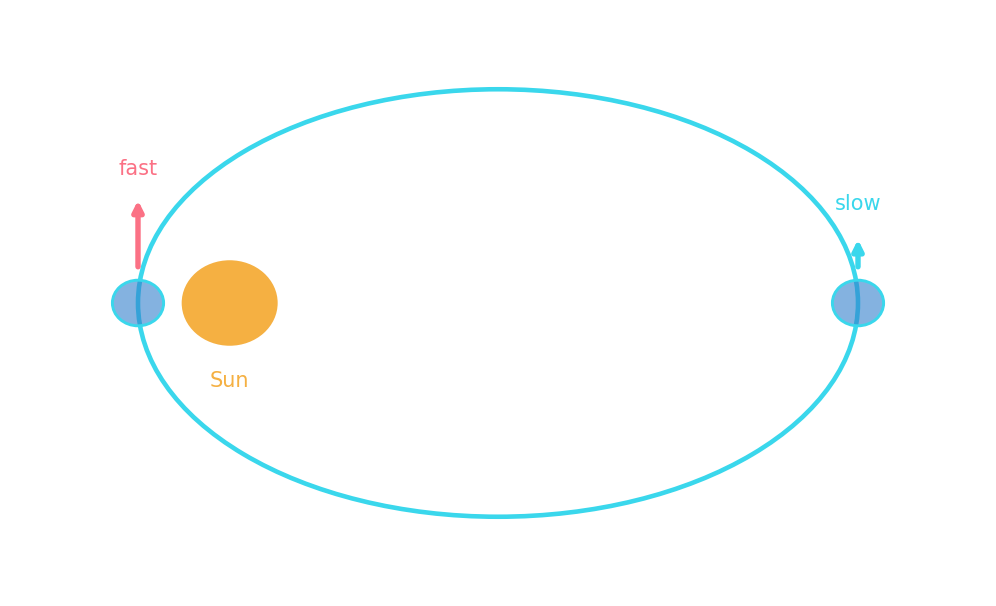
- Most orbits are ellipses 椭圆 (stretched circles), with the Sun at one focus (not the centre).
- A planet moves faster when closer to the Sun: as its gravitational PE falls, its kinetic energy rises (energy is conserved).
Órbitas e gravidade
- A gravidade do Sol se estende e mantém os planetas em órbita; ela é mais fraca mais longe, então planetas externos orbitam mais lentamente.
- A maioria das órbitas são elipses 椭圆 (círculos alongados), com o Sol em um foco (não no centro).
- Um planeta move-se mais rápido quando mais próximo do Sol: à medida que sua energia potencial gravitacional cai, sua energia cinética aumenta (a energia é conservada).
What keeps the planets in their orbits around the Sun? · O que mantém os planetas em suas órbitas ao redor do Sol?
The Sun holds most of the mass of the Solar System, and its gravity pulls the planets into orbit. · O Sol detém a maior parte da massa do Sistema Solar, e sua gravidade puxa os planetas para órbita.
A planet on an elliptical orbit moves fastest when it is: · Um planeta em uma órbita elíptica move-se mais rapidamente quando está:
As the planet comes closer, its gravitational PE falls and its kinetic energy rises (energy is conserved), so it speeds up. · À medida que o planeta se aproxima, sua energia potencial gravitacional diminui e sua energia cinética aumenta (energia é conservada), então ele acelera.
Light travel time and how it formed
- Space is huge, so we use light travel time: $\text{time} = \dfrac{\text{distance}}{\text{speed}}$, with light at $3.0 \times 10^8\ \text{m/s}$.
- Sunlight takes about 8 minutes to reach Earth.
- The Solar System formed by accretion 吸积: gravity pulled a spinning cloud of gas and dust into a disc; most fell to the centre to form the Sun, and the planets grew from the rest.
- Near the hot young Sun only rock and metal stayed solid → rocky inner planets; far out, gases collected too → giant outer planets.
The Solar System
Tempo de viagem da luz e como se formou
- O espaço é imenso, então usamos o tempo de viagem da luz: $\text{time} = \dfrac{\text{distance}}{\text{speed}}$, com a luz viajando a $3.0 \times 10^8\ \text{m/s}$.
- A luz solar leva cerca de 8 minutos para chegar à Terra.
- O Sistema Solar se formou por acréscimo 吸积: a gravidade puxou uma nuvem giratória de gás e poeira para um disco; a maioria caiu no centro para formar o Sol, e os planetas cresceram do resto.
- Perto do Sol jovem e quente apenas rocha e metal permaneceram sólidos → planetas internos rochosos; mais longe, gases também se acumularam → gigantes externos.

O Sistema Solar
The Sun is about $1.5 \times 10^{11}\ \text{m}$ away. How long does its light take to reach Earth, in seconds? (light speed $3.0 \times 10^8\ \text{m/s}$) · O Sol está a cerca de $1.5 \times 10^{11}\ \text{m}$ de distância. Quanto tempo a luz leva para chegar à Terra, em segundos? (velocidade da luz $3.0 \times 10^8\ \text{m/s}$)
$\text{time} = \dfrac{d}{v} = \dfrac{1.5 \times 10^{11}}{3.0 \times 10^8} = 500\ \text{s}$ (about 8 minutes). · $\text{time} = \dfrac{d}{v} = \dfrac{1.5 \times 10^{11}}{3.0 \times 10^8} = 500\ \text{s}$ (cerca de 8 minutos).
Why are the inner planets rocky? · Por que os planetas internos são rochosos?
Close to the hot Sun, gases could not condense — only rock and metal stayed solid, so the inner planets are rocky. · Perto do Sol quente, os gases não puderam condensar — apenas rocha e metal permaneceram sólidos, então os planetas internos são rochosos.
You've got it
- eight planets: four rocky inner, four gaseous outer (gas giants + ice giants)
- the Sun's gravity holds the planets; outer ones orbit slower
- orbits are ellipses with the Sun at a focus; planets move faster when closer
- light from the Sun takes ~8 min; the system formed by accretion of gas and dust
Entendeu?
- oito planetas: quatro rochosos internos, quatro gasosos externos (gigantes gasosos + gigantes de gelo)
- a gravidade do Sol segura os planetas; os externos orbitam mais lentamente
- as órbitas são elipses com o Sol em um foco; os planetas se movem mais rápido quando mais próximos
- a luz do Sol leva ~8 min; o sistema se formou por acréscimo de gás e poeira