The magnetic effect of a current and the motor · O efeito magnético de uma corrente e o motor
| English | Português |
|---|---|
| solenoid/ˈsəʊlənɔɪd/ | solenoide |
| d.c. motor/ˌdiː ˈsiː ˈməʊtə/ | motor CC |
| motor effect/ˈməʊtə ɪˈfekt/ | efeito motor |
| left-hand rule/left hænd ruːl/ | regra da mão esquerda |
| commutator/ˈkɒmjuːteɪtə/ | comutador |
Electricity makes magnetism
- A wire carrying a current creates a magnetic field around itself.
- Put that wire in another magnet's field and it feels a force — the idea behind every electric motor.
- This is where electricity and magnetism meet.
Eletricidade gera magnetismo
- Um fio que percorre uma corrente cria um campo magnético à sua volta.
- Coloque esse fio num campo magnético e ele sentirá uma força — o princípio por trás de todo motor elétrico.
- É aqui que a eletricidade e o magnetismo se encontram.
The magnetic effect of a current
- A current in a straight wire makes circular field lines around it; reverse the current and the field reverses.
- A solenoid 螺线管 (a long coil) makes a field just like a bar magnet, with a N and a S pole.
- Make it stronger by: more current, more turns, or a soft-iron core.
- Used in relays and loudspeakers.
A d.c. motor 直流电动机
O efeito magnético de uma corrente
- Uma corrente num fio reto produz linhas de campo circulares à sua volta; inverte-se a corrente e o campo inverte-se.
- Um solenoide 螺线管 (uma bobina longa) produz um campo igual ao de um íman em barra, com polo N e polo S.
- Torne-o mais forte com: mais corrente, mais espiras ou um núcleo de ferro mole.
- Usado em relés e alto-falantes.

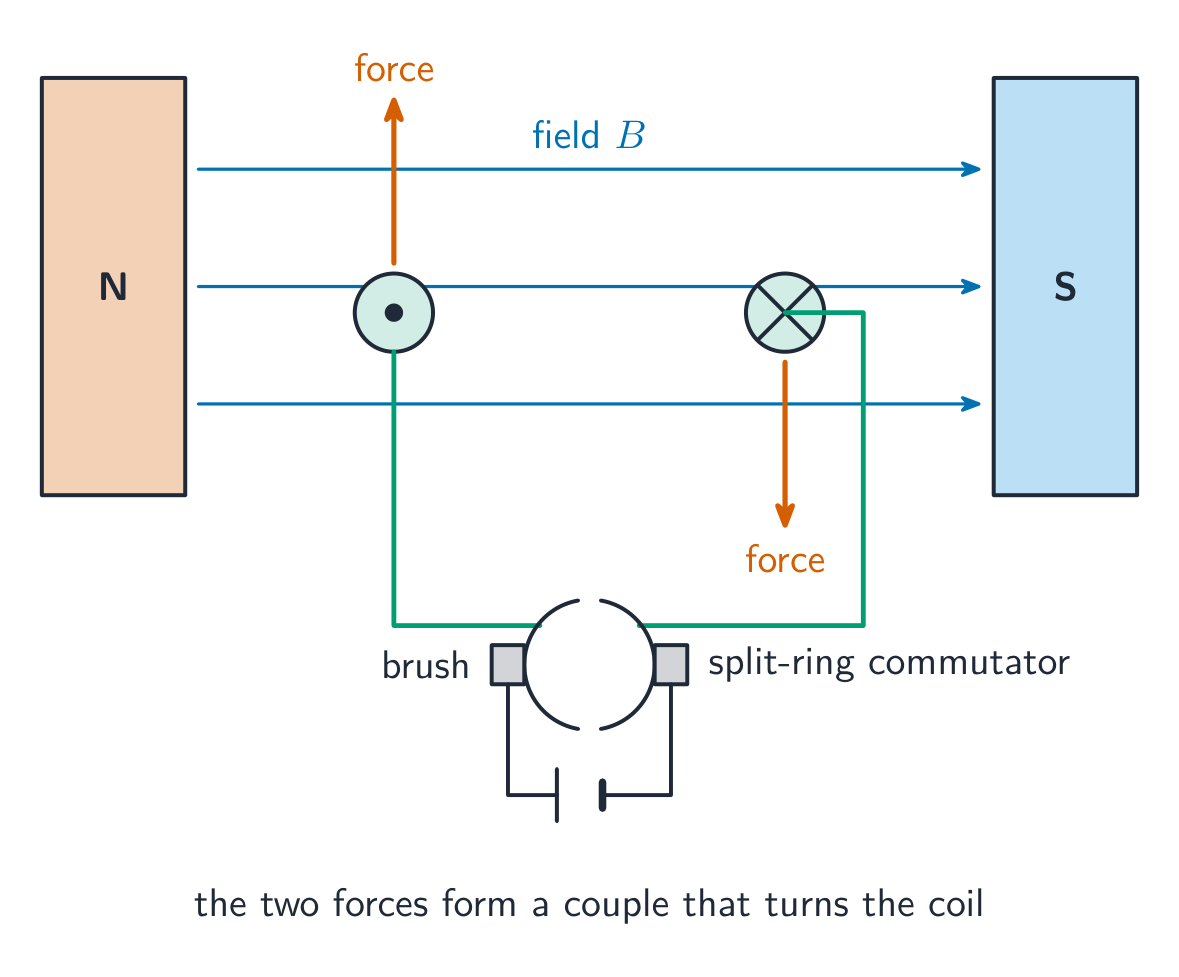
Um motor c.c. 直流电动机
The force that spins a motor · A força que faz um motor girar
A current in a magnetic field is pushed at right angles to both — reverse the current or flip the magnet and it pushes the other way. That is what turns a motor. · Uma corrente em um campo magnético é empurrada perpendicularmente a ambos — inverta a corrente ou vire o ímã e ele empurra na outra direção. É isso que faz um motor girar.
The magnetic field of a solenoid (a long coil carrying current) looks like the field of: · O campo magnético de um solenóide (uma bobina longa percorrida por corrente) parece-se com o campo de:
A solenoid produces a bar-magnet-like field, with a north pole at one end and a south at the other. · Um solenóide produz um campo semelhante ao de um ímã de barra, com polo norte em uma extremidade e sul na outra.
Which change makes an electromagnet stronger? · Qual mudança torna um eletroímã mais forte?
More current, more turns, and a soft-iron core all make the field stronger. · Mais corrente, mais espiras e um núcleo de ferro mole tornam o campo mais forte.
The motor effect 电动机效应
- A current-carrying wire in a magnetic field feels a force — the motor effect.
- Reverse the current, or reverse the field, and the force reverses.
- A bigger current or stronger field gives a bigger force; the force is greatest when the wire is at right angles to the field.
- Find the direction with the left-hand rule 左手定则: thumb = force, first finger = field (N→S), second finger = current.
O efeito do motor 电动机效应
- Um fio percorrido por corrente num campo magnético sente uma força — o efeito do motor.
- Inverta a corrente, ou inverta o campo, e a força inverte-se.
- Uma corrente maior ou um campo mais forte dá uma força maior; a força é máxima quando o fio está em ângulo reto ao campo.
- Encontre a direção com a regra da mão esquerda 左手定则: polegar = força, dedo indicador = campo (N→S), dedo médio = corrente.

In the motor effect, reversing the current direction: · No efeito motor, inverter a direção da corrente:
Reversing either the current or the field reverses the force. Reversing both leaves it unchanged. · Inverter either a corrente ou o campo inverte a força. Inverter ambos deixa inalterada.
In Fleming's left-hand rule, the thumb points in the direction of the: · Na regra da mão esquerda de Fleming, o polegar aponta na direção da:
Thumb = force, first finger = field, second finger = current — all at right angles. · Polegar = força, primeiro dedo = campo, segundo dedo = corrente — todos em ângulos retos.
The force on a current-carrying wire is greatest when the wire is at right angles to the magnetic field. · A força sobre um fio percorrido por corrente é maior quando o fio está perpendicular ao campo magnético.
The force is largest when the wire is perpendicular to the field, and zero when the wire lies along the field. · A força é maior quando o fio é perpendicular ao campo e zero quando o fio está alinhado com o campo.
Match each idea to what it describes. · Combine cada ideia com o que ela descreve.
Each item links the term to its correct meaning. · Cada item associa o termo ao seu significado correto.
The d.c. motor
- A current-carrying coil in a field feels a turning effect: the forces on its two sides act in opposite directions.
- A split-ring commutator 换向器 swaps the current direction every half-turn, so the coil keeps spinning the same way.
- The turning effect is bigger with more turns, a bigger current, or a stronger field.
The motor effect on a current-carrying wire
O motor c.c.
- Uma bobina percorrida por corrente num campo sente um efeito rotativo: as forças nos seus dois lados atuam em direções opostas.
- Um comutador de anel partido 换向器 inverte a direção da corrente a cada meia volta, para que a bobina continue a girar na mesma direção.
- O efeito rotativo é maior com mais espiras, uma corrente maior ou um campo mais forte.
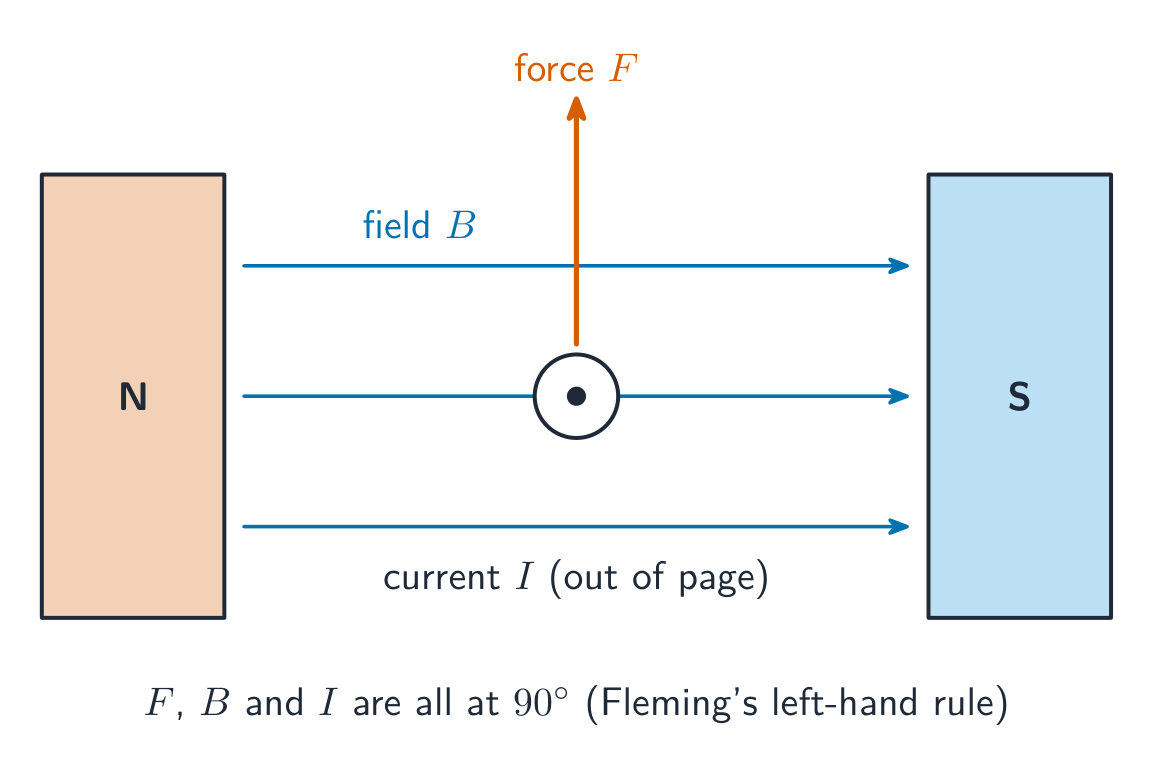
O efeito do motor num fio percorrido por corrente
What is the job of the split-ring commutator in a d.c. motor? · Qual é a função do comutador de anéis partidos em um motor de c.d.?
Without the commutator the coil would stop after half a turn. Swapping the current each half-turn keeps it rotating the same way. · Sem o comutador, a bobina pararia após meia volta. Trocar a corrente a cada meia volta mantém a rotação na mesma direção.
You've got it
- a current makes a magnetic field: circles round a wire, bar-magnet field for a solenoid
- stronger electromagnet: more current, more turns, soft-iron core
- motor effect: a wire carrying current in a field feels a force (left-hand rule)
- a d.c. motor spins; the split-ring commutator reverses the current each half-turn
Entendeu?
- uma corrente cria um campo magnético: círculos à volta de um fio, campo de ímã em barra para um solenoide
- eletroímã mais forte: mais corrente, mais espiras, núcleo de ferro mole
- efeito do motor: um fio com corrente num campo sente uma força (regra da mão esquerda)
- um motor c.c. gira; o comutador de anel partido inverte a corrente a cada meia volta