Circuits — series, parallel and potential dividers · Circuitos — série, paralelo e divisores de potencial
| English | Português |
|---|---|
| components/kəmˈpəʊnənts/ | componentes |
| series/ˈsɪəriːz/ | série |
| parallel/ˈpærəlel/ | paralelo |
| potential divider/pəˈtenʃl dɪˈvaɪdə/ | divisor de tensão |
| fuse/fjuːz/ | fusível |
| thermistor/ˈθɜːmɪstə/ | termistor |
| LDR/ˌel diː ˈɑː/ | LDR |
Building circuits
- Real gadgets are circuits built from a handful of components 元件, wired in two basic ways.
- Get the rules for series 串联 and parallel 并联 and you can predict any simple circuit.
- We finish with a clever trick: the potential divider 分压器.
Montando circuitos
- Aparelhos reais são circuitos construídos a partir de um punhado de componentes 元件, ligados de duas formas básicas.
- Entenda as regras para série 串联 e paralelo 并联 e você pode prever qualquer circuito simples.
- Concluímos com uma técnica inteligente: o divisor de potencial 分压器.
Components to know
- cell / battery — drives the current; a switch breaks or completes the circuit.
- resistor (fixed) and variable resistor (to control the current).
- fuse 保险丝 — melts if the current is too big; diode / LED — current one way only (an LED also lights).
- thermistor 热敏电阻 — resistance falls as it gets hotter; LDR 光敏电阻 — resistance falls as light gets brighter.
Standard circuit symbols
Componentes a conhecer
- pilha / bateria — impulsiona a corrente; uma chave interrompe ou completa o circuito.
- resistor (fixo) e resistor variável (para controlar a corrente).
- fusível 保险丝 — derrete se a corrente for muito grande; diodo / LED — corrente em apenas uma direção (um LED também ilumina).
- termistor 热敏电阻 — resistência diminui quando esquenta; LDR 光敏电阻 — resistência diminui quando a luz fica mais brilhante.
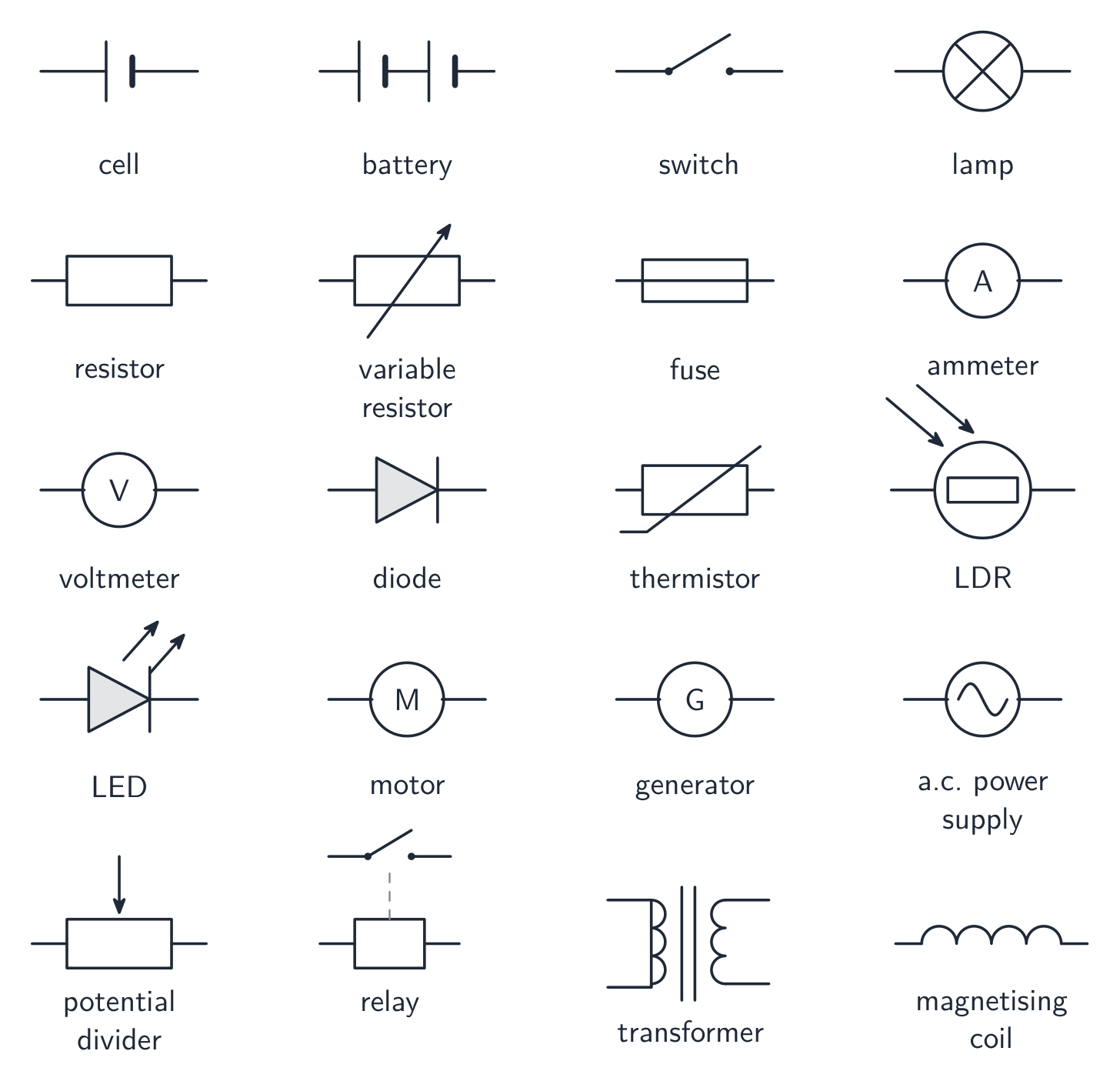
Símbolos padrão de circuitos
Build the current with Ohm's law · Construa a corrente com a lei de Ohm
Turn up the voltage and the electrons speed up and the bulb glows brighter; add resistance and the current drops. I = V/R, brightness = power. · Aumente a tensão e os elétrons aceleram e a lâmpada brilha mais; adicione resistência e a corrente cai. I = V/R, brilho = potência.
What happens to the resistance of a thermistor as it gets hotter? · O que acontece com a resistência de um termistor à medida que ele esquenta?
A thermistor's resistance falls as temperature rises — useful in temperature-sensing circuits. · A resistência de um termistor cai à medida que a temperatura sobe — útil em circuitos de detecção de temperatura.
Match each circuit rule to where it applies. · Combine cada regra de circuito com onde ela se aplica.
Each item links the term to its correct meaning. · Cada item associa o termo ao seu significado correto.
Series circuits
- The parts form one single loop.
- The current is the same at every point.
- The supply p.d. is shared between the components.
- Resistors in series add up: $R_{\text{total}} = R_1 + R_2 + \dots$
Series and parallel circuits
Circuitos em série
- As partes formam um único laço.
- A corrente é a mesma em todos os pontos.
- A d.p. da fonte é compartilhada entre os componentes.
- Resistores em série somam-se: $R_{\text{total}} = R_1 + R_2 + \dots$

Circuitos em série e paralelo
A $3.0\ \Omega$ and a $5.0\ \Omega$ resistor are connected in series. What is the total resistance, in Ω? · Um resistor de $3.0\ \Omega$ e um resistor de $5.0\ \Omega$ estão conectados em série. Qual é a resistência total, em Ω?
In series, resistances add: $R = 3.0 + 5.0 = 8.0\ \Omega$. · Em série, as resistências somam: $R = 3.0 + 5.0 = 8.0\ \Omega$.
In a series circuit, the current is: · Em um circuito em série, a corrente é:
There is only one path, so the same current flows through every component in a series circuit. · Há apenas um caminho, então a mesma corrente flui através de cada componente em um circuito em série.
Parallel circuits
- The parts are on separate branches.
- Each branch gets the full supply p.d.; the current splits between branches.
- The total resistance is less than the smallest single resistor: $\dfrac{1}{R_{\text{total}}} = \dfrac{1}{R_1} + \dfrac{1}{R_2}$
- Home lamps are wired in parallel — each gets full voltage, and one failing leaves the others on.
Circuitos em paralelo
- As partes estão em ramos separados.
- Cada ramo recebe a d.p. total da fonte; a corrente se divide entre os ramos.
- A resistência total é menor que o menor resistor individual: $\dfrac{1}{R_{\text{total}}} = \dfrac{1}{R_1} + \dfrac{1}{R_2}$
- Lâmpadas domésticas são ligadas em paralelo — cada uma recebe tensão total, e uma falha deixa as outras acesas.

A $6.0\ \Omega$ and a $3.0\ \Omega$ resistor are connected in parallel. What is the total resistance, in Ω? · Um resistor de $6.0\ \Omega$ e um resistor de $3.0\ \Omega$ estão conectados em paralelo. Qual é a resistência total, em Ω?
$\dfrac{1}{R} = \dfrac{1}{6.0} + \dfrac{1}{3.0} = \dfrac{1}{6} + \dfrac{2}{6} = \dfrac{3}{6}$, so $R = 2.0\ \Omega$ — less than the smallest resistor. · $\dfrac{1}{R} = \dfrac{1}{6.0} + \dfrac{1}{3.0} = \dfrac{1}{6} + \dfrac{2}{6} = \dfrac{3}{6}$, então $R = 2.0\ \Omega$ — menos que o menor resistor.
Why are the lamps in a house wired in parallel? · Por que as lâmpadas em uma casa são ligadas em paralelo?
In parallel each lamp gets the full supply p.d., and a break in one branch does not stop the others. · Em paralelo, cada lâmpada recebe a d.p. total de alimentação, e uma ruptura em um ramo não impede as outras.
Potential dividers
- Two resistors in series share the supply voltage — a potential divider.
- The bigger resistor takes the bigger share of the voltage:
- Use a thermistor or LDR as one resistor and the output voltage changes with temperature or light — perfect for switching a heater or lamp on automatically.
Divisores de potencial
- Dois resistores em série compartilham a tensão da fonte — um divisor de potencial.
- O resistor maior recebe a maior parcela da tensão:
- Use um termistor ou LDR como um dos resistores e a tensão de saída muda com a temperatura ou a luz — perfeito para ligar automaticamente um aquecedor ou lâmpada.

Two equal resistors are in series across a $12\ \text{V}$ supply. What is the p.d. across one of them, in V? · Dois resistores iguais estão em série sobre uma alimentação de $12\ \text{V}$. Qual é a d.p. sobre um deles, em V?
Equal resistors share the voltage equally: each gets $\dfrac{12}{2} = 6\ \text{V}$. · Resistores iguais compartilham a tensão igualmente: cada um recebe $\dfrac{12}{2} = 6\ \text{V}$.
You've got it
- series: one loop, same current everywhere, p.d. shared, $R_{\text{total}} = R_1 + R_2$
- parallel: branches, each gets full p.d., current splits, $\dfrac{1}{R_{\text{total}}} = \dfrac{1}{R_1} + \dfrac{1}{R_2}$
- thermistor: R falls when hot · LDR: R falls in bright light
- potential divider: two series resistors share the voltage by their ratio
Entendeu?
- série: um laço, mesma corrente em todo lugar, d.p. compartilhada, $R_{\text{total}} = R_1 + R_2$
- paralelo: ramos, cada um recebe d.p. total, corrente se divide, $\dfrac{1}{R_{\text{total}}} = \dfrac{1}{R_1} + \dfrac{1}{R_2}$
- termistor: R cai quando quente · LDR: R cai sob luz forte
- divisor de potencial: dois resistores em série compartilham a tensão conforme sua razão