Lenses and dispersion · Lentes e dispersão
| English | Português |
|---|---|
| dispersion/dɪˈspɜːʃn/ | dispersão |
| diverging lens/daɪˈvɜːdʒɪŋ lenz/ | lente divergente |
| converging lens/kənˈvɜːdʒɪŋ lenz/ | lente convergente |
| principal focus/ˈprɪnsɪpl ˈfəʊkəs/ | foco principal |
| focal length/ˈfəʊkl leŋθ/ | distância focal |
| real image/rɪəl ˈɪmɪdʒ/ | imagem real |
| virtual image/ˈvɜːtʃuːəl ˈɪmɪdʒ/ | imagem virtual |
| spectrum/ˈspektrəm/ | espectro |
| monochromatic/ˌmɒnəʊkrəʊˈmætɪk/ | monocromático |
Focusing and splitting light
- A magnifying glass makes tiny print big; a prism turns white light into a rainbow.
- Both use refraction — bending light in a careful, shaped way.
- Meet the lens and dispersion 色散.
Foco e separação da luz
- Uma lupa torna a letra pequena grande; um prisma transforma luz branca num arco-íris.
- Ambos usam refração — dobrar a luz de forma cuidadosa e moldada.
- Conheça a lente e a dispersão 色散.
Converging and diverging lenses 凹透镜
- A converging lens 凸透镜 is fat in the middle. It bends parallel rays inwards to meet at the principal focus 焦点.
- The distance from the lens to that focus is the focal length 焦距 $f$.
- A diverging lens is thin in the middle and spreads rays out.
A converging lens and its principal focus
Lentes convergentes e divergentes 凹透镜
- Uma lente convergente 凸透镜 é grossa no meio. Ela dobra raios paralelos para dentro para encontrar no foco principal 焦点.
- A distância da lente até esse foco é o comprimento focal 焦距 $f$.
- Uma lente divergente é fina no meio e espalha os raios para fora.
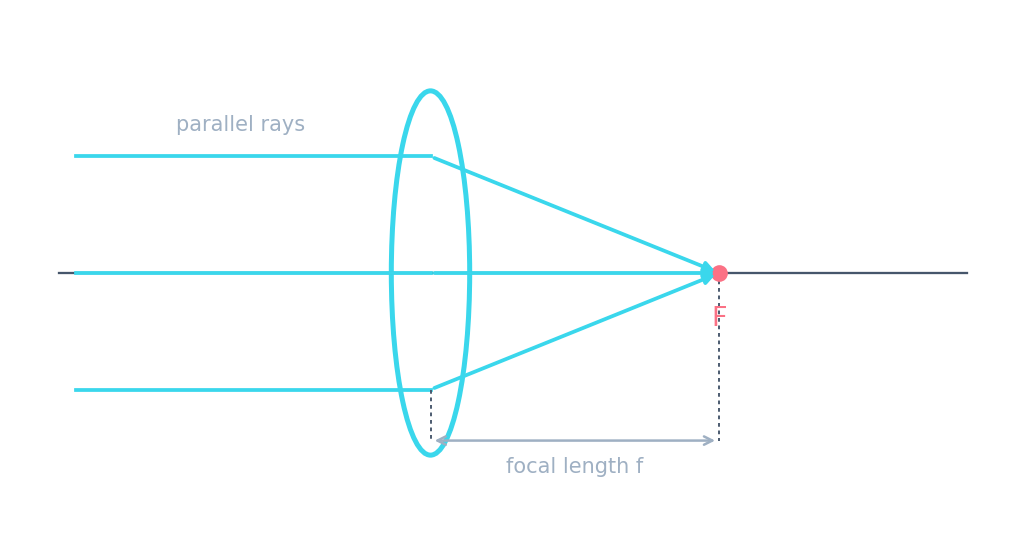
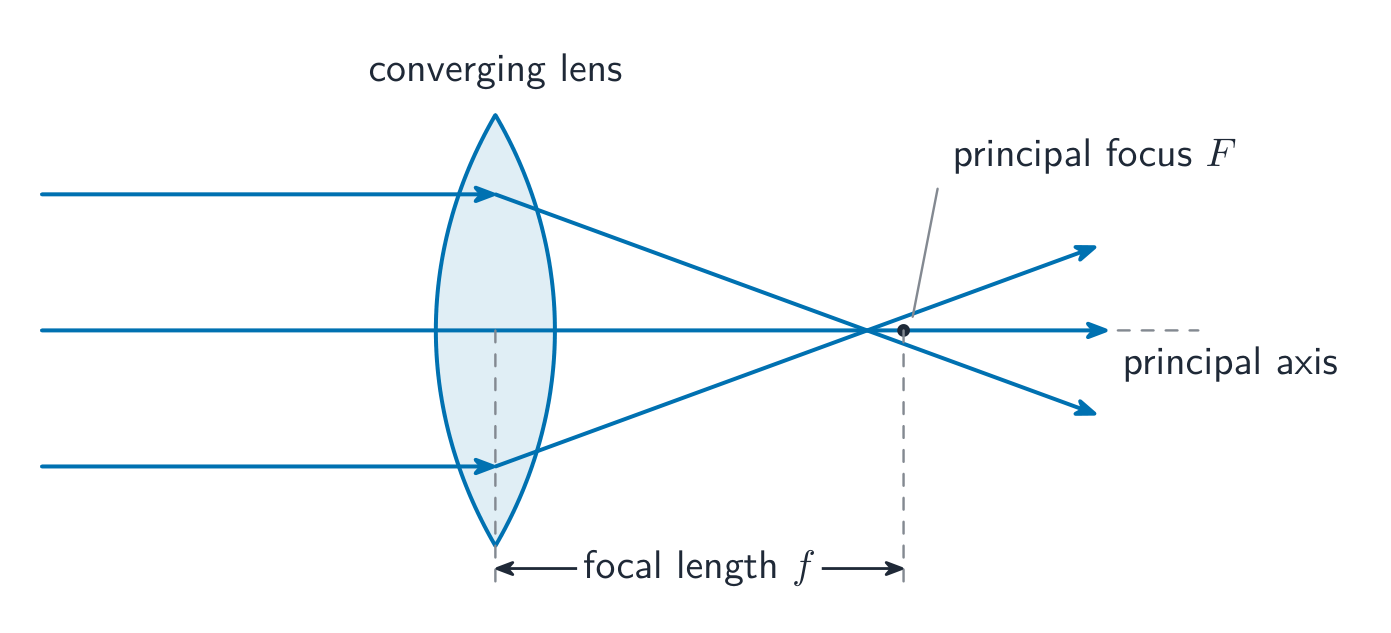
Uma lente convergente e seu foco principal
Image formation by a converging lens · Formação de imagem por uma lente convergente
Trace the three special rays from the object — where they meet is the image. Move the object closer than the focal point to flip it into a magnifying glass. · Trace os três raios especiais vindos do objeto — onde eles se encontram é a imagem. Mova o objeto mais perto que o ponto focal para virá-lo em uma lupa.
A converging lens makes parallel rays of light: · Uma lente convergente faz raios paralelos de luz:
A converging (convex) lens bends parallel rays inward so they meet at the principal focus. · Uma lente convergente (convexa) curva raios paralelos para dentro para que se encontrem no foco principal.
The distance from the lens to its principal focus is called the ____ length. · A distância da lente até seu foco principal é chamada de ____ distância.
The focal length is the distance from the centre of the lens to the principal focus. · A distância focal é a distância do centro da lente até o foco principal.
Images from a lens
- A converging lens can make a real image 实像 — the rays really meet, so it can be shown on a screen (as in a camera or the eye).
- When the object is very close, it makes a larger virtual image 虚像 instead.
- Used close to the eye like this, the lens is a magnifying glass.
Imagens formadas por uma lente
- Uma lente convergente pode formar uma imagem real 实像 — os raios realmente se encontram, então pode ser projetada numa tela (como numa câmera ou no olho).
- Quando o objeto está muito próximo, ela forma uma imagem virtual 虚像 maior em vez disso.
- Usada perto do olho assim, a lente é uma lupa.
Used close to the eye as a magnifying glass, a converging lens makes a: · Usada perto do olho como uma lupa, uma lente convergente produz uma:
With the object very close, the lens forms an enlarged, upright virtual image — a magnifying glass. · Com o objeto muito próximo, a lente forma uma imagem virtual ampliada e ereta — uma lupa.
Dispersion
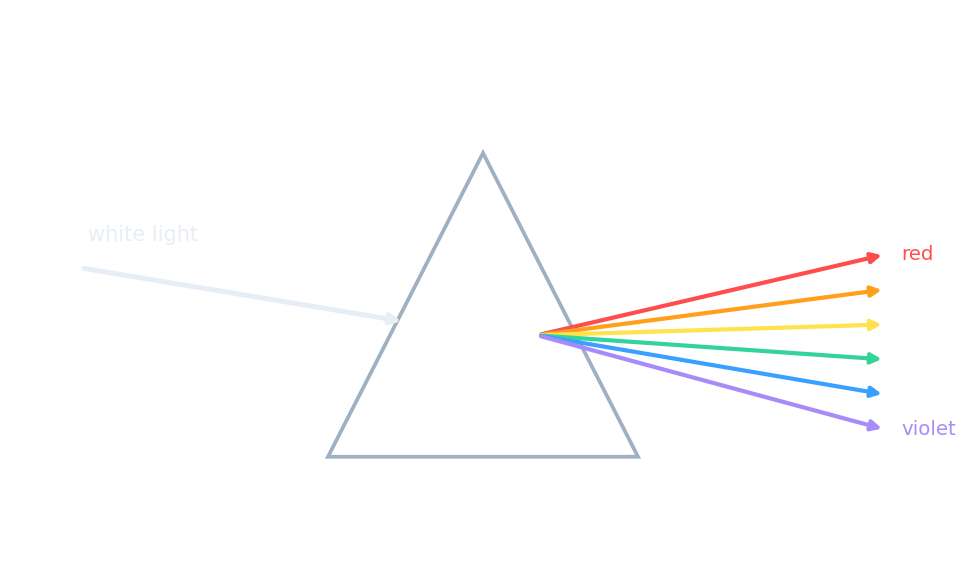
- A glass prism splits white light into a band of colours — the spectrum 光谱. This splitting is dispersion.
- The order is red, orange, yellow, green, blue, indigo, violet.
- Red bends least: it has the longest wavelength and lowest frequency. Violet is the opposite.
- Light of a single colour (one frequency) is monochromatic 单色.
Dispersão
- Um prisma de vidro divide a luz branca numa faixa de cores — o espectro 光谱. Essa divisão é dispersão.
- A ordem é vermelho, laranja, amarelo, verde, azul, anil, violeta.
- Vermelho dobra menos: tem o maior comprimento de onda e a menor frequência. Violeta é o oposto.
- Luz de uma única cor (uma única frequência) é monocromática 单色.
Put these spectrum colours in order of wavelength, longest first. · Coloque as cores do espectro em ordem de comprimento de onda, do maior para o menor.
Red has the longest wavelength and violet the shortest, so: red, yellow, green, blue, violet. · O vermelho tem o maior comprimento de onda e o violeta o menor, então: vermelho, amarelo, verde, azul, violeta.
Which colour of visible light has the longest wavelength? · Qual cor da luz visível tem o maior comprimento de onda?
Red light has the longest wavelength and lowest frequency; violet has the shortest wavelength and highest frequency. · A luz vermelha tem o maior comprimento de onda e menor frequência; o violeta tem o menor comprimento de onda e maior frequência.
You've got it
- a converging lens brings parallel rays to the principal focus; lens-to-focus = focal length
- it makes a real image (on a screen) — or a magnified virtual image when the object is close (magnifying glass)
- a prism causes dispersion: white light → red…violet
- red = longest wavelength, lowest frequency; violet = shortest, highest
Entendeu?
- uma lente convergente reúne raios paralelos no foco principal; lente-foco = distância focal
- forma uma imagem real (numa tela) — ou uma imagem virtual ampliada quando o objeto está próximo (lupa)
- um prisma causa dispersão: luz branca → vermelho…violeta
- vermelho = maior comprimento de onda, menor frequência; violeta = menor, maior