Reflection and refraction · Reflexão e refração
| English | Português |
|---|---|
| normal/ˈnɔːml/ | normal |
| angle of incidence/ˈæŋɡl ɒv ˈɪnsɪdəns/ | ângulo de incidência |
| angle of reflection/ˈæŋɡl ɒv rɪˈflekʃn/ | ângulo de reflexão |
| virtual/ˈvɜːtʃuːəl/ | virtual |
| refractive index/rɪˈfræktɪv ˈɪndeks/ | índice de refração |
| total internal reflection/ˈtəʊtl ɪnˈtɜːnl rɪˈflekʃn/ | reflexão total interna |
| critical angle/ˈkrɪtɪkl ˈæŋɡl/ | ângulo crítico |
| optical fibres/ˈɒptɪkl ˈfaɪbəz/ | fibras ópticas |
Bouncing and bending light
- A mirror bounces light back; a straw in a glass of water looks bent.
- These are reflection and refraction — the two basic things light does at a surface.
- We measure all angles from the normal 法线: a line at $90°$ to the surface.
Reflexão e refração da luz
- Um espelho devolve a luz; um canudo em um copo d'água parece dobrado.
- Estes são reflexão e refração — as duas coisas básicas que a luz faz numa superfície.
- Medimos todos os ângulos a partir da normal 法线: uma linha em $90°$ à superfície.
Reflection
- The law of reflection: the angle of incidence 入射角 equals the angle of reflection 反射角 (both from the normal).
- A plane mirror makes an image that is: the same size, the same distance behind the mirror, and virtual 虚的 (it cannot be caught on a screen).
The law of reflection
Reflexão
- A lei da reflexão: o ângulo de incidência 入射角 é igual ao ângulo de reflexão 反射角 (ambos medidos da normal).
- Um espelho plano forma uma imagem que é: do mesmo tamanho, à mesma distância atrás do espelho, e virtual 虚的 (não pode ser projetada em uma tela).

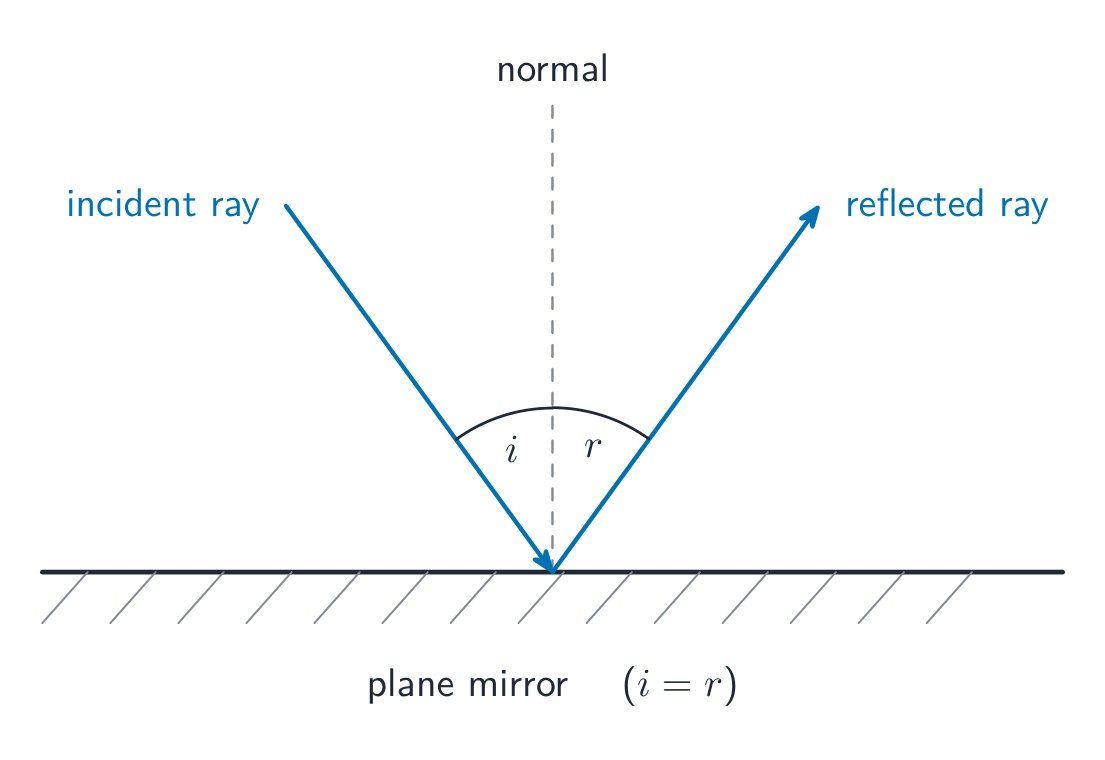
A lei da reflexão
Bend a light ray · Dobre um raio de luz
Shine light into water, glass or diamond and change the angle. The ray slows and bends toward the normal — the denser the material (higher n), the more it bends. That bending is why a straw looks broken in a glass, and why diamonds sparkle. · Ilumine luz em água, vidro ou diamante e alterne o ângulo. O raio desacelera e se curva em direção à normal — quanto mais denso o material (maior n), mais ele se curva. Essa curvura é por que um palito parece quebrado em um copo e por que diamantes brilham.
A ray hits a plane mirror at $30°$ to the normal. At what angle to the normal does it reflect? · Um raio incide num espelho plano a $30°$ da normal. Em que ângulo em relação à normal ele reflete?
The law of reflection: the angle of reflection equals the angle of incidence, both measured from the normal. · A lei da reflexão: o ângulo de reflexão é igual ao ângulo de incidência, ambos medidos a partir da normal.
An image in a plane mirror is: · Uma imagem em um espelho plano é:
A plane mirror gives a virtual image, the same size, the same distance behind the mirror — it cannot be caught on a screen. · Um espelho plano forma uma imagem virtual, do mesmo tamanho, à mesma distância atrás do espelho — não pode ser capturada em uma tela.
Refraction
- When light passes into a new material it changes speed and bends.
- Going from air into glass, it slows down and bends toward the normal (so $i > r$).
- The refractive index 折射率 compares the bending:
Refração
- Quando a luz entra num novo material, ela muda de velocidade e dobra.
- Passando do ar para dentro do vidro, ela desacelera e dobra em direção à normal (portanto $i > r$).
- O índice de refração 折射率 compara o grau de dobra:

A ray of light passes from air into glass. It: · Um raio de luz passa do ar para o vidro. Ele:
Light travels slower in glass, so going air → glass it bends toward the normal ($i > r$). · A luz viaja mais devagar no vidro, então ao passar de ar → vidro, ela se curva em direção à normal ($i > r$).
For light entering glass, $\sin i = 0.80$ and · e $\sin r = 0.50$. What is the refractive index? · Para a luz entrando no vidro, $\sin i = 0.80$ e $\sin r = 0.50$. Qual é o índice de refração?
$n = \dfrac{\sin i}{\sin r} = \dfrac{0.80}{0.50} = 1.6$.
Total internal reflection 全反射
- Light leaving glass bends away from the normal. Past a certain angle — the critical angle 临界角 $c$ — it cannot get out at all and reflects completely.
- This is total internal reflection, and it happens when the angle inside is bigger than $c$:
- It keeps light bouncing along optical fibres 光纤, the thin glass threads that carry internet and phone signals.
Total internal reflection keeps light bouncing along each optical fibre until it shines out at the tip
Reflexão interna total 全反射
- A luz saindo do vidro dobra afastando-se da normal. Além de um certo ângulo — o ângulo crítico 临界角 $c$ — ela não consegue sair e reflete completamente.
- Isso é reflexão interna total, e ocorre quando o ângulo interno é maior que $c$:
- Mantém a luz rebatendo ao longo de fibras ópticas 光纤, os finos fios de vidro que transportam sinais de internet e telefone.


A reflexão interna total mantém a luz rebatendo ao longo de cada fibra óptica até brilhar na ponta
Total internal reflection happens when light inside glass hits the surface at an angle that is: · A reflexão total interna ocorre quando a luz dentro do vidro atinge a superfície em um ângulo que é:
Above the critical angle the light cannot escape and is reflected completely back inside. · Acima do ângulo crítico, a luz não consegue escapar e é refletida completamente de volta para dentro.
Optical fibres use total internal reflection to carry light signals. · As fibras ópticas usam reflexão total interna para transportar sinais de luz.
Light bounces along the fibre by total internal reflection, carrying internet and phone signals over long distances. · A luz rebote ao longo da fibra por reflexão total interna, carregando sinais de internet e telefone por longas distâncias.
You've got it
- measure angles from the normal; reflection: angle i = angle r
- a plane mirror image is virtual, same size, same distance behind
- refraction: into glass → slows, bends toward the normal; $n = \dfrac{\sin i}{\sin r}$
- past the critical angle, light is totally internally reflected (optical fibres)
Entendeu?
- meça os ângulos a partir da normal; reflexão: ângulo i = ângulo r
- a imagem num espelho plano é virtual, do mesmo tamanho, à mesma distância atrás
- refração: entrando no vidro → desacelera, dobra em direção à normal; $n = \dfrac{\sin i}{\sin r}$
- além do ângulo crítico, a luz é totalmente refletida internamente (fibras ópticas)