Pythagoras and trigonometry in 3D · Pitágoras e trigonometria em 3D
| English | Português |
|---|---|
| space diagonal/speɪs daɪˈæɡənl/ | diagonal espacial |
| base diagonal/beɪs daɪˈæɡənl/ | diagonal da base |
The diagonal through a room
- How long is the longest pole that fits inside a box? It's the space diagonal 空间对角线 — running from one corner to the far opposite corner.
- 3D Pythagoras and trig reduce this to a flat triangle hidden inside the solid.
A diagonal através de um quarto
- Qual o comprimento do bastão mais longo que cabe dentro de uma caixa? É a diagonal espacial 空间对角线 — indo de um canto ao canto oposto distante.
- Pitágoras 3D e trigonometria reduzem isso a um triângulo plano escondido dentro do sólido.
The strategy: find a triangle inside
- Every 3D problem becomes a 2D problem: spot a right-angled triangle inside the solid, then use Pythagoras or trig on it.
- Often you find a base diagonal 底面对角线 first, then bring in the height to form a second triangle.
A estratégia: encontre um triângulo dentro
- Todo problema 3D torna-se um problema 2D: identifique um triângulo retângulo dentro do sólido, depois use Pitágoras ou trigonometria nele.
- Frequentemente você encontra primeiro uma diagonal da base 底面对角线, depois traz a altura para formar um segundo triângulo.
Pythagoras' theorem · Teorema de Pitágoras
In a right-angled triangle a² + b² = c². The same idea, applied twice, gives lengths inside 3-D solids. · Em um triângulo retângulo a² + b² = c². A mesma ideia, aplicada duas vezes, dá comprimentos dentro de sólidos 3-D.
A box has a base 6 cm by 8 cm. Find the length of the base diagonal (cm). · Uma caixa tem base de 6 cm por 8 cm. Encontre o comprimento da diagonal da base (cm).
√(6² + 8²) = √100 = 10 cm.
In a 3-D problem you look for a right-angled triangle inside the solid to work with. · Em um problema 3-D você procura um triângulo retângulo dentro do sólido para trabalhar.
The whole 3-D method is to reduce it to a flat right-angled triangle. · O método completo 3-D consiste em reduzi-lo a um triângulo retângulo plano.
In 3D problems, you often find the ______ diagonal first, then use it with the height. · Em problemas 3D, você geralmente encontra primeiro a ______ diagonal, depois a usa com a altura.
The base diagonal (found using 2D Pythagoras) becomes one side of a second right triangle with the height. · A diagonal da base (encontrada usando Pitágoras 2D) torna-se um lado de um segundo triângulo retângulo com a altura.
Worked example — box diagonal
- A box has base $6\text{ cm} \times 8\text{ cm}$, height $5\text{ cm}$.
- Step 1 — base diagonal: $\sqrt{6^2 + 8^2} = \sqrt{100} = 10\text{ cm}$.
- Step 2 — space diagonal: $\sqrt{10^2 + 5^2} = \sqrt{125} = 11.2\text{ cm}$.
Exemplo resolvido — diagonal de caixa
- Uma caixa tem base $6\text{ cm} \times 8\text{ cm}$, altura $5\text{ cm}$.
- Passo 1 — diagonal da base: $\sqrt{6^2 + 8^2} = \sqrt{100} = 10\text{ cm}$.
- Passo 2 — diagonal espacial: $\sqrt{10^2 + 5^2} = \sqrt{125} = 11.2\text{ cm}$.
A box has dimensions 6, 8 and 5 cm. The space diagonal is √(6² + 8² + 5²). Find it (1 dp). · Uma caixa tem dimensões 6, 8 e 5 cm. A diagonal espacial é √(6² + 8² + 5²). Encontre-a (1 casa decimal).
√(36 + 64 + 25) = √125 ≈ 11.2 cm.
A cube has side 3 cm. Its space diagonal is √(3² + 3² + 3²) = √27. Find it (2 dp). · Um cubo tem lado 3 cm. Sua diagonal espacial é √(3² + 3² + 3²) = √27. Encontre-a (2 casas decimais).
√27 = 3√3 ≈ 5.20 cm.
Worked example — angle to the base
- The base diagonal ($10$) and height ($5$) form a right triangle.
- $\tan\theta = \dfrac{5}{10} = 0.5$, so $\theta = \tan^{-1}(0.5) = 26.6^{\circ}$.
3D Pythagoras shortcut. The space diagonal of a box $l \times w \times h$ is $\sqrt{l^2 + w^2 + h^2}$. For our box: $\sqrt{36 + 64 + 25} = \sqrt{125} = 11.2$ cm.
Two steps, not one. For the angle, you need the base diagonal AND the height to form the second triangle. Using the space diagonal as a side gives the wrong angle.
Exemplo resolvido — ângulo para a base
- A diagonal da base ($10$) e a altura ($5$) formam um triângulo retângulo.
- $\tan\theta = \dfrac{5}{10} = 0.5$, logo $\theta = \tan^{-1}(0.5) = 26.6^{\circ}$.
Atalho Pitágoras 3D. A diagonal espacial de uma caixa $l \times w \times h$ é $\sqrt{l^2 + w^2 + h^2}$. Para nossa caixa: $\sqrt{36 + 64 + 25} = \sqrt{125} = 11.2$ cm.
Dois passos, não um. Para o ângulo, você precisa da diagonal da base E da altura para formar o segundo triângulo. Usar a diagonal espacial como lado dá o ângulo errado.
The base diagonal is 10 cm and the box height is 5 cm. The angle to the base has tan θ = 5/10. Find θ (degrees, 1 dp). · A diagonal da base é 10 cm e a altura da caixa é 5 cm. O ângulo em relação à base tem tan θ = 5/10. Encontre θ (graus, 1 casa decimal).
θ = tan⁻¹(0.5) = 26.6°.
Where 3D trig appears
- Architecture: the angle of a roof rafter, the diagonal of a room.
- Engineering: the length of a support strut, the angle of a crane arm.
3D Pythagoras is just 2D Pythagoras applied twice — first on the base, then with the height.
Onde a trigonometria 3D aparece
- Arquitetura: o ângulo de uma caibra de telhado, a diagonal de uma sala.
- Engenharia: o comprimento de uma escora de suporte, o ângulo do braço de um guindaste.
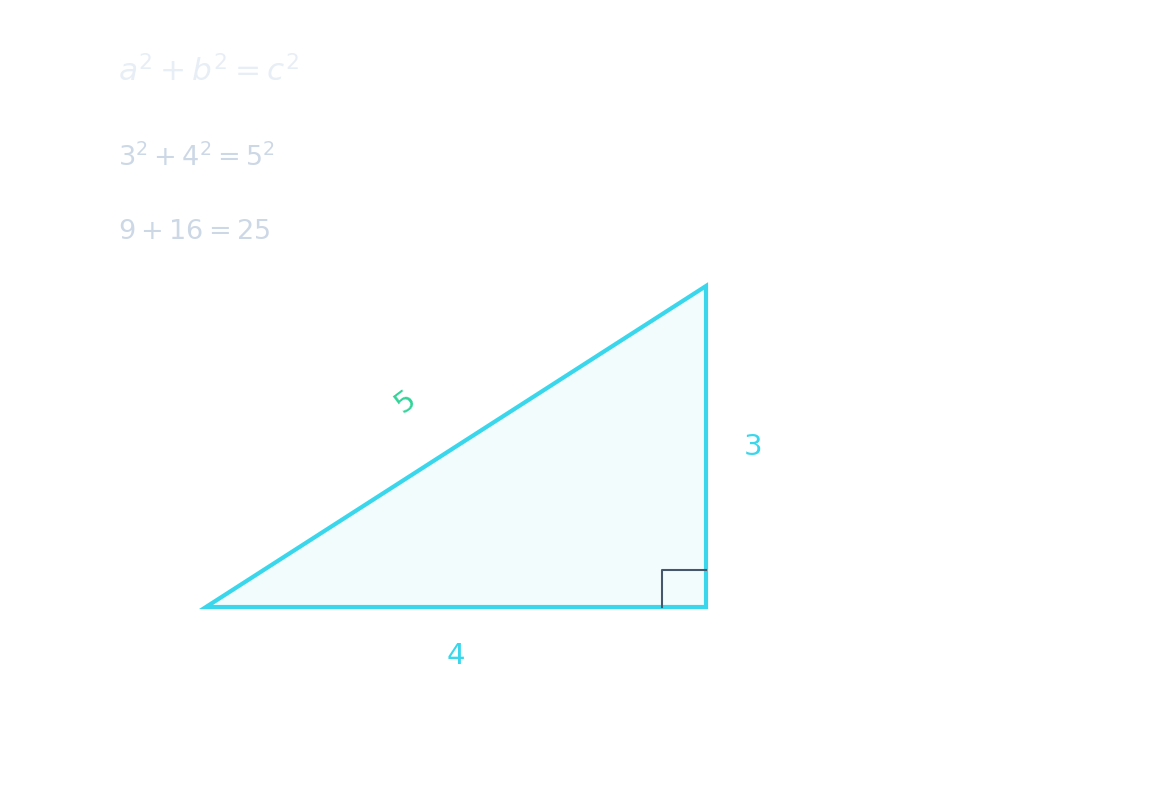
Pitágoras 3D é apenas Pitágoras 2D aplicado duas vezes — primeiro na base, depois com a altura.
You've got it
- in 3D, spot a right-angled triangle inside the solid, then use Pythagoras/trig
- often find a base diagonal first, then bring in the height
- box $6 \times 8 \times 5$: base diagonal $10$, space diagonal $\sqrt{125} \approx 11.2$, angle $26.6^{\circ}$
Entendeu?
- em 3D, identifique um triângulo retângulo interno no sólido, então use Pitágoras/trigonometria
- muitas vezes encontre uma diagonal da base primeiro, depois adicione a altura
- caixa $6 \times 8 \times 5$: diagonal da base $10$, diagonal espacial $\sqrt{125} \approx 11.2$, ângulo $26.6^{\circ}$