Transformations · Transformações
| English | Português |
|---|---|
| transformations/trænsfɔːˈmeɪʃnz/ | transformações |
| reflection/rɪˈflekʃn/ | reflexão |
| rotation/rəʊˈteɪʃn/ | rotação |
| enlargement/enˈlɑːdʒmənt/ | ampliação |
| mirror line/ˈmɪrə laɪn/ | eixo de simetria |
| scale factor/skeɪl ˈfæktə/ | fator de escala |
| translation/trænˈsleɪʃn/ | tradução |
| column vector/ˈkɒlʌm ˈvektə/ | vetor coluna |
The mirror, the spin, the zoom, the slide
- Computer graphics use transformations 变换 to animate characters — reflections 反射 for mirror images, rotations 旋转 for spinning, enlargements 放大 for zooming.
- Every transformation needs a complete description to earn full marks.
O espelho, o giro, o zoom, o deslize
- Gráficos por computador usam transformações para animar personagens — reflexões para imagens espelhadas, rotações para girar, ampliações para dar zoom.
- Toda transformação precisa de uma descrição completa para garantir nota máxima.
Reflection
- Flips a shape over a mirror line 对称轴. Give the line's equation.
- Reflect $(3,2)$ in the $y$-axis → $(-3, 2)$ (only $x$'s sign changes).
- Reflect in the $x$-axis → $(3, -2)$ (only $y$'s sign changes).
Reflection in the $y$-axis: flip the sign of $x$. The shape stays the same size — it's congruent.
Reflexão
- Inverte uma figura sobre uma linha de espelho. Forneça a equação da linha.
- Reflita $(3,2)$ no eixo $y$ → $(-3, 2)$ (apenas o sinal de $x$ muda).
- Reflita no eixo $x$ → $(3, -2)$ (apenas o sinal de $y$ muda).
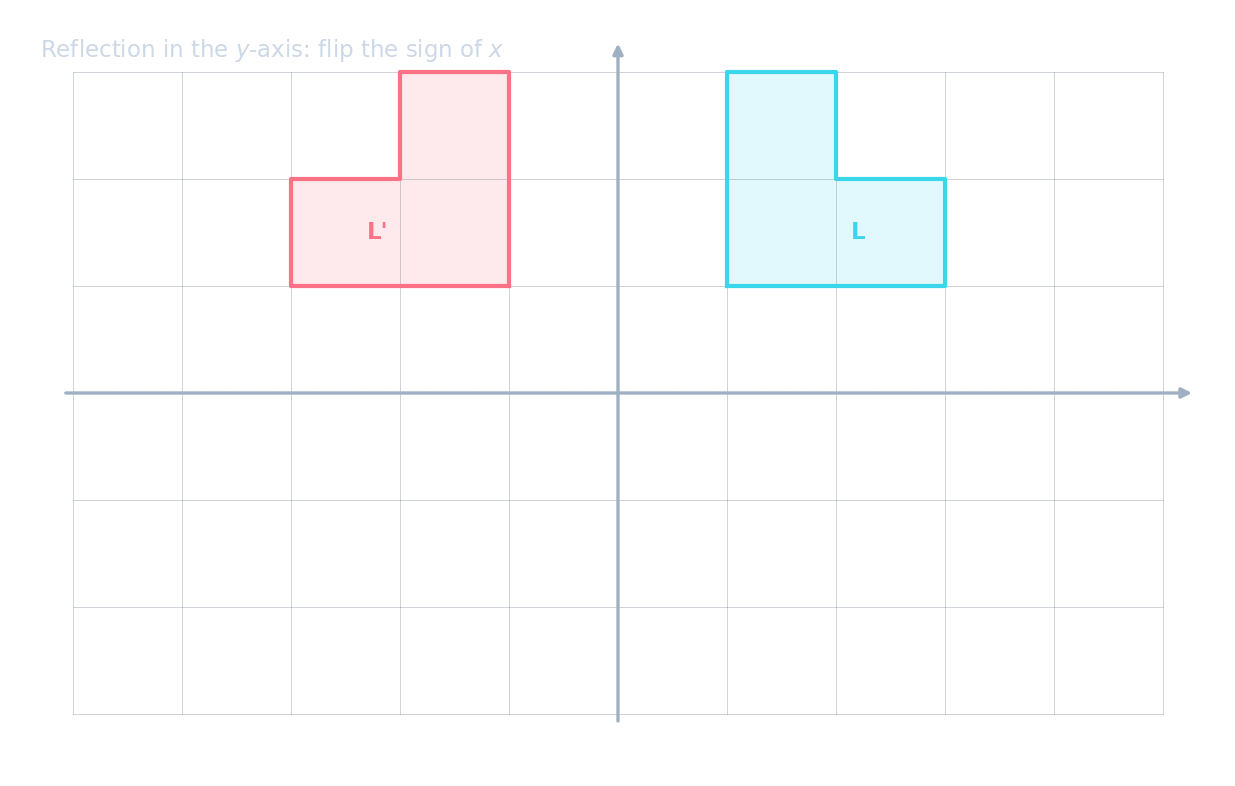
Reflexão no eixo $y$: inverte o sinal de $x$. A forma mantém o mesmo tamanho — ela é congruente.
Transformations · Transformações
(x, y) → (x', y')
Translate, reflect, rotate or enlarge a shape — and see what stays the same. · Transladar, refletir, girar ou ampliar uma figura — e ver o que permanece inalterado.
Reflect the point (3, 2) in the y-axis. The image is (a, 2). What is a? · Refletir o ponto (3, 2) no eixo y. A imagem é (a, 2). Qual é a?
Reflecting in the y-axis flips the sign of x: a = −3. · Refletir no eixo y inverte o sinal de x: a = −3.
Rotation
- Turns a shape about a centre. Give centre, angle, and direction.
- Rotate $(3,1)$ by $90^{\circ}$ anticlockwise about $O$: $(x,y) \to (-y, x) \to (-1, 3)$.
Quick rules about the origin: $90^{\circ}$ clockwise: $(x,y) \to (y, -x)$. $90^{\circ}$ anticlockwise: $(x,y) \to (-y, x)$. $180^{\circ}$: $(x,y) \to (-x, -y)$.
Geometric tiles are built by reflecting, rotating and translating shapes
Rotação
- Gira uma figura em torno de um centro. Dê o centro, o ângulo e a direção.
- Rotacione $(3,1)$ em $90^{\circ}$ anti-horário em torno de $O$: $(x,y) \to (-y, x) \to (-1, 3)$.
Regras rápidas sobre a origem: $90^{\circ}$ horário: $(x,y) \to (y, -x)$. $90^{\circ}$ anti-horário: $(x,y) \to (-y, x)$. $180^{\circ}$: $(x,y) \to (-x, -y)$.

Azulejos geométricos são construídos refletindo, rotacionando e transladando formas
Rotate (3, 1) by 90° anticlockwise about the origin. The rule is (x, y) → (−y, x). The image is (a, 3). What is a? · Girar (3, 1) em 90° anti-horário em torno da origem. A regra é (x, y) → (−y, x). A imagem é (a, 3). Qual é a?
(3, 1) → (−1, 3). So a = −1. · (3, 1) → (−1, 3). Então a = −1.
Enlargement
- Changes size by a scale factor 比例因子 $k$ from a centre. Give centre and $k$.
- Enlarge $(1,2)$ from $O$ by $k=2$ → $(2, 4)$.
- Core includes positive fractional factors: $k=\dfrac12$ makes it smaller. Extended also includes negative factors, such as $k=-1$, which puts the image on the opposite side of the centre.
Describe fully. "It got bigger" is not enough. You must give: centre of enlargement AND scale factor. Both are needed for full marks.
An enlargement multiplies every distance from the centre by the scale factor (here 2)
A rotation turns the shape about a fixed centre, here $90^\circ$ anticlockwise about the origin
Ampliação
- Altera o tamanho por um fator de escala $k$ a partir de um centro. Forneça o centro e $k$.
- Amplie $(1,2)$ de $O$ por $k=2$ → $(2, 4)$.
- Core inclui fatores fracionários positivos: $k=\dfrac12$ a torna menor. Extended também inclui fatores negativos, como $k=-1$, que coloca a imagem do lado oposto ao centro.
Descreva completamente. "Ficou maior" não é suficiente. Você deve dar: centro de ampliação E fator de escala. Ambos são necessários para nota máxima.

Uma ampliação multiplica todas as distâncias do centro pelo fator de escala (aqui 2)

Uma rotação gira a figura em torno de um centro fixo, aqui $90^\circ$ anti-horário em torno da origem
Which transformation changes the size of a shape? · Qual transformação muda o tamanho de uma figura?
Only enlargement changes size; the other three keep it congruent. · Apenas a ampliação muda o tamanho; as outras três mantêm a congruência.
Enlarge the point (4, 6) from the origin with scale factor 3. The image is (12, b). What is b? · Ampliar o ponto (4, 6) da origem com fator de escala 3. A imagem é (12, b). Qual é b?
Multiply both coordinates by 3: (4×3, 6×3) = (12, 18). · Multiplicar ambas as coordenadas por 3: (4×3, 6×3) = (12, 18).
Translation 平移
- Slides every point by the same amount. Describe with a column vector 列向量 $\begin{pmatrix} x \\ y \end{pmatrix}$.
- Translate $(5,3)$ by $\begin{pmatrix} -2 \\ 4 \end{pmatrix}$ → $(5-2, 3+4) = (3, 7)$.
- Translation preserves everything: size, shape, and orientation.
A translation slides every point by the same column vector, with no turning
Translação
- Desliza cada ponto pela mesma quantidade. Descreva com um vetor coluna $\begin{pmatrix} x \\ y \end{pmatrix}$.
- Transladar $(5,3)$ por $\begin{pmatrix} -2 \\ 4 \end{pmatrix}$ → $(5-2, 3+4) = (3, 7)$.
- A translação preserva tudo: tamanho, forma e orientação.

Uma translação desliza cada ponto pelo mesmo vetor coluna, sem virar
Translate (5, 3) by the vector (−2, 4). The image is (3, b). What is b? · Transladar (5, 3) pelo vetor (−2, 4). A imagem é (3, b). Qual é b?
Move 4 up: 3 + 4 = 7. · Mover 4 para cima: 3 + 4 = 7.
A translation changes the size and shape of an object. · Uma translação muda o tamanho e a forma de um objeto.
Translation only changes position — the shape stays congruent (same size and shape). · A translação apenas muda a posição — a forma permanece congruente (mesmo tamanho e forma).
The centre need not be the origin
- Enlarge $P=(3,2)$ by factor 2 about $C=(1,1)$. Displacement $P-C=(2,1)$ doubles to $(4,2)$, so $P'=C+2(P-C)=(5,3)$.
- To find a centre from a shape and image, rule lines through matching vertices and extend them; they meet at the centre. A factor $1/2$ puts each image point halfway from the centre to its original. Core transformations are single operations, not combinations.
O centro não precisa ser a origem
- Amplie $P=(3,2)$ pelo fator 2 em relação a $C=(1,1)$. O deslocamento $P-C=(2,1)$ dobra para $(4,2)$, logo $P'=C+2(P-C)=(5,3)$.
- Para encontrar um centro a partir de uma figura e sua imagem, trace linhas pelos vértices correspondentes e estenda-as; elas se encontram no centro. Um fator $1/2$ posiciona cada ponto da imagem exatamente na metade do caminho do centro até o original. Transformações core são operações únicas, não combinações.
Enlarge P = (3,2) by factor 2 about C = (1,1). Find the image x-coordinate. · Amplie P = (3,2) por fator 2 em relação a C = (1,1). Encontre a coordenada x da imagem.
x′ = 1 + 2(3−1) = 5.
You've got it
- reflection (mirror line), rotation (centre, angle, direction)
- enlargement (centre, scale factor $k$), translation (column vector)
- describe each fully — that's what earns the marks
Entendeu?
- reflexão (linha espelho), rotação (centro, ângulo, direção)
- ampliação (centro, fator de escala $k$), translação (vetor coluna)
- descreva cada uma completamente — é isso que garante as notas