Pythagoras' theorem · Teorema de Pitágoras
| English | Português |
|---|---|
| Pythagoras/paɪˈθæɡərəs/ | Pitágoras |
| right-angled triangle/raɪt ˈæŋɡld ˈtraɪæŋɡl/ | triângulo retângulo |
| hypotenuse/haɪˈpɒtənjuːs/ | hipotenusa |
| Pythagorean triples/ˈpaɪθəɡɔːrɪən ˈtrɪplz/ | triplas pitagóricas |
The rope that made a right angle
- Ancient Egyptian builders used a rope with 12 equally-spaced knots to create a perfect right angle: stretch it into a triangle with sides 3, 4, and 5 — the corner opposite the longest side is always $90^{\circ}$.
- Pythagoras 勾股定理 proved why this works, and his theorem is still the most-used result in all of mathematics.
A corda que fez um ângulo reto
- Construtores antigos egípcios usavam uma corda com 12 nós igualmente espaçados para criar um ângulo reto perfeito: estique-a formando um triângulo com lados 3, 4 e 5 — o canto oposto ao lado mais longo é sempre $90^{\circ}$.
- Pitágoras 勾股定理 provou por que isso funciona, e seu teorema continua sendo o resultado mais usado em toda a matemática.
The theorem
- In a right-angled triangle 直角三角形, the square on the hypotenuse 斜边 equals the sum of the squares on the other two sides:
- $c$ is the hypotenuse — the longest side, opposite the right angle.
The classic 3-4-5 triangle: $3^2 + 4^2 = 5^2$. The theorem works for every right-angled triangle.
$c$ must be the hypotenuse. The formula $a^2 + b^2 = c^2$ only works when $c$ is the side opposite the right angle. If you label the wrong side as $c$, you'll get the wrong answer.
O teorema
- Em um triângulo retângulo 直角三角形, o quadrado da hipotenusa 斜边 é igual à soma dos quadrados dos outros dois lados:
- $c$ é a hipotenusa — o lado mais longo, oposto ao ângulo reto.
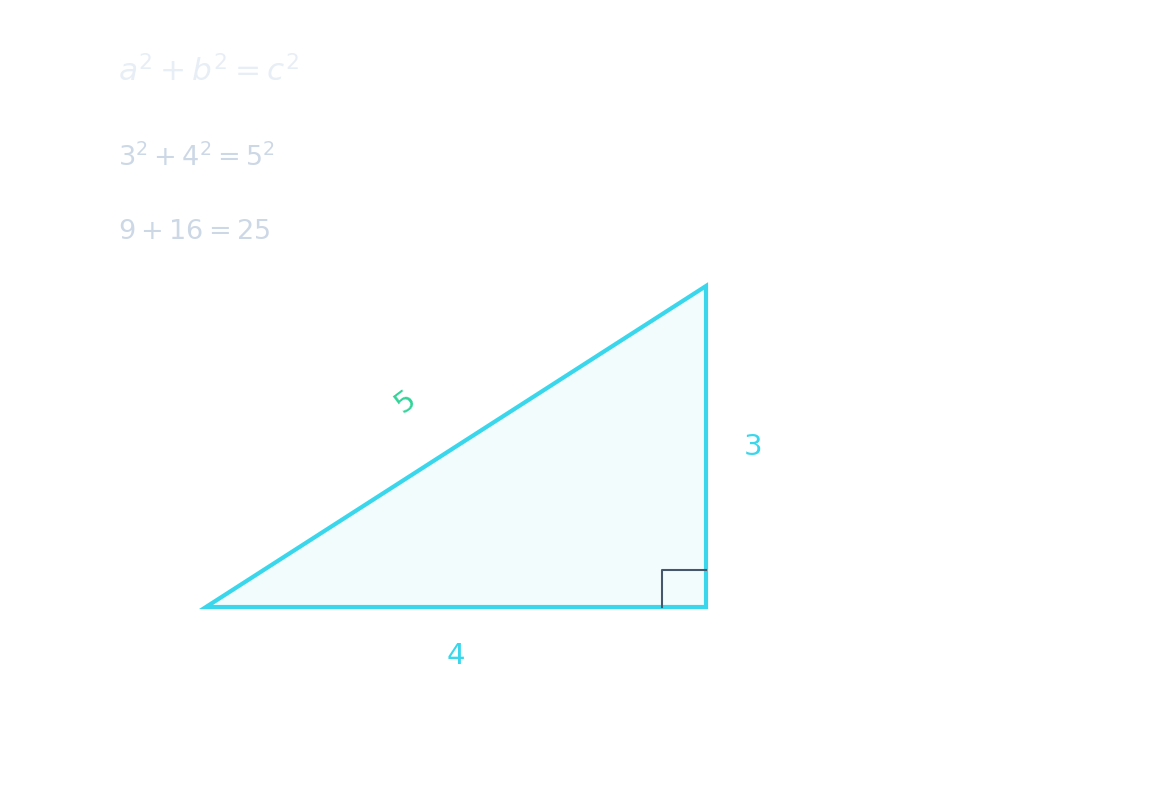
O clássico triângulo 3-4-5: $3^2 + 4^2 = 5^2$. O teorema funciona para todo triângulo retângulo.
$c$ deve ser a hipotenusa. A fórmula $a^2 + b^2 = c^2$ só funciona quando $c$ é o lado oposto ao ângulo reto. Se você rotular o lado errado como $c$, obterá a resposta errada.
Pythagoras' theorem · Teorema de Pitágoras
a² + b² = c²
The squares on the two legs always add up to the square on the hypotenuse. · Os quadrados nos dois catetos sempre somam o quadrado na hipotenusa.
A right-angled triangle has short sides 3 cm and 4 cm. Find the hypotenuse (cm). · Um triângulo retângulo tem lados curtos 3 cm e 4 cm. Encontre a hipotenusa (cm).
√(3² + 4²) = √25 = 5 cm.
The hypotenuse of a right-angled triangle is: · A hipotenusa de um triângulo retângulo é:
The hypotenuse is the longest side and lies opposite the 90° angle. · A hipotenusa é o lado mais longo e fica oposto ao ângulo de 90°.
In Pythagoras theorem, a² + b² = c², the side c must be the ______. · No teorema de Pitágoras, a² + b² = c², o lado c deve ser o ______.
c must always be the hypotenuse (the side opposite the right angle). · c deve ser sempre a hipotenusa (o lado oposto ao ângulo reto).
Finding a missing side
- Finding the hypotenuse: $c = \sqrt{a^2 + b^2}$ (add and square-root).
- Finding a short side: $a = \sqrt{c^2 - b^2}$ (subtract and square-root).
Hypotenuse $13$, short side $5$: $b = \sqrt{13^2 - 5^2} = \sqrt{169 - 25} = \sqrt{144} = 12$.
Pythagoras as areas: the squares on the two shorter sides ($9+16$) add up to the square on the hypotenuse ($25$)
Encontrando um lado desconhecido
- Encontrando a hipotenusa: $c = \sqrt{a^2 + b^2}$ (somar e extrair raiz).
- Encontrando um cateto: $a = \sqrt{c^2 - b^2}$ (subtrair e extrair raiz).
Hipotenusa $13$, cateto $5$: $b = \sqrt{13^2 - 5^2} = \sqrt{169 - 25} = \sqrt{144} = 12$.

Pitágoras como áreas: os quadrados nos dois lados menores ($9+16$) somam-se ao quadrado na hipotenusa ($25$)
The hypotenuse is 13 cm and one short side is 5 cm. Find the other short side (cm). · A hipotenusa é 13 cm e um lado curto é 5 cm. Encontre o outro lado curto (cm).
√(13² − 5²) = √(169 − 25) = √144 = 12 cm.
A right-angled triangle has hypotenuse 10 cm and one short side 6 cm. Find the other short side (cm). · Um triângulo retângulo tem hipotenusa 10 cm e um lado curto 6 cm. Encontre o outro lado curto (cm).
√(10² − 6²) = √(100 − 36) = √64 = 8 cm.
Pythagorean triples 勾股数 worth knowing
- $3, 4, 5$ — the smallest triple.
- $5, 12, 13$ — the next most common.
- Multiples work too: $6, 8, 10$ and $9, 12, 15$ are also right-angled.
- Spotting a triple saves calculation time in exams.
Ternas pitagóricas 勾股数 worth knowing
- $3, 4, 5$ — a menor terna.
- $5, 12, 13$ — a próxima mais comum.
- Múltiplos também funcionam: $6, 8, 10$ e $9, 12, 15$ também são retângulos.
- Identificar uma terna economiza tempo de cálculo em provas.
A triangle with sides 6, 8, 10 is right-angled. · Um triângulo com lados 6, 8, 10 é retângulo.
6² + 8² = 36 + 64 = 100 = 10². It is a multiple of the 3-4-5 triple. · 6² + 8² = 36 + 64 = 100 = 10². É um múltiplo da terna 3-4-5.
You've got it
- $a^2 + b^2 = c^2$, with $c$ the hypotenuse (opposite the right angle)
- to find a short side, subtract: $b = \sqrt{c^2 - a^2}$
- $3$-$4$-$5$ and $5$-$12$-$13$ are worth remembering
Entendeu?
- $a^2 + b^2 = c^2$, com $c$ sendo a hipotenusa (oposta ao ângulo reto)
- para encontrar um cateto, subtraia: $b = \sqrt{c^2 - a^2}$
- $3$-$4$-$5$ e $5$-$12$-$13$ valem a pena memorizar