Algebra basics and manipulation · Introdução à álgebra e manipulação
| English | Português |
|---|---|
| algebra/ˈældʒɪbrə/ | álgebra |
| variable/ˈveərɪəbl/ | variável |
| substitute/ˈsʌbstɪtjuːt/ | substituir |
| like terms/laɪk tɜːmz/ | termos semelhantes |
| expanding/ekˈspændɪŋ/ | expansiva |
| factorising/ˈfæktəraɪzɪŋ/ | fatoração |
| difference of two squares/ˈdɪfrəns ɒv tuː skweəz/ | diferença de dois quadrados |
The language of the unknown
- Al-Khwarizmi, a 9th-century Persian mathematician, wrote the first book on "al-jabr" — restoring and balancing. That's where "algebra 代数" comes from.
- He used words instead of letters. We use letters because they're faster — and because a single letter can stand for any number.
A linguagem do desconhecido
- Al-Khwarizmi, um matemático persa do século 9, escreveu o primeiro livro sobre "al-jabr" — restauração e equilíbrio. Daí vem a palavra "álgebra".
- Ele usava palavras em vez de letras. Usamos letras porque são mais rápidas — e porque uma única letra pode representar qualquer número.
Algebra manipulation route · Rota de manipulação algébrica
Follow expression work from collecting terms to solving. · Siga o trabalho de expressão desde agrupar termos até resolver.
Variables 变量 and substitution
- A variable is a letter that stands for a number. Its value can change.
- To substitute 代入 means to replace a letter with a specific number.
- Example: $3x^2 - 2y$ at $x = 4$, $y = 5$: $\;3(4)^2 - 2(5) = 48 - 10 = 38$.
Square first, then multiply. $3x^2$ at $x = 4$ is $3 \times 16 = 48$, not $(3 \times 4)^2 = 144$. Indices apply only to the letter immediately before them.
Collecting like terms: add terms with the same letter
Variáveis e substituição
- Uma variável é uma letra que representa um número. Seu valor pode mudar.
- Substituir significa trocar uma letra por um número específico.
- Exemplo: $3x^2 - 2y$ em $x = 4$, $y = 5$: $\;3(4)^2 - 2(5) = 48 - 10 = 38$.
Elevue ao quadrado primeiro, depois multiplique. $3x^2$ em $x = 4$ é $3 \times 16 = 48$, não $(3 \times 4)^2 = 144$. Os expoentes aplicam-se apenas à letra imediatamente anterior a eles.
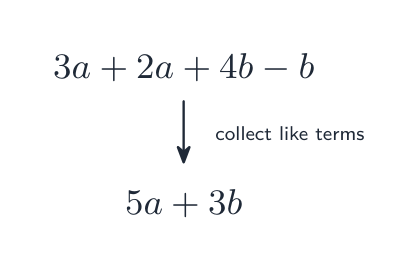
Coletando termos semelhantes: some termos com a mesma letra
Find the value of 3x² − 2y when x = 4 and y = 5. · Encontre o valor de 3x² − 2y quando x = 4 e y = 5.
3 × 4² − 2 × 5 = 3 × 16 − 10 = 48 − 10 = 38.
Collecting like terms 同类项
- Like terms have the same letter(s) raised to the same power(s).
- $2a^2 + 5a^2 = 7a^2$ (same letter, same power — collect them).
- $3x + 2y$ cannot be simplified — different letters.
Agrupando termos semelhantes
- Termos semelhantes possuem as mesmas letra(s) elevada(s) à(s) mesma(s) potência(s).
- $2a^2 + 5a^2 = 7a^2$ (mesma letra, mesma potência — cole-os).
- $3x + 2y$ não pode ser simplificado — letras diferentes.
Simplify 2a² + 5a² + 3a − a. What is the coefficient of a²? · Simplifique 2a² + 5a² + 3a − a. Qual é o coeficiente de a²?
2a² + 5a² = 7a²; 3a − a = 2a. The coefficient of a² is 7. · 2a² + 5a² = 7a²; 3a − a = 2a. O coeficiente de a² é 7.
Expanding 展开 brackets
- Single bracket: $3(2x + 5) = 6x + 15$.
- Double brackets (FOIL): $(2x + 1)(x - 4) = 2x^2 - 8x + x - 4 = 2x^2 - 7x - 4$.
Quick check. $(x + 3)(x + 5) = x^2 + 5x + 3x + 15 = x^2 + 8x + 15$. The constant term is $3 \times 5 = 15$.
Expandindo parênteses
- Colchete único: $3(2x + 5) = 6x + 15$.
- Dois colchetes (FOIL): $(2x + 1)(x - 4) = 2x^2 - 8x + x - 4 = 2x^2 - 7x - 4$.
Verificação rápida. $(x + 3)(x + 5) = x^2 + 5x + 3x + 15 = x^2 + 8x + 15$. O termo constante é $3 \times 5 = 15$.
Expand (2x + 1)(x − 4) = 2x² + bx + c. What is the constant term c? · Expandir (2x + 1)(x − 4) = 2x² + bx + c. Qual é o termo constante c?
(2x+1)(x−4) = 2x² − 8x + x − 4 = 2x² − 7x − 4, so c = −4. · (2x+1)(x−4) = 2x² − 8x + x − 4 = 2x² − 7x − 4, logo c = −4.
(x + 3)(x + 5) = x² + 8x + 15.
x² + 5x + 3x + 15 = x² + 8x + 15. ✓
Factorising 因式分解
- Factorising is the reverse of expanding — write as a product.
- Common factor: $9x^2 + 15xy = 3x(3x + 5y)$.
- Extended quadratic factorisation: $x^2 + 5x + 6 = (x + 2)(x + 3)$.
- Extended difference of two squares 平方差: $9x^2 - 16 = (3x + 4)(3x - 4)$.
Factorising a difference of two squares ($a^2 - b^2$) is like comparing two square areas.
Fatoração
- Fatorar é o oposto de expandir — escrever como um produto.
- Fator comum: $9x^2 + 15xy = 3x(3x + 5y)$.
- Fatoração quadrática estendida: $x^2 + 5x + 6 = (x + 2)(x + 3)$.
- Diferença de quadrados estendida: $9x^2 - 16 = (3x + 4)(3x - 4)$.
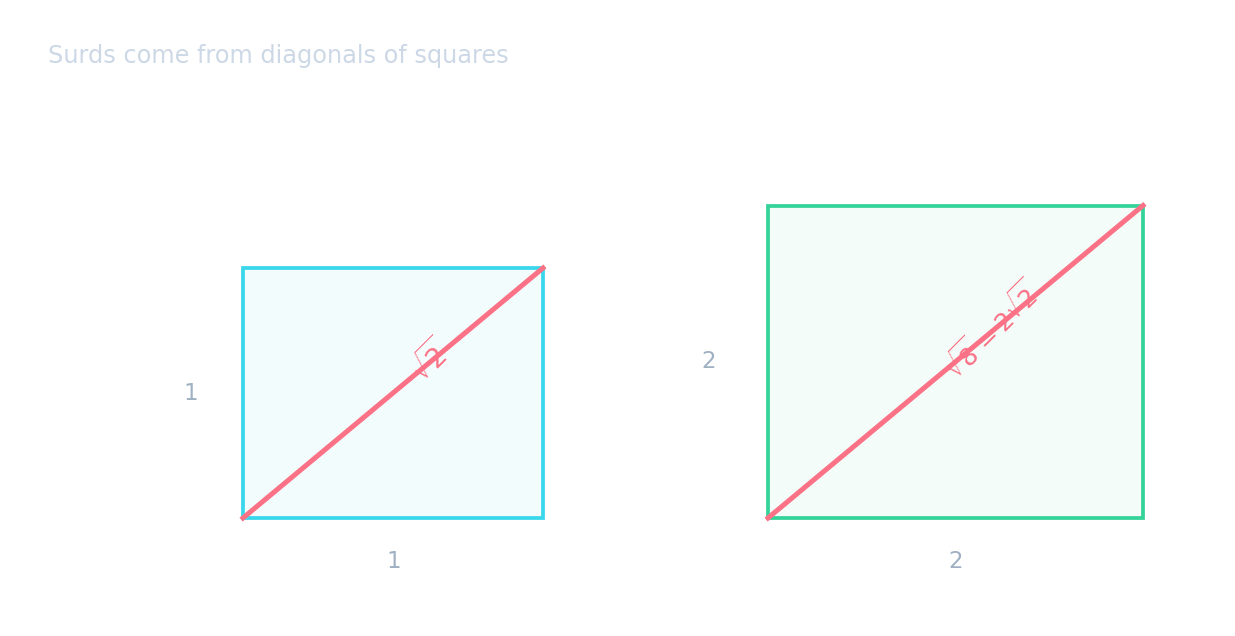
Fatorar uma diferença de dois quadrados ($a^2 - b^2$) é como comparar duas áreas de quadrados.
Factorise the difference of two squares 9x² − 16. · Fatorizar a diferença de dois quadrados 9x² − 16.
a² − b² = (a+b)(a−b), with a = 3x, b = 4. · a² − b² = (a+b)(a−b), com a = 3x, b = 4.
Match each expression to its factorisation. · Associe cada expressão à sua fatoração.
x²+7x+10: factors of 10 that add to 7 are 2 and 5. x²−9 = x²−3². 6x+9: HCF is 3. x²+4x+4 is a perfect square. · x²+7x+10: fatores de 10 que somam 7 são 2 e 5. x²−9 = x²−3². 6x+9: MDC é 3. x²+4x+4 é um quadrado perfeito.
You've got it
- substitute numbers for letters; collect like terms
- expand = multiply out brackets; factorise = write as a product
- (Extended) $a^2 - b^2 = (a+b)(a-b)$ — the difference of two squares
Entendeu?
- substitua números pelas letras; cole termos semelhantes
- expandir = multiplicar os colchetes; fatorar = escrever como um produto
- (Estendido) $a^2 - b^2 = (a+b)(a-b)$ — a diferença de dois quadrados