Writing an article · Escrevendo um artigo
What an article is for
- An article is for a magazine, a newspaper or a website.
- It informs or entertains a general reader.
- You usually give your own view, with reasons.
An article title is a front door, not the whole building.
Para que serve um artigo
- Um artigo é para uma revista, jornal ou site.
- Ele informa ou entretém um leitor geral.
- Você geralmente dá sua própria opinião, com razões.
O título de um artigo é uma porta de entrada, não o prédio inteiro.
Who reads an article?
An article is written for many general readers.
Catch the reader
- A strong title and first line catch the reader's interest.
- Ask a question, or start with a surprising fact.
- Keep the reader wanting to read more.
Three ways to catch the reader's interest in your first lines
Capture o leitor
- Um título forte e primeira linha capturam o interesse do leitor.
- Faça uma pergunta, ou comece com um fato surpreendente.
- Mantenha o leitor querendo ler mais.
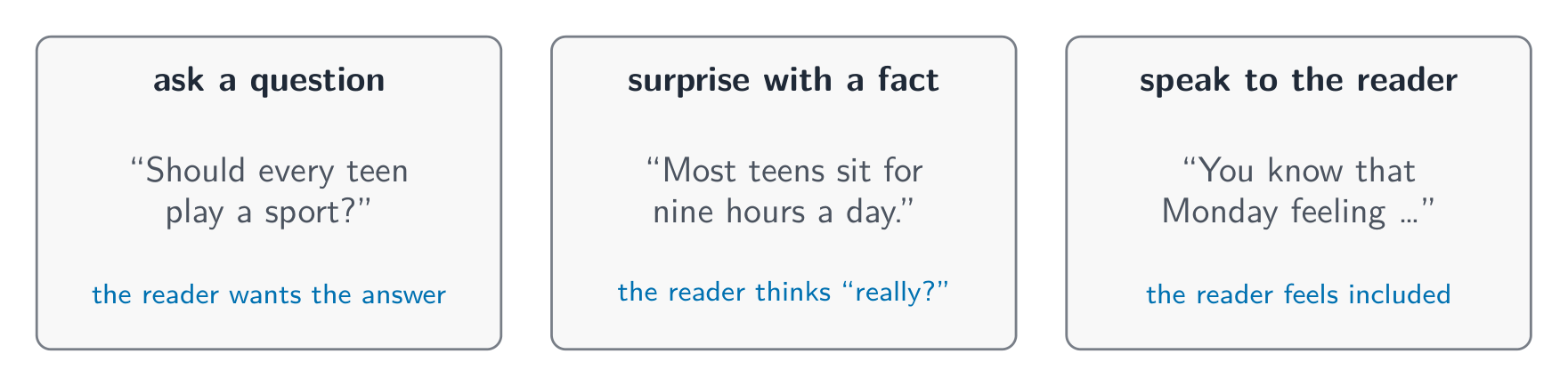
Três maneiras de capturar o interesse do leitor nas primeiras linhas
Hook or snooze? · Gancho ou tédio?
A hook makes the reader need line two; a snooze announces the topic and loses them.
A dull title is fine for an article.
A catchy title is needed to grab interest.
Write a catchy first line for an article about your favourite hobby.
Example: 'Could one small hobby change your whole week?'
Lively language
- Shape: introduction → middle → short conclusion.
- Use varied words and sentence lengths.
- You can speak to the reader directly with 'you'.
Linguagem animada
- Forma: introdução → meio → conclusão curta.
- Use palavras variadas e comprimentos de frase variados.
- Você pode falar diretamente com o leitor usando 'you'.
Put the parts of an article in order.
Title and opening first, then the points, then a conclusion.
An article has an introduction, a developed middle and a short ____.
The conclusion draws the ideas together and leaves the reader with a clear final thought.
Hook, then deliver
- Task: an article for the school magazine about learning an instrument.
- Headline: "The Ten-Minute Musician" — short, curious, no full stop.
- Hook: "Did you know ten minutes of practice a day beats a two-hour cram on Sunday?"
- Then deliver: your view plus reasons, and an ending that echoes the hook: "Ten minutes. Every day. That's the whole secret."
Gancho, depois entrega
- Tarefa: um artigo para a revista escolar sobre aprender um instrumento.
- Manchete: "The Ten-Minute Musician" — curta, curiosa, sem ponto final.
- Gancho: "Did you know ten minutes of practice a day beats a two-hour cram on Sunday?"
- Depois entregue: sua opinião mais razões, e um final que ecoa o gancho: "Ten minutes. Every day. That's the whole secret."
Match the hook technique to its example.
Four reliable hooks — pick the one that fits your topic and audience.
An article for a school magazine argues for a quiet reading room. Which sentence best addresses its readers?
Direct address suits a magazine article for students. The alternatives belong to a formal letter or report.
An interesting opening is enough; the article does not need reasons or development.
The opening attracts attention, but the middle must deliver useful ideas and supporting reasons.
- An article is for many readers; it informs or entertains.
- A catchy title and opening grab interest.
- Lively, varied language keeps energy up.
- Um artigo é para muitos leitores; informa ou entretém.
- Um título cativante e abertura capturam o interesse.
- Linguagem animada e variada mantém a energia alta.