Foreign exchange rates
Introduzido| English | Significado |
|---|---|
| currency/ˈkʌrənsi/ | moeda |
| exchange rate/eksˈtʃeɪndʒ reɪt/ | taxa de câmbio |
| appreciation/əˌpriːʃɪˈeɪʃn/ | valorização |
| depreciation/dɪˌpriːʃɪˈeɪʃn/ | desvalorização |
What is a currency worth?
- A Chinese firm that buys German machines must pay in euros, so it first buys euros with yuan. The price of one currency 货币 in terms of another is the exchange rate 汇率, for example 1 euro = 7.8 yuan.
- When that price changes, the cost of every import and export changes too. This lesson explains how the rate is set, why it changes, and what a change does to the economy.
How a floating exchange rate is set
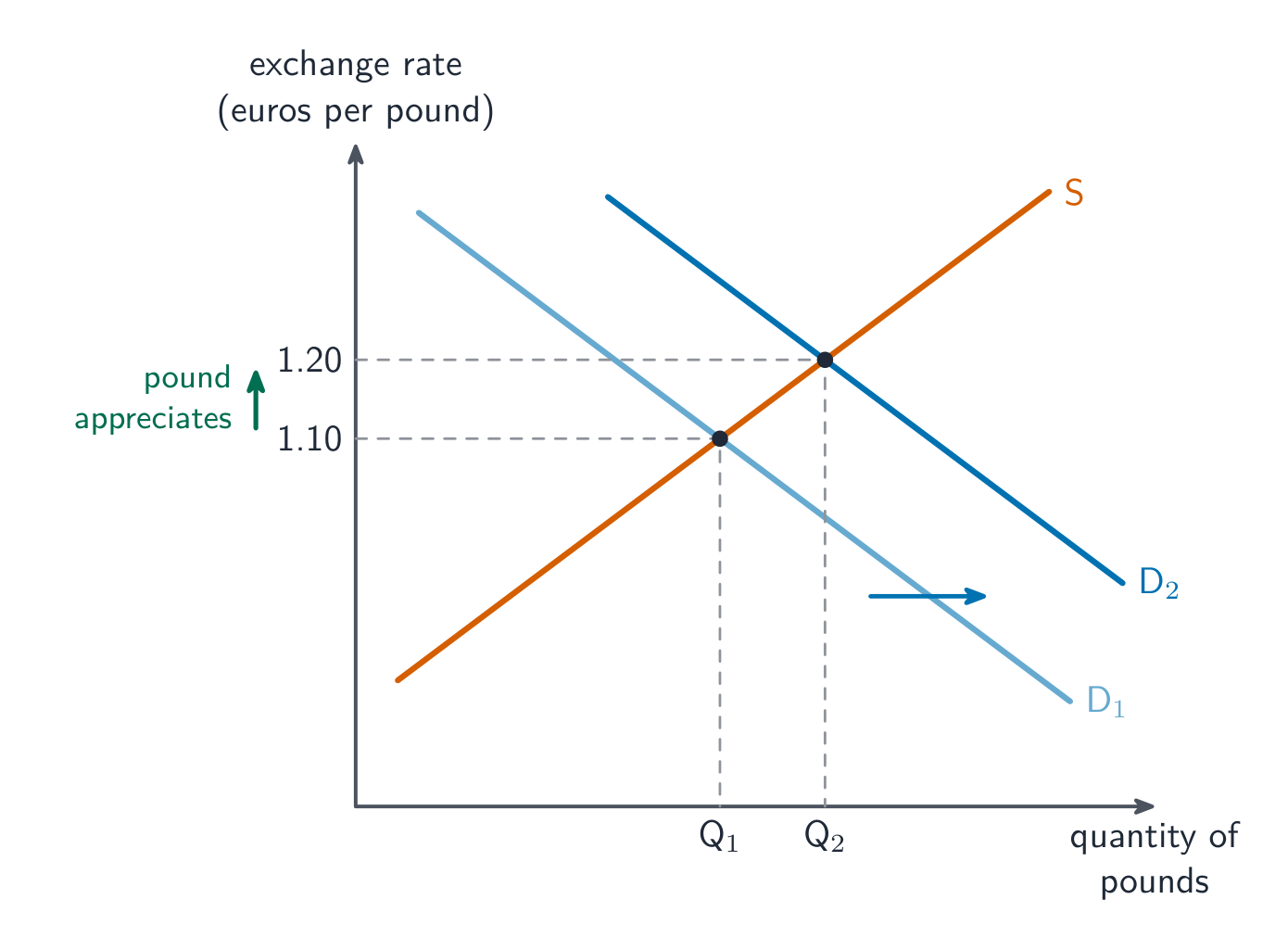
- In a floating system, the exchange rate is set by the demand for and supply of the currency, like any other price. In a fixed system, the government or central bank holds the rate at a chosen level.
| The pound is demanded by… | The pound is supplied by… |
|---|---|
| foreigners buying UK exports | UK residents buying imports |
| foreign tourists visiting the UK | UK tourists going abroad |
| foreigners investing in the UK or saving in UK banks | UK firms and people investing abroad |
O mercado cambial
A currency is bought and sold like any good. More demand for it raises its exchange rate — it appreciates.
An exchange rate is:
Dificuldade 1/5 · Moedas 100 + pequeno bônus na primeira conclusão hoje
It is the price of a currency, set by supply and demand.
Appreciation and depreciation
- Appreciation 升值: the currency rises in value, so one unit buys more foreign currency (1 pound = 1.10 euros → 1.20 euros).
- Depreciation 贬值: the currency falls in value, so one unit buys less (1 pound = 1.10 euros → 1.00 euro).
| Cause | Effect on the currency | Result |
|---|---|---|
| foreign demand for the country's exports rises | demand for the currency rises | appreciation |
| interest rates rise at home, attracting foreign savings | demand for the currency rises | appreciation |
| more foreign investment comes in (for example a new car factory) | demand for the currency rises | appreciation |
| people at home buy more imports | supply of the currency rises | depreciation |
| inflation is higher than abroad, so exports lose sales | demand falls (and supply rises) | depreciation |
| speculators expect the currency to fall and sell it | supply of the currency rises | depreciation |
Currency depreciation means the currency has:
Dificuldade 1/5 · Moedas 100 + pequeno bônus na primeira conclusão hoje
Depreciation is a fall; appreciation is a rise.
A rise in the value of a currency is called ______.
Dificuldade 1/5 · Moedas 100 + pequeno bônus na primeira conclusão hoje
Appreciation is a rise; depreciation is a fall.
The central bank raises interest rates. What is the likely effect on a floating exchange rate?
Dificuldade 1/5 · Moedas 100 + pequeno bônus na primeira conclusão hoje
Higher interest rates attract savings from abroad. To save there, foreigners must buy the currency, so demand rises and the rate appreciates.
How a change affects prices
- SPICED: a Strong Pound makes Imports Cheaper and Exports Dearer. A weak currency does the opposite.
Worked example. A UK firm sells a machine for £2000. The rate falls from 1 pound = 1.20 euros to 1 pound = 1.00 euro.
- Price in euros before: 2000 × 1.20 = 2400 euros. After: 2000 × 1.00 = 2000 euros.
- The depreciation makes the UK export 400 euros cheaper for a European buyer, so sales should rise.
- A French wine costs 12 euros. In pounds: before 12 ÷ 1.20 = £10; after 12 ÷ 1.00 = £12. Imports become dearer.
- Rule: from pounds to euros, multiply by the rate; from euros to pounds, divide.
A weaker (depreciated) currency makes a country's exports:
Dificuldade 1/5 · Moedas 100 + pequeno bônus na primeira conclusão hoje
A weaker currency lowers the foreign price of exports.
A stronger currency makes imports more expensive.
Dificuldade 1/5 · Moedas 100 + pequeno bônus na primeira conclusão hoje
False. A stronger currency buys more foreign goods, so imports become cheaper and exports dearer.
A Japanese firm sells a camera for 60 000 yen. The rate is 1 US dollar = 150 yen. What is the price in dollars?
Dificuldade 2/5 · Moedas 140 + pequeno bônus na primeira conclusão hoje
From yen to dollars, divide by the rate: 60 000 ÷ 150 = 400 dollars.
The yen depreciates to 1 US dollar = 160 yen. What is the dollar price of the same 60 000-yen camera now?
Dificuldade 2/5 · Moedas 140 + pequeno bônus na primeira conclusão hoje
60 000 ÷ 160 = 375 dollars. The yen depreciated, so the Japanese export became 25 dollars cheaper in the US.
Consequences for the economy
| Depreciation | Appreciation | |
|---|---|---|
| exports | cheaper abroad → more sold | dearer abroad → fewer sold |
| imports | dearer → fewer bought | cheaper → more bought |
| current account | may move towards a surplus | may move towards a deficit |
| employment and growth | more output for export → more jobs | export firms may cut jobs |
| inflation | imported goods and raw materials cost more → higher inflation | cheaper imports → lower inflation |
Exam question. Analyse how a fall in a country's foreign exchange rate could increase employment. [6]
- Model answer: A fall in the exchange rate makes the country's exports cheaper in foreign currencies (1). Foreign buyers demand more exports (1), so export firms need to produce more (1) and hire more workers (1), reducing unemployment. At the same time imports become dearer (1), so people at home switch to domestic goods, and domestic firms also need more workers (1).
- Mark-scheme reasoning: "Analyse" marks the links. Each step that follows from the one before earns a mark; jumping from "exchange rate falls" to "more jobs" earns little.
Why can a depreciation cause inflation?
Dificuldade 1/5 · Moedas 100 + pequeno bônus na primeira conclusão hoje
After a depreciation, each import costs more of the home currency. Firms pay more for imported fuel and parts and pass the cost on, so the price level rises.
Discuss: does a rise in the exchange rate benefit the economy?
Exam question. Discuss whether or not a rise in a country's foreign exchange rate would benefit its economy. [8]
- It may benefit: imports become cheaper, so inflation may fall, especially if the country imports oil, food or raw materials. Firms that import parts face lower costs. Consumers can buy more foreign goods and holidays with the same income.
- It may not: exports become dearer abroad, so export sales fall. Export firms may cut output and jobs, and economic growth may slow. Cheaper imports also take sales from domestic firms, and the current account may move into deficit.
- Conclusion: it depends on how large the rise is, on whether the economy relies more on exports or on imported raw materials, and on whether inflation or unemployment is the bigger problem at the time.
- Mark-scheme reasoning: up to 4 marks for each side, each point developed as a chain, with credit for a reasoned conclusion that says what it depends on.
You've got it
- the exchange rate is the price of a currency; in a floating system it is set by demand and supply
- demand for a currency comes from exports, inward tourism and investment; supply from imports and investment abroad
- appreciation = the currency buys more foreign currency; depreciation = it buys less
- SPICED: a strong currency makes imports cheaper and exports dearer
- depreciation: more exports and jobs, but higher inflation; appreciation: the opposite
- converting prices: home → foreign multiply by the rate; foreign → home divide
One US dollar used to buy 8 units of the local currency and now buys only 6. Has the local currency appreciated or depreciated? What happens to the price of the country's exports in dollars, and to employment in export firms?
Read the rate from the local currency's side: 1 unit was worth 1/8 dollar and is now worth 1/6 dollar, which is more. A dollar buying less local money always means the local currency has risen.
One US dollar used to buy 8 units of the local currency and now buys 6. What has happened to the local currency?
Dificuldade 1/5 · Moedas 100 + pequeno bônus na primeira conclusão hoje
A dollar buys fewer local units, so the dollar has fallen and the local currency has risen: 1 unit was worth 1/8 dollar and is now worth 1/6 dollar.