Pobreza
Introduzido| English | Significado |
|---|---|
| poverty/ˈpɒvəti/ | pobreza |
| inequality/ɪniːˈkwɒlɪti/ | desigualdade |
| absolute poverty/ˈæbsəluːt ˈpɒvəti/ | pobreza absoluta |
| relative poverty/ˈrelətɪv ˈpɒvəti/ | pobreza relativa |
| Lorenz curve/ˈlɒrənts kɜːv/ | curva de Lorenz |
| progressive taxes/prəˈɡresɪv ˈtæksɪz/ | impostos progressivos |
| minimum wage/ˈmɪnɪməm weɪdʒ/ | salário mínimo |
The gap between rich and poor
- In every country, some people have far more than others. In some, the gap is enormous.
- Economics studies both poverty 贫困 (having too little) and inequality 不平等 (the gap itself).
Laboratório de casos de economia
Classify real examples by the economic idea they show.
Absolute poverty means:
Dificuldade 1/5 · Moedas 100 + pequeno bônus na primeira conclusão hoje
Absolute poverty is a lack of basic necessities.
A family that can meet its basic needs but has far less than the national average is in:
Dificuldade 1/5 · Moedas 100 + pequeno bônus na primeira conclusão hoje
Relative poverty is defined against the average in society.
Poverty measured against the average income in society is ______ poverty.
Dificuldade 1/5 · Moedas 100 + pequeno bônus na primeira conclusão hoje
Relative poverty compares to the societal average.
Two kinds of poverty
- Absolute poverty 绝对贫困: not having enough for basic needs — food, shelter, clean water.
- Relative poverty 相对贫困: having much less than the average in your society, even if basic needs are met.
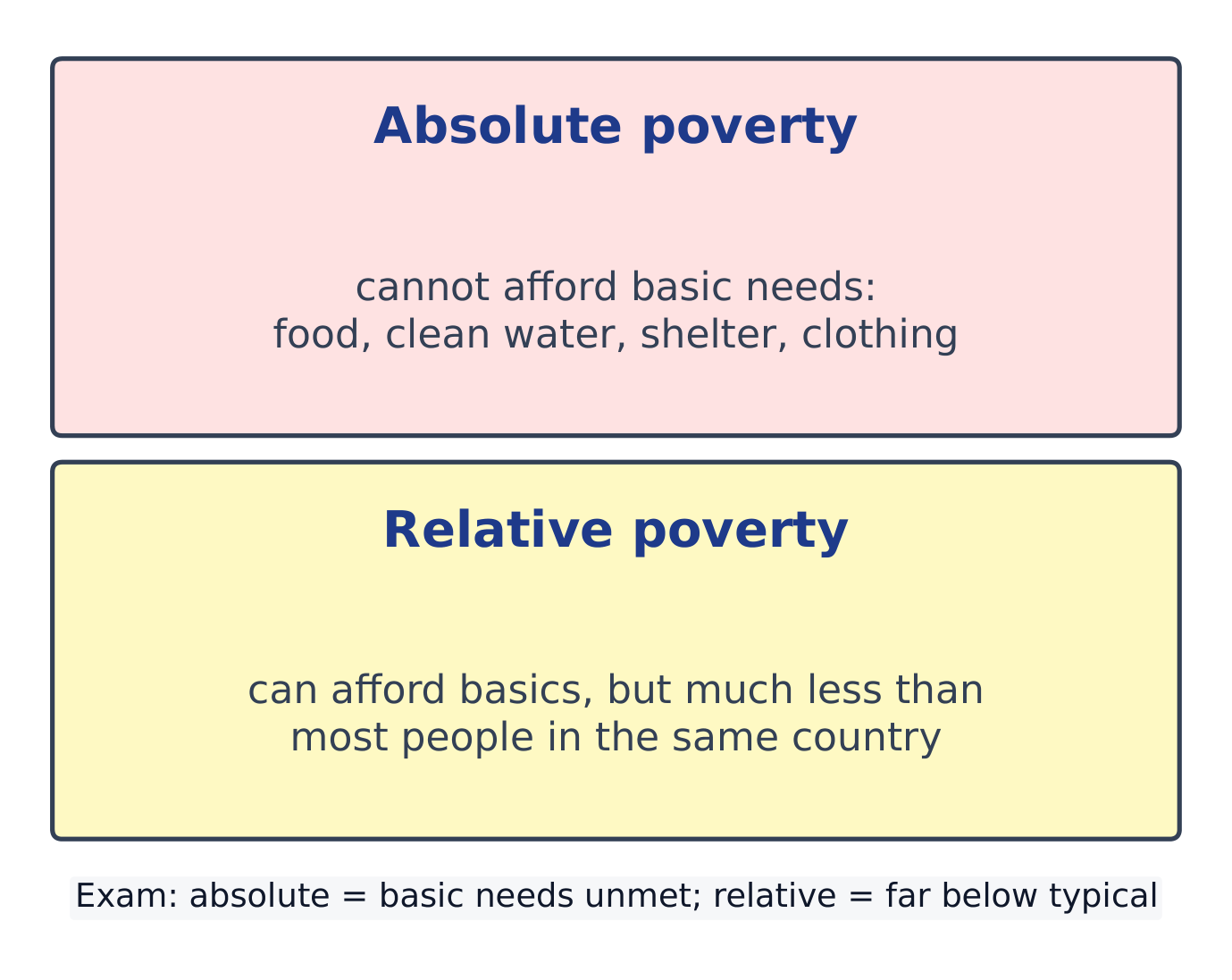
Two types of poverty: absolute (cannot afford basic needs) and relative (poor compared with others in the same country)
On a Lorenz curve, greater inequality is shown by a curve that:
Dificuldade 1/5 · Moedas 100 + pequeno bônus na primeira conclusão hoje
The more it bows away from the diagonal, the more unequal the distribution.
Picturing inequality
- A Lorenz curve 洛伦兹曲线 plots the share of income against the share of population.
- The further it bows from the diagonal line of equality, the more unequal the country.
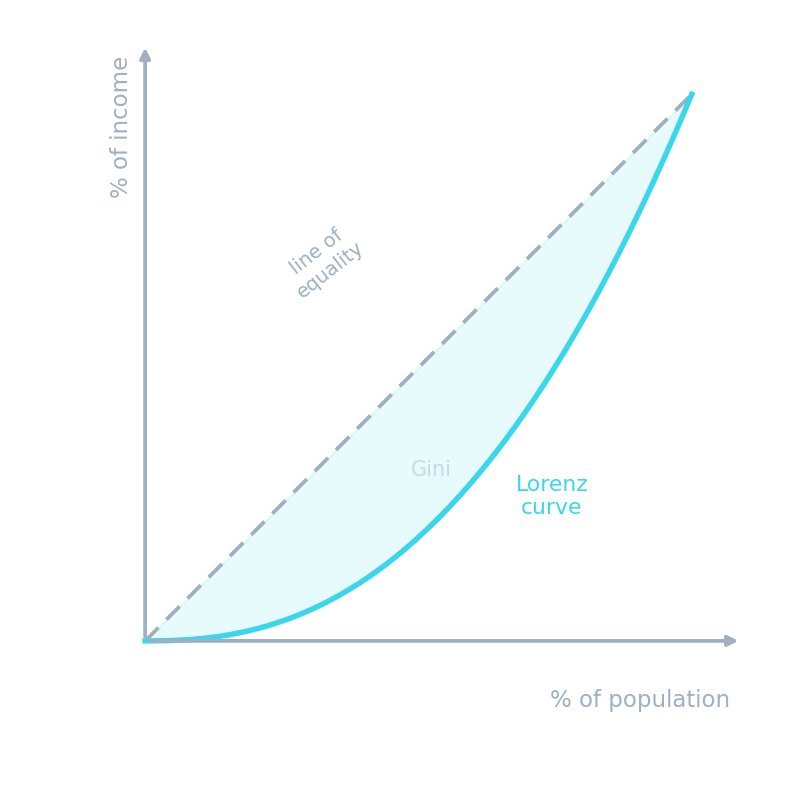
The further the Lorenz curve bows from the diagonal, the greater the inequality.
Bend the Lorenz curve
Drag the top-20% income share of each economy. The more the curve bows away from the diagonal, the more unequal the country.
Which policies help reduce poverty? (Select all that apply.)
Dificuldade 2/5 · Moedas 140 + pequeno bônus na primeira conclusão hoje
Cutting the minimum wage would worsen poverty.
Causes and cures
- Causes: unemployment, low wages, poor education, illness, old age.
- Policies: progressive taxes 累进税, benefits, a minimum wage 最低工资, free education and healthcare.
Poverty and inequality aren't the same. A rich country can have low absolute poverty but high inequality. Reducing one doesn't automatically reduce the other.
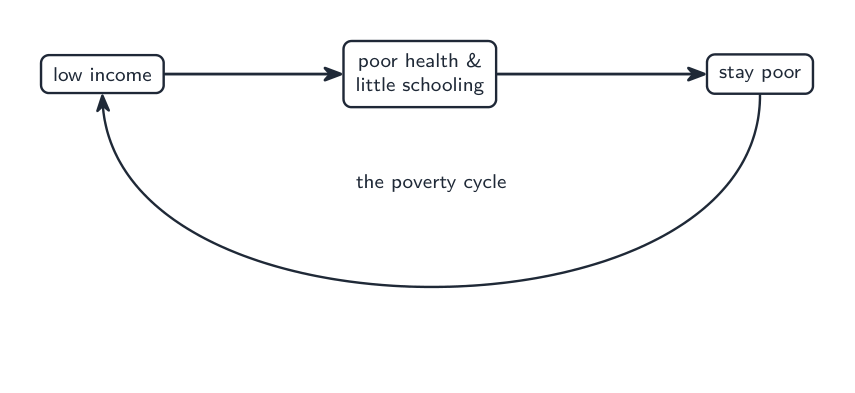
A poverty cycle
Worked example: two kinds of poor
Family A lives on less than 2.15 US dollars a day and cannot afford clean water. Family B in a rich country has a home and food, but an income less than half the national average. Classify each and suggest one policy.
- Family A is in absolute poverty: basic needs are not met. Free clean water, healthcare and education help most.
- Family B is in relative poverty: much poorer than the average in its own society. Progressive taxes, benefits and a minimum wage narrow the gap, which would make the country's Lorenz curve move closer to the line of equality.
Country X's Lorenz curve bows further from the line of equality than Country Y's. This means:
Dificuldade 1/5 · Moedas 100 + pequeno bônus na primeira conclusão hoje
The bigger the gap from the diagonal, the more unequal the income.
A progressive tax takes a higher percentage of income from people with higher incomes.
Dificuldade 1/5 · Moedas 100 + pequeno bônus na primeira conclusão hoje
Higher earners pay a larger share, which reduces inequality.
You've got it
- absolute poverty = can't meet basic needs; relative poverty = far below the average
- a Lorenz curve shows inequality — the more it bows, the more unequal
- cures: progressive taxes, benefits, minimum wage, free education/healthcare
Write from the data: find the income share
- The poorest 20 percent of people earn 5 percent of income.
- State the Lorenz point and what a deeper bow means.
The poorest 20 percent of people earn 5 percent of income. What is that income share as a decimal, and what does a Lorenz curve that bows further from the diagonal show?
5 percent is 0.05 of income.
What does a deeper bow in the Lorenz curve show?
Dificuldade 1/5 · Moedas 100 + pequeno bônus na primeira conclusão hoje
The share 0.05 for 20 percent of people is far below an equal share.