Polímeros
Introduzido| English | Significado |
|---|---|
| polymers/ˈpɒlɪməz/ | polímeros |
| monomer/ˈmɒnəʊmə/ | monômero |
| addition polymerisation/əˈdɪʃn ˌpɒlɪməraɪˈzeɪʃn/ | polimerização por adição |
| non-biodegradable/nɒn ˌbaɪəʊdɪˈɡreɪdəbl/ | não biodegradável |
Tiny units, giant chains
- Plastics are everywhere — and they're all built the same way, by joining small molecules into long chains.
- These long-chain molecules are polymers 聚合物.
A monomer is:
Dificuldade 1/5 · Moedas 100 + pequeno bônus na primeira conclusão hoje
Monomers join to form polymers.
A polymer is:
Dificuldade 1/5 · Moedas 100 + pequeno bônus na primeira conclusão hoje
Polymers are long chains of repeating units.
Monomers 单体 and polymers
- A monomer is a small molecule that can join to others.
- A polymer is a very long molecule made of many monomers joined together.
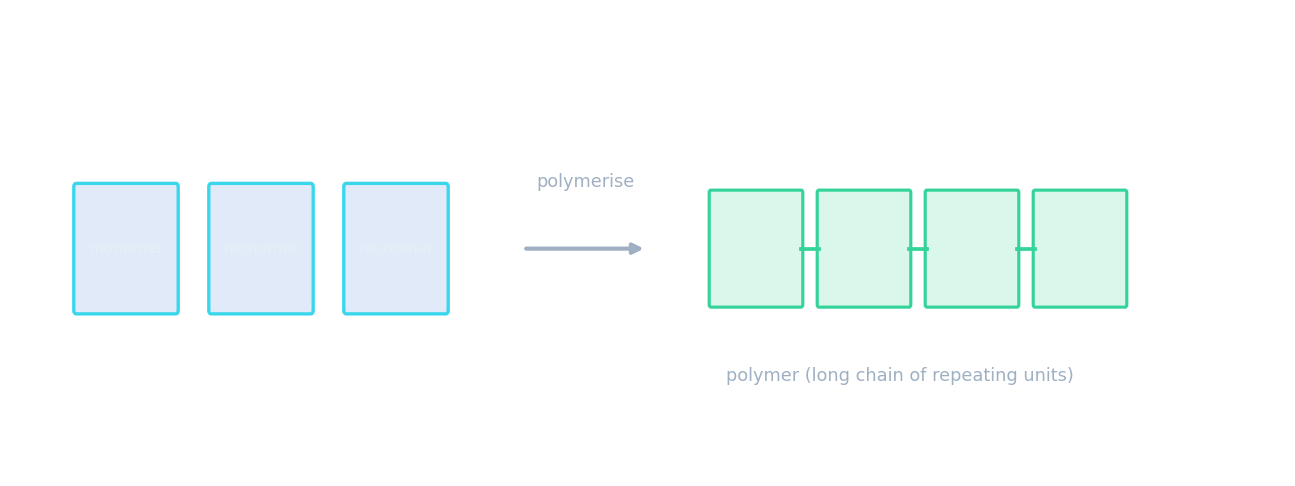
Many small monomers join to make one long polymer chain.
Making a polymer
Small monomers join into a long chain — the basis of all plastics.
In addition polymerisation, the monomers are:
Dificuldade 1/5 · Moedas 100 + pequeno bônus na primeira conclusão hoje
Alkene double bonds open and join.
Many ethene molecules join to form the polymer poly(______).
Dificuldade 1/5 · Moedas 100 + pequeno bônus na primeira conclusão hoje
Poly(ethene) is polythene.
Addition polymerisation 加聚
- In addition polymerisation, many alkene monomers add together.
- Their double bonds open up and join, with no other product formed.
- Example: many ethene molecules → poly(ethene) (polythene).
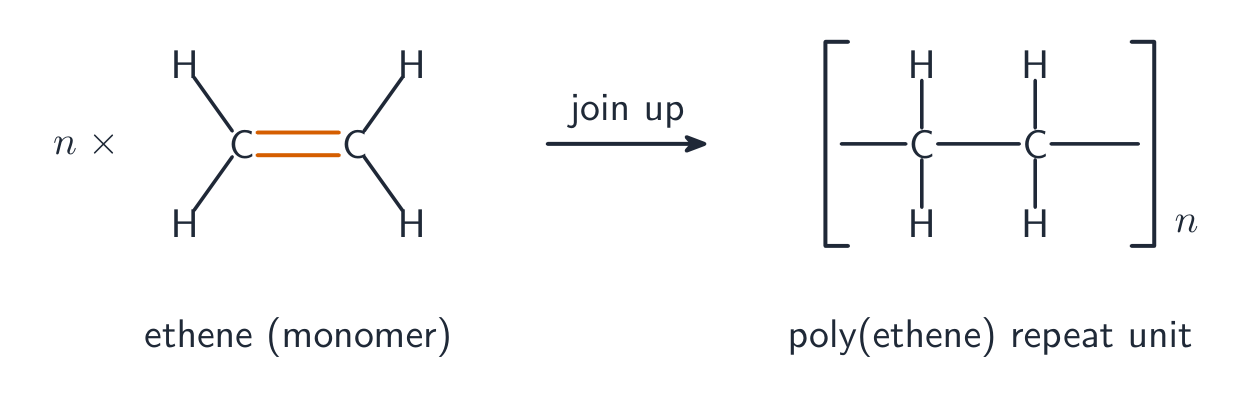
In addition polymerisation the C=C bonds open up and many ethene monomers join into one long poly(ethene) chain
Most addition polymers are non-biodegradable.
Dificuldade 1/5 · Moedas 100 + pequeno bônus na primeira conclusão hoje
They do not rot, so they build up as waste.
The plastic problem
- Most addition polymers are non-biodegradable 不可生物降解的 — they don't rot away.
- They build up as waste, so recycling and careful disposal matter.
Worked example. Ethene (CH₂=CH₂) has a double bond. Under pressure, thousands of ethene molecules open their double bonds and join into one long chain — poly(ethene), the plastic in bags and bottles.
Worked example: from monomer to repeat unit
Draw the polymer made from propene, CH₂=CH–CH₃.
- Draw the monomer with its C=C in the middle and the CH₃ group hanging below.
- Open the double bond into a single bond, and add a bond out of each side through the brackets.
- Write n after the bracket: the repeat unit is –[CH₂–CH(CH₃)]–, and the polymer is poly(propene).
| Addition polymer | Condensation polymer (Supplement) | |
|---|---|---|
| monomers | alkenes, with C=C | two different monomers with reacting groups |
| other product | none | a small molecule, e.g. water |
| examples | poly(ethene), poly(propene) | nylon (a polyamide), PET (a polyester) |
The repeat unit of a polymer is –[CH₂–CHCl]–. What is its monomer?
Dificuldade 1/5 · Moedas 100 + pequeno bônus na primeira conclusão hoje
Put back the double bond between the two carbons of the repeat unit: CH₂=CHCl. The polymer is PVC.
How does condensation polymerisation differ from addition polymerisation?
Dificuldade 1/5 · Moedas 100 + pequeno bônus na primeira conclusão hoje
In condensation polymerisation each link releases a small molecule; addition polymerisation forms the polymer only.
You've got it
- a polymer is a long chain made of many small monomers
- addition polymerisation: alkene monomers' double bonds open and join (no other product)
- e.g. ethene → poly(ethene); most are non-biodegradable, so recycling matters
Write from this case
- Many ethene molecules are joined into one chain.
- The product is poly(ethene).
What happens to the double bond as the chain forms?
Addition polymerisation uses the opened double bond to link monomers.
What happens to the double bond when ethene polymerises?
Dificuldade 1/5 · Moedas 100 + pequeno bônus na primeira conclusão hoje
The monomer's double bond becomes the link in the chain.