Fertilizantes
Introduzido| English | Significado |
|---|---|
| fertilisers/ˈfɜːtəlaɪzəz/ | fertilizantes |
| nitrogen/ˈnaɪtrədʒn/ | nitrogênio |
| phosphorus/ˈfɒsfɔːrəs/ | fósforo |
| potassium/pəˈtæsɪəm/ | potássio |
| eutrophication/ˌjuːtrəfɪˈkeɪʃn/ | eutrofização |
Feeding the crops
- To grow well, plants need certain elements from the soil — and farming removes them over time.
- Fertilisers 肥料 put these nutrients back.
Fertiliser route lab
Follow nitrogen from raw materials to crop growth.
NPK fertilisers supply nitrogen, phosphorus and:
Dificuldade 1/5 · Moedas 100 + pequeno bônus na primeira conclusão hoje
N, P and K are the three key nutrients.
The three elements supplied by NPK fertilisers are nitrogen, ______ and potassium.
Dificuldade 1/5 · Moedas 100 + pequeno bônus na primeira conclusão hoje
N, P and K.
The key nutrients
- Plants need nitrogen 氮气 (N), phosphorus 磷 (P) and potassium 钾 (K).
- Fertilisers supplying these are called NPK fertilisers.
Nitrogen in fertiliser mainly helps plants with:
Dificuldade 1/5 · Moedas 100 + pequeno bônus na primeira conclusão hoje
Nitrogen is used to make proteins for growth.
Why each matters
- Nitrogen: for healthy leaves and growth (making proteins).
- Phosphorus: for roots; potassium: for flowers and fruit.
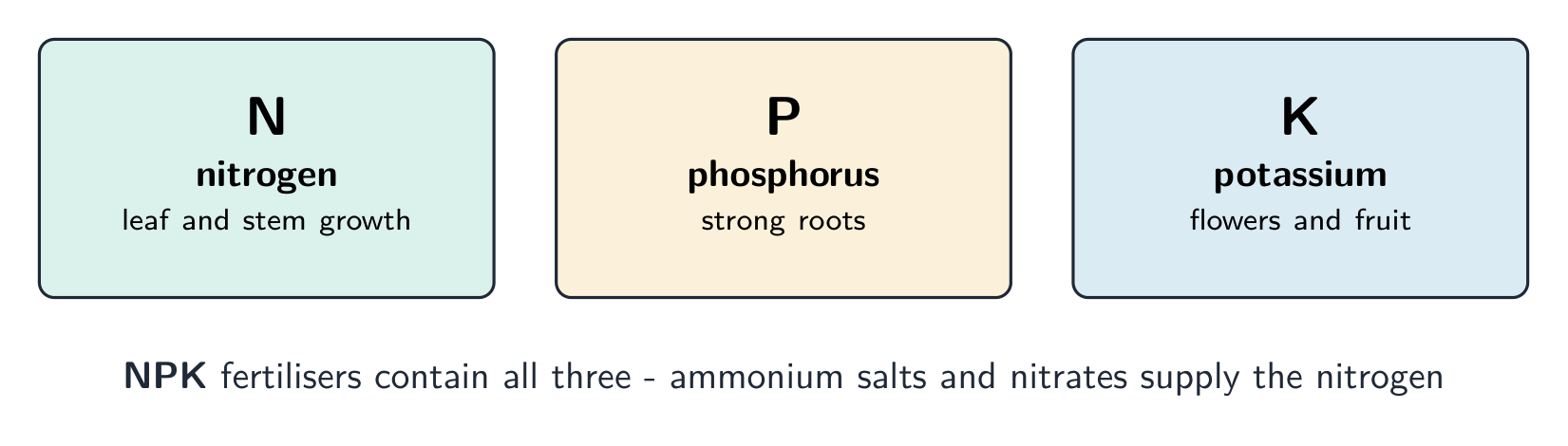
N for leaves and stems, P for roots, K for flowers and fruit
A benefit of fertilisers is that they:
Dificuldade 1/5 · Moedas 100 + pequeno bônus na primeira conclusão hoje
They replace nutrients, raising yields.
Excess fertiliser washing into rivers can cause eutrophication.
Dificuldade 1/5 · Moedas 100 + pequeno bônus na primeira conclusão hoje
Nutrient run-off feeds algal blooms that deplete oxygen.
Benefits and problems
- Fertilisers raise crop yields, feeding more people.
- But run-off into rivers causes eutrophication 富营养化 (an environmental problem).
Fertilisers boost yields but can pollute water. Excess fertiliser washes into rivers, feeding algal blooms that use up the oxygen and kill fish (eutrophication). Use must be balanced.
Worked example: how much nitrogen?
Ammonium nitrate, $\text{NH}_4\text{NO}_3$, is a common fertiliser. What percentage of its mass is nitrogen? ($A_r$: N = 14, H = 1, O = 16)
- $M_r = 14 + 4(1) + 14 + 3(16) = 80$. It contains 2 N atoms, so the mass of nitrogen is $2 \times 14 = 28$.
- Percentage of nitrogen $= \dfrac{28}{80} \times 100 = 35\%$. A farmer compares fertilisers this way: more nitrogen per kilogram means less needs to be spread.
Ammonium sulfate, $(\text{NH}_4)_2\text{SO}_4$, has $M_r = 132$. What percentage of its mass is nitrogen? Give your answer to 1 decimal place.
Dificuldade 2/5 · Moedas 140 + pequeno bônus na primeira conclusão hoje
It has 2 N atoms: $\dfrac{28}{132} \times 100 = 21.2\%$.
Which compound would supply potassium in an NPK fertiliser?
Dificuldade 1/5 · Moedas 100 + pequeno bônus na primeira conclusão hoje
Only KCl contains potassium; the others supply nitrogen or phosphorus.
You've got it
- plants need nitrogen, phosphorus and potassium — supplied by NPK fertilisers
- nitrogen → growth/leaves; phosphorus → roots; potassium → flowers/fruit
- fertilisers raise yields but excess causes eutrophication
Write from this case
- An NPK fertiliser supplies nitrogen, phosphorus and potassium.
- A grower wants more leaf and stem growth.
Which element is the main one for that growth?
Nitrogen is the N in NPK and supports leafy growth.
Which element in NPK mainly supports leaves?
Dificuldade 1/5 · Moedas 100 + pequeno bônus na primeira conclusão hoje
The three elements do different jobs in the plant.