Insoluble salts and water of crystallisation · Sais insolúveis e água de cristalização
| English | Português |
|---|---|
| precipitation/prɪˌsɪpɪˈteɪʃn/ | precipitação |
| precipitate/prɪˈsɪpɪteɪt/ | precipitado |
| water of crystallisation/ˈwɔːtə ɒv ˌkrɪstəlaɪˈzeɪʃn/ | água de cristalização |
| hydrated/haɪˈdreɪtɪd/ | hidratado |
| anhydrous/ænˈhaɪdrəs/ | anidro |
Salts that won't dissolve
- Some salts don't dissolve in water. They're made a different way — by precipitation 沉淀.
- And some crystals trap water inside them.
Sais que não se dissolvem
- Alguns sais não se dissolvem em água. Eles são feitos de outra forma — por precipitação 沉淀.
- E alguns cristais aprisionam água em seu interior.
An insoluble salt is made by: · Um sal insolúvel é feito por:
Precipitation forms an insoluble solid. · A precipitação forma um sólido insolúvel.
The insoluble solid that forms when two solutions are mixed is called a: · O sólido insolúvel que se forma quando duas soluções são misturadas é chamado de:
An insoluble solid formed this way is a precipitate. · Um sólido insolúvel formado dessa maneira é um precipitado.
Making insoluble salts
- Mix two soluble salt solutions that contain the right ions.
- The insoluble salt forms as a solid precipitate 沉淀, which is filtered off.
Worked example. To make insoluble silver chloride, mix silver nitrate solution with sodium chloride solution. Silver chloride forms as a white precipitate, which you filter, wash and dry.
Mixing two solutions that each carry one of the needed ions makes the insoluble salt appear as a solid precipitate
A strong acid is fully split into ions; a weak acid stays mostly as molecules
Fazendo sais insolúveis
- Misturar duas soluções de sais solúveis que contenham os íons corretos.
- O sal insolúvel forma-se como um precipitado sólido 沉淀, que é filtrado.
Exemplo resolvido. Para fazer cloreto de prata insolúvel, misturar solução de nitrato de prata com solução de cloreto de sódio. Cloreto de prata forma-se como um precipitado branco, que você filtra, lava e seca.
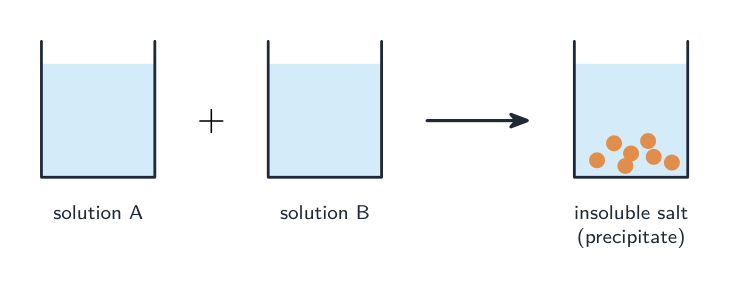
Misturar duas soluções que carregam cada uma um dos íons necessários faz o sal insolúvel aparecer como um precipitado sólido

Um ácido forte é totalmente dividido em íons; um ácido fraco permanece principalmente como moléculas
Making an insoluble salt by precipitation · Produzindo um sal insolúvel por precipitação
Step through precipitation. Mix two solutions whose ions swap partners to make an insoluble salt, then filter, wash and dry the solid. · Siga a precipitação passo a passo. Misture duas soluções cujos íons trocam parceiros para formar um sal insolúvel, depois filtre, lave e seque o sólido.
A salt that contains water of crystallisation is described as: · Um sal que contém água de cristalização é descrito como:
Hydrated salts contain locked-in water. · Sais hidratados contêm água aprisionada.
Water locked into the structure of a crystal is called water of ______. · A água aprisionada na estrutura de um cristal é chamada de água de ______.
Such salts are hydrated. · Tais sais são hidratados.
Water of crystallisation 结晶水
- Some salt crystals contain water locked into their structure — water of crystallisation.
- These are hydrated 水合 salts (e.g. blue copper sulfate, CuSO₄·5H₂O).
Água de cristalização 结晶水
- Alguns cristais de sal contêm água presa em sua estrutura — água de cristalização.
- Estes são sais hidratados 水合 (ex. sulfato de cobre azul, CuSO₄·5H₂O).
Heating hydrated copper sulfate (blue) drives off water, leaving white anhydrous salt. · Aquecer sulfato de cobre hidratado (azul) remove a água, deixando o sal anidro branco.
Removing the water of crystallisation turns it white. · Remover a água de cristalização torna-se branco.
Hydrated and anhydrous 无水
- Heating a hydrated salt drives off the water, leaving the anhydrous salt.
- Blue hydrated copper sulfate turns white when the water is removed.
Precipitation is for insoluble salts; the excess-acid method is for soluble ones. Choose the method by the salt's solubility: insoluble → mix two solutions; soluble → react acid with excess base.
Hidratado e anidro 无水
- Aquecer um sal hidratado elimina a água, deixando o sal anidro.
- Sulfato de cobre hidratado azul torna-se branco quando a água é removida.
Precipitação é para sais insolúveis; o método de excesso de ácido é para sais solúveis. Escolha o método pela solubilidade do sal: insolúvel → misture duas soluções; solúvel → reaja ácido com base em excesso.
You've got it
- insoluble salts are made by precipitation (mix two solutions, filter the solid)
- water of crystallisation is water locked in crystals → a hydrated salt
- heating removes it, leaving the anhydrous salt (blue → white copper sulfate)
Entendeu?
- sais insolúveis são feitos por precipitação (misture duas soluções, filtre o sólido)
- água de cristalização é água presa nos cristais → um sal hidratado
- aquecimento remove-a, deixando o sal anidro (azul → branco sulfato de cobre)