Redox
Introduzido| English | Significado |
|---|---|
| redox/rɪˈdɒks/ | oxirredução |
| oxidation/ˌɒksɪˈdeɪʃn/ | oxidação |
| reduction/rɪˈdʌkʃn/ | redução |
| reducing agent/rɪˈdjuːsɪŋ ˈeɪdʒənt/ | agente redutor |
| oxidising agent/ˈɒksɪdaɪzɪŋ ˈeɪdʒənt/ | agente oxidante |
| respiration/ˌrespɪˈreɪʃn/ | respiração |
| displacement/dɪˈspleɪsmənt/ | deslocamento |
Electron bookkeeping
- Many reactions involve electrons moving from one substance to another.
- These are redox 氧化还原 reactions — short for reduction and oxidation.
In terms of electrons, oxidation is:
Dificuldade 1/5 · Moedas 100 + pequeno bônus na primeira conclusão hoje
OIL: Oxidation Is Loss of electrons.
Oxidation and reduction:
Dificuldade 1/5 · Moedas 100 + pequeno bônus na primeira conclusão hoje
Electrons lost by one are gained by another.
The memory aid for redox is OIL ______.
Dificuldade 1/5 · Moedas 100 + pequeno bônus na primeira conclusão hoje
Oxidation Is Loss, Reduction Is Gain.
Oxidation 氧化 and reduction 还原
- Oxidation Is Loss of electrons; Reduction Is Gain of electrons (OIL RIG).
- The two always happen together: if one substance loses electrons, another gains them.
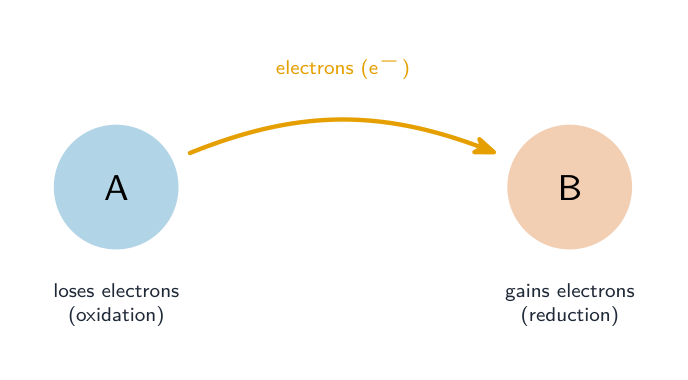
Electrons pass from the substance that is oxidised (loses them) to the one that is reduced (gains them) — OIL RIG
Oxidação e redução acontecem juntas
Step through a redox reaction. One substance loses electrons while another gains them — you can never have one without the other.
A reducing agent:
Dificuldade 1/5 · Moedas 100 + pequeno bônus na primeira conclusão hoje
A reducing agent donates electrons.
Oxidising and reducing agents 还原剂
- An oxidising agent 氧化剂 takes electrons (so it is itself reduced).
- A reducing agent gives electrons (so it is itself oxidised).
In terms of oxygen, oxidation is the loss of oxygen.
Dificuldade 1/5 · Moedas 100 + pequeno bônus na primeira conclusão hoje
False. Oxidation is the gain of oxygen; reduction is the loss of oxygen.
Redox in the world
- Many everyday reactions are redox: combustion, rusting, respiration 呼吸作用, and displacement 置换.
- In terms of oxygen, oxidation is gain of oxygen and reduction is loss of oxygen.
Worked example. When magnesium burns: Mg loses electrons (oxidised) and oxygen gains them (reduced). Magnesium is the reducing agent; oxygen is the oxidising agent. One reaction, both processes.
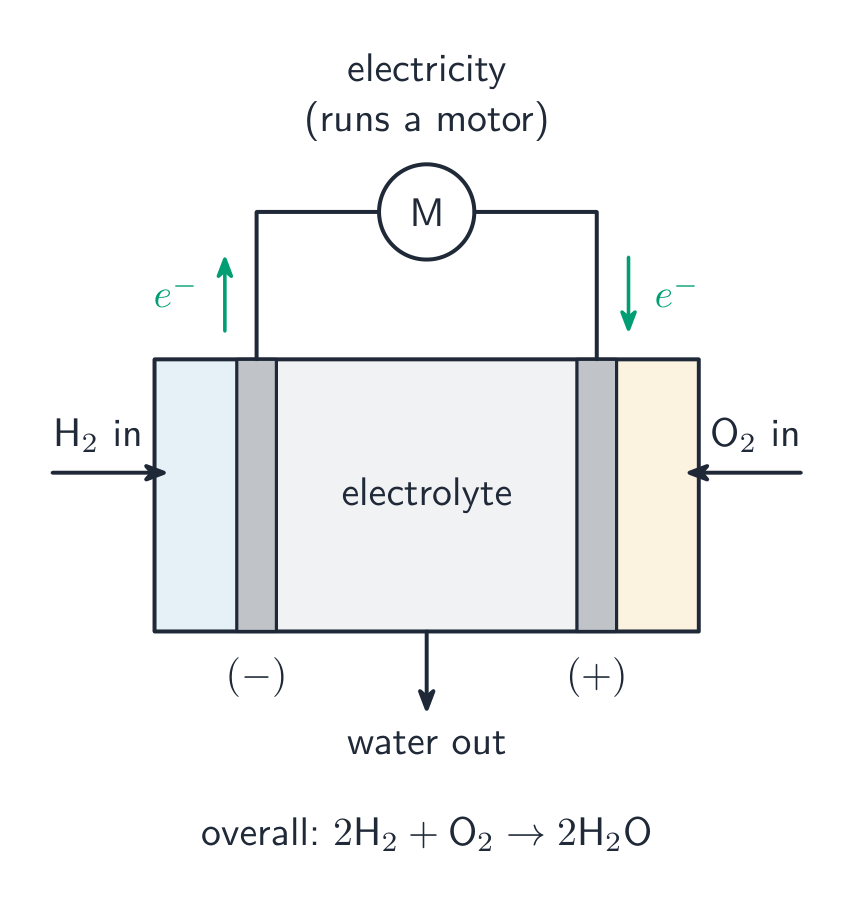
A hydrogen fuel cell runs on a redox reaction: hydrogen is oxidised and oxygen is reduced
Tests for oxidising and reducing agents
| Reagent added | Colour change | Shows the unknown is |
|---|---|---|
| acidified potassium manganate(VII) | purple → colourless | a reducing agent |
| potassium iodide | colourless → brown (iodine forms) | an oxidising agent |
- In an ionic equation, find which particle loses electrons. In Zn + Cu²⁺ → Zn²⁺ + Cu, zinc loses 2 electrons (oxidised) and Cu²⁺ gains them (reduced).
- Supplement: Roman numerals give the oxidation number: in iron(III) oxide iron is +3.
Acidified potassium manganate(VII) turns from purple to colourless when a solution is added. What does this show?
Dificuldade 1/5 · Moedas 100 + pequeno bônus na primeira conclusão hoje
The reducing agent gives electrons to the manganate(VII) ions, which are reduced and lose their purple colour.
In Zn + Cu²⁺ → Zn²⁺ + Cu, which species is oxidised?
Dificuldade 1/5 · Moedas 100 + pequeno bônus na primeira conclusão hoje
Zinc atoms lose two electrons to become Zn²⁺: loss of electrons is oxidation.
You've got it
- redox = reduction + oxidation, always happening together
- OIL RIG: Oxidation Is Loss, Reduction Is Gain of electrons
- an oxidising agent gains electrons; a reducing agent loses them
Write from magnesium being oxidised
- Magnesium atoms become Mg2+ ions and electrons are released.
- Another species gains those electrons.
Is the magnesium oxidised or reduced?
Loss of electrons is oxidation.
What happens to magnesium when it forms Mg2+?
Dificuldade 1/5 · Moedas 100 + pequeno bônus na primeira conclusão hoje
The atom loses two electrons.