Activation energy and reaction pathways
Introduzido| English | Significado |
|---|---|
| activation energy/ˌæktɪˈveɪʃn ˈenədʒi/ | energia de ativação |
| reaction pathway diagram/rɪˈækʃn ˈpæθweɪ ˈdaɪəɡræm/ | diagrama de caminho da reação |
A match that waits for the box, 1855
- In 1855 the Swedish inventor Johan Edvard Lundström patented the safety match. Its head will not light by itself, even though burning releases a lot of energy; it lights only when struck on the special strip on the box, which gives the energy needed to start the reaction.
- Every reaction needs this starting energy: the activation energy 活化能, $E_a$. A reaction pathway diagram 反应进程图 shows it.
Why does a safety match not light by itself in the box?
Dificuldade 1/5 · Moedas 100 + pequeno bônus na primeira conclusão hoje
Friction provides the starting energy.
The energy hill
- Particles must collide with at least the activation energy to react. On a reaction pathway diagram it is the height from the reactants to the top of the curve.
- A low $E_a$ means many collisions succeed; a high $E_a$ means few do, so the reaction is slow or does not start.
Energia de ativação
Ea = the energy barrier
Every reaction must climb the activation-energy barrier before products can form.
Activation energy is the minimum energy colliding particles need to react.
Dificuldade 1/5 · Moedas 100 + pequeno bônus na primeira conclusão hoje
The height of the energy hill.
Exothermic and endothermic pathways
- Exothermic: the products are lower than the reactants; energy is given out and the surroundings warm up. $\Delta H$ is negative.
- Endothermic: the products are higher; energy is taken in and the surroundings cool. $\Delta H$ is positive.
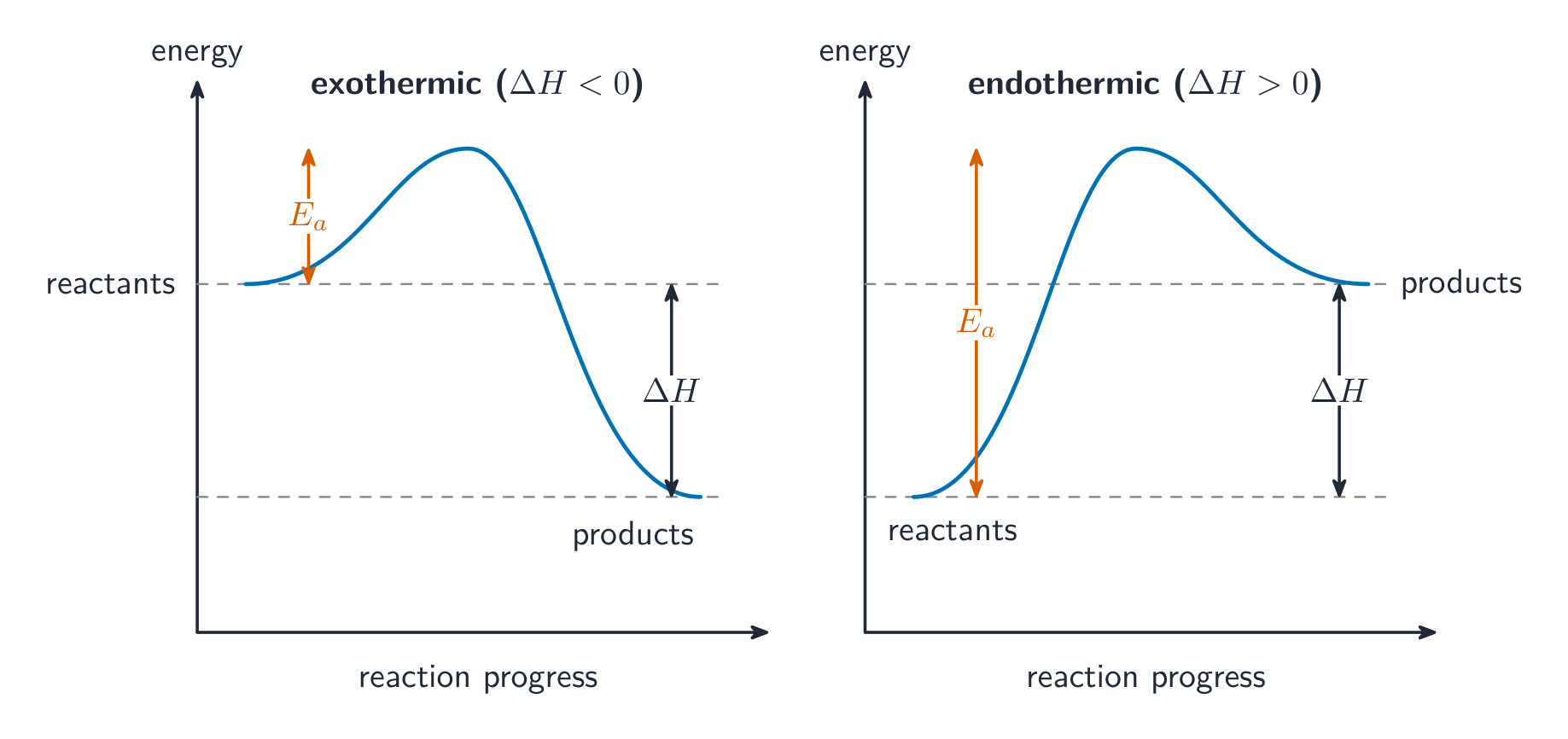
Match each description to the reaction type.
Dificuldade 2/5 · Moedas 140 + pequeno bônus na primeira conclusão hoje
Energy given out or taken in.
What is the sign of ΔH for an exothermic reaction?
Dificuldade 1/5 · Moedas 100 + pequeno bônus na primeira conclusão hoje
Energy is given out.
Reading values from a diagram
- $E_a$ = energy at the top − energy of the reactants.
- $\Delta H$ = energy of the products − energy of the reactants. The sign tells you exothermic (−) or endothermic (+).
Worked example: read two values
On a diagram, the reactants are at 50 kJ, the peak at 130 kJ and the products at 20 kJ.
- Activation energy: $130 - 50 = 80$ kJ.
- Enthalpy change: $20 - 50 = -30$ kJ, so the reaction is exothermic.
- Reverse reaction: its activation energy is $130 - 20 = 110$ kJ.
Reactants 40 kJ, peak 150 kJ, products 90 kJ. What is the activation energy in kJ?
Dificuldade 2/5 · Moedas 140 + pequeno bônus na primeira conclusão hoje
150 − 40.
For the same diagram, what is ΔH in kJ?
Dificuldade 2/5 · Moedas 140 + pequeno bônus na primeira conclusão hoje
90 − 40 = +50; endothermic.
Catalysts lower the hill
- A catalyst gives a different pathway with a lower activation energy, so more collisions succeed and the rate increases.
- It does not change the energy of the reactants or products, so $\Delta H$ stays the same.
A catalyst changes ΔH.
Dificuldade 1/5 · Moedas 100 + pequeno bônus na primeira conclusão hoje
It lowers E_a only.
Measure $E_a$ from the reactants, not from zero or from the products. And a catalyst lowers $E_a$ only — it never changes $\Delta H$.
Activation energy is the minimum energy colliding particles need to react. On a pathway diagram, $E_a$ is reactants to peak, $\Delta H$ is reactants to products, and a catalyst lowers the peak only.
Sketch and describe, in words, a pathway diagram for an exothermic reaction with and without a catalyst. Label E_a and ΔH.
E_a from reactants; ΔH unchanged.