Configuração eletrônica e a Tabela Periódica
Introduzido| English | Significado |
|---|---|
| electronic configuration/ɪlekˈtrɒnɪk kənˌfɪɡjəˈreɪʃn/ | configuração eletrônica |
| group/ɡruːp/ | grupo |
| period/ˈpɪərɪəd/ | período |
How electrons are arranged
- Electrons aren't scattered randomly — they fill up shells around the nucleus in a set order.
- This arrangement explains the whole shape of the Periodic Table.
Qual é o número máximo de elétrons na primeira (mais interna) camada?
Dificuldade 2/5 · Moedas 140 + pequeno bônus na primeira conclusão hoje
A primeira camada suporta até 2 elétrons.
Filling the shells
- Electrons fill the innermost shell first, then the next.
- The shells hold up to 2, then 8, then 8 electrons (at this level).
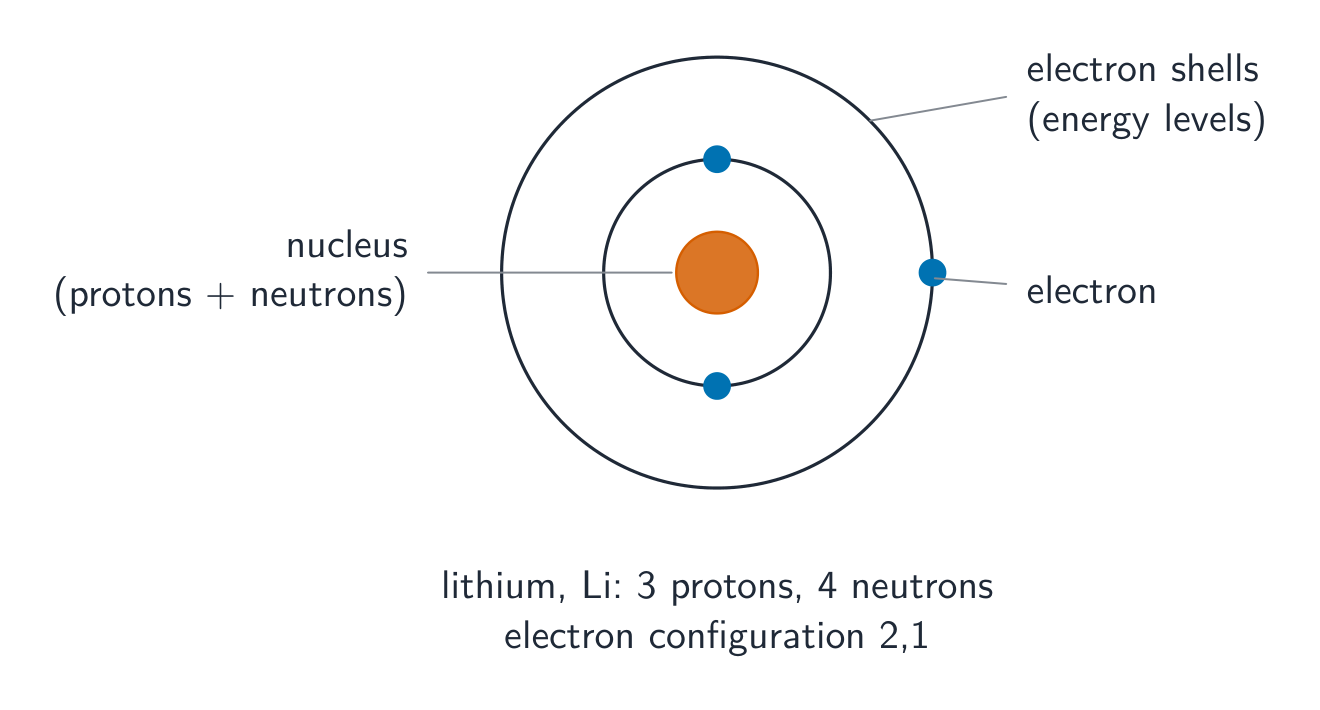
An atom has a tiny nucleus of protons and neutrons, with electrons in shells around it
A configuração eletrônica do sódio (11 elétrons) é:
Dificuldade 1/5 · Moedas 100 + pequeno bônus na primeira conclusão hoje
Preencha as camadas internas primeiro: 2, 8, depois 1.
Cloro tem 17 elétrons, resultando na configuração 2, 8, ______.
Dificuldade 1/5 · Moedas 100 + pequeno bônus na primeira conclusão hoje
2 + 8 + 7 = 17 elétrons.
Writing the configuration
- The electronic configuration 电子排布 lists how many electrons are in each shell.
- Example: sodium (11 electrons) is 2, 8, 1.
Worked example. Chlorine has 17 electrons. Fill the shells: 2, then 8, then the remaining 7 → configuration 2, 8, 7. The 7 outer electrons place it in Group 族 VII.
Preencha as camadas eletrônicas
Elétrons preenchem a camada interna primeiro (máximo 2), depois a próxima (máximo 8). O número na CAMADA EXTERNA é o número do grupo — o cloro 2,8,7 coloca-o no Grupo VII.
Um elemento com 7 elétrons em sua camada externa está no:
Dificuldade 1/5 · Moedas 100 + pequeno bônus na primeira conclusão hoje
Elétrons externos = número do grupo, então 7 → Grupo VII.
O número de camadas eletrônicas que um átomo usa é igual ao seu número de período.
Dificuldade 1/5 · Moedas 100 + pequeno bônus na primeira conclusão hoje
Período = número de camadas ocupadas.
Link to the Periodic Table
- The number of outer-shell electrons = the group number.
- The number of shells used = the period 周期 number.
The outer shell decides the chemistry. Elements in the same group have the same number of outer electrons, so they react in similar ways. That's why the group number is so important.
You've got it
- electrons fill shells from the inside out: 2, 8, 8
- the electronic configuration lists electrons per shell (e.g. sodium 2,8,1)
- outer electrons = group number; number of shells = period number
Write from the data given
- An atom has the electronic configuration 2, 8, 8, 1.
- The first shell still holds at most 2 electrons, which is the lesson's shell limit and not the question here.
Em qual período está este elemento?
O período é igual ao número de camadas ocupadas.
Qual é o período de 2, 8, 8, 1?
Dificuldade 1/5 · Moedas 100 + pequeno bônus na primeira conclusão hoje
Quatro números na configuração indicam quatro camadas. Outras opções — Período 2 (máximo da primeira camada); Período 1 (contagem de elétrons externos).