Costs, scale of production and break-even · Custos, escala de produção e ponto de equilíbrio
| English | Português |
|---|---|
| total cost/ˈtəʊtl kɒst/ | custo total |
| fixed costs/fɪkst kɒsts/ | custos fixos |
| variable costs/ˈveərɪəbl kɒsts/ | custos variáveis |
| economies of scale/ɪˈkɒnəmiz ɒv skeɪl/ | economias de escala |
| average cost/ˈævrɪdʒ kɒst/ | custo médio |
| contribution/ˌkɒntrɪˈbjuːʃn/ | contribuição |
| break-even output/breɪk ˈiːvən ˈaʊtpʊt/ | produção de equilíbrio |
| margin of safety/ˈmɑːdʒɪn ɒv ˈseɪfti/ | margem de segurança |
Costs, scale and the break-even point
- Before a business can price its product or judge profit, it must understand its costs.
- A key tool is the break-even point — the sales level where the business stops making a loss.
Custos, escala e ponto de equilíbrio
- Antes de definir o preço de seu produto ou julgar o lucro, uma empresa deve entender seus custos.
- Uma ferramenta-chave é o ponto de equilíbrio — o nível de vendas onde a empresa deixa de ter prejuízos.
Which is a fixed cost? · Qual é um custo fixo?
Rent does not change with output — a fixed cost. · O aluguel não muda com a produção — um custo fixo.
Fixed, variable and total costs 总成本
- Fixed costs 固定成本 don't change with output: rent, salaries.
- Variable costs 可变成本 rise with output: materials, power.
- Total cost = fixed + variable. Larger scale can bring economies of scale 规模经济 (lower average cost 平均成本).
Fixed, variable and total cost as output rises
Custos fixos, variáveis e totais
- Custos fixos não mudam com a produção: aluguel, salários.
- Custos variáveis aumentam com a produção: materiais, energia.
- Custo total = fixo + variável. Escala maior pode trazer economias de escala (custo médio menor).

Custos fixos, variáveis e totais conforme a produção aumenta
Break-even · Ponto de equilíbrio
Break-even · Ponto de equilíbrio is where total revenue · receita crosses total cost · custo. · Ponto de equilíbrio é onde a receita total cruza o custo total.
Selling price is 12 and variable cost per unit is 8. What is the contribution per unit? · Preço de venda é 12 e custo variável por unidade é 8. Qual é a contribuição por unidade?
Contribution = 12 − 8 = 4. · Contribuição = 12 − 8 = 4.
Fixed costs are 1,600 and contribution per unit is 4. What is the break-even output (units)? · Os custos fixos são 1,600 e a contribuição por unidade é 4. Qual é o ponto de equilíbrio (unidades)?
Break-even = 1,600 ÷ 4 = 400 units. · Ponto de equilíbrio = 1,600 ÷ 4 = 400 unidades.
At the break-even point, the business makes: · No ponto de equilíbrio, o negócio faz:
Revenue exactly equals total cost. · Receita iguala exatamente ao custo total.
Contribution 贡献 and break-even
- Contribution per unit = selling price − variable cost per unit.
- Break-even output 盈亏平衡产量 = fixed costs ÷ contribution per unit. At this point, revenue = total cost.
Below break-even the business makes a loss; above it, a profit.
Contribuição e ponto de equilíbrio
- Contribuição por unidade = preço de venda − custo variável por unidade.
- Volume de equilíbrio = custos fixos ÷ contribuição por unidade. Neste ponto, receita = custo total.
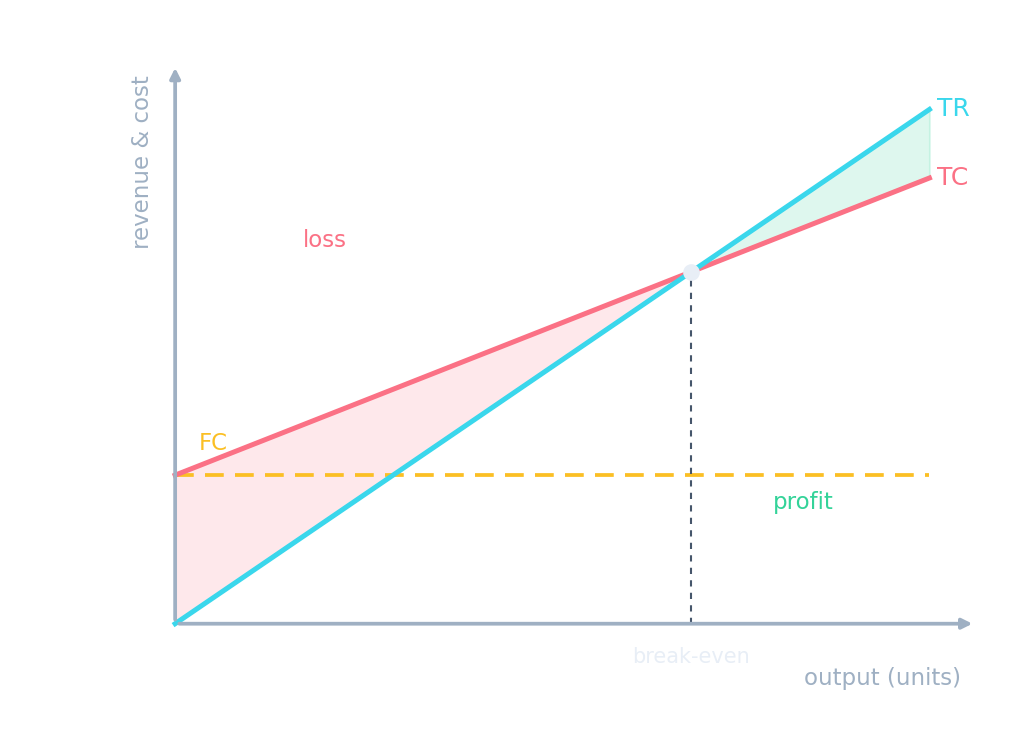
Abaixo do ponto de equilíbrio, a empresa tem prejuízo; acima dele, lucro.
Actual output minus break-even output is the margin of ______. · Saída real menos saída do ponto de equilíbrio é a margem de ______.
It shows how far sales can fall before a loss. · Mostra o quanto as vendas podem cair antes de haver prejuízo.
Margin of safety 安全边际
- Margin of safety = actual output − break-even output.
- It shows how far sales can fall before the business makes a loss.
Worked example. Price 10, variable cost 6 → contribution = 4. Fixed costs 2,000 → break-even = 2,000 ÷ 4 = 500 units. Selling 700 gives a margin of safety of 200 units.
The break-even point is where total revenue equals total cost
Margem de Segurança 安全边际
- Margem de segurança = produção real − produção de equilíbrio.
- Mostra o quanto as vendas podem cair antes que a empresa tenha prejuízo.
Exemplo resolvido. Preço 10, custo variável 6 → contribuição = 4. Custos fixos 2,000 → ponto de equilíbrio = 2,000 ÷ 4 = 500 unidades. Vender 700 gera uma margem de segurança de 200 unidades.
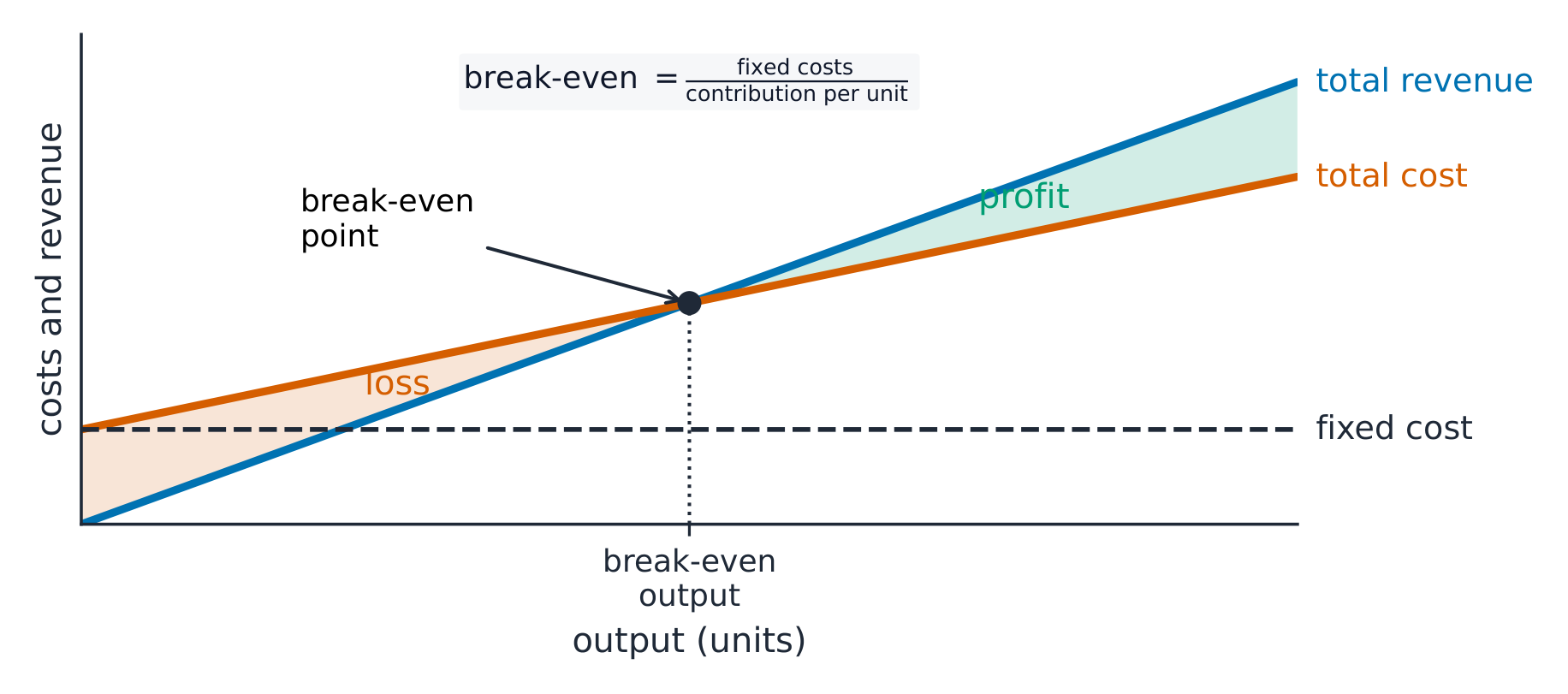
O ponto de equilíbrio é onde a receita total iguala o custo total
You've got it
- total cost = fixed + variable; larger scale can lower average cost
- contribution = price − variable cost per unit; break-even = fixed costs ÷ contribution
- margin of safety = actual − break-even output
Entendeu?
- custo total = fixo + variável; escala maior pode reduzir custo médio
- contribuição = preço − custo variável por unidade; equilíbrio = custos fixos ÷ contribuição
- margem de segurança = volume real − volume de equilíbrio