Selective breeding
Introduzido| English | Significado |
|---|---|
| selective breeding/sɪˈlektɪv ˈbriːdɪŋ/ | seletiva artificial |
| artificial selection/ˌɑːtɪˈfɪʃl sɪˈlekʃn/ | seleção artificial |
| gene pool/dʒiːn puːl/ | pool gênico |
Choosing the parents
- For thousands of years, humans have bred animals and plants to get features they want.
- This is selective breeding 选择育种 (artificial selection 人工选择).
Selective breeding means choosing:
Dificuldade 1/5 · Moedas 100 + pequeno bônus na primeira conclusão hoje
Humans pick the parents with the wanted trait.
Selective breeding is also known as ______ selection.
Dificuldade 1/5 · Moedas 100 + pequeno bônus na primeira conclusão hoje
Humans, not the environment, do the selecting.
How it works
- Choose parents with the desired feature (e.g. high milk yield, big fruit).
- Breed them together, then choose the best offspring to breed again.
- Repeat over many generations.
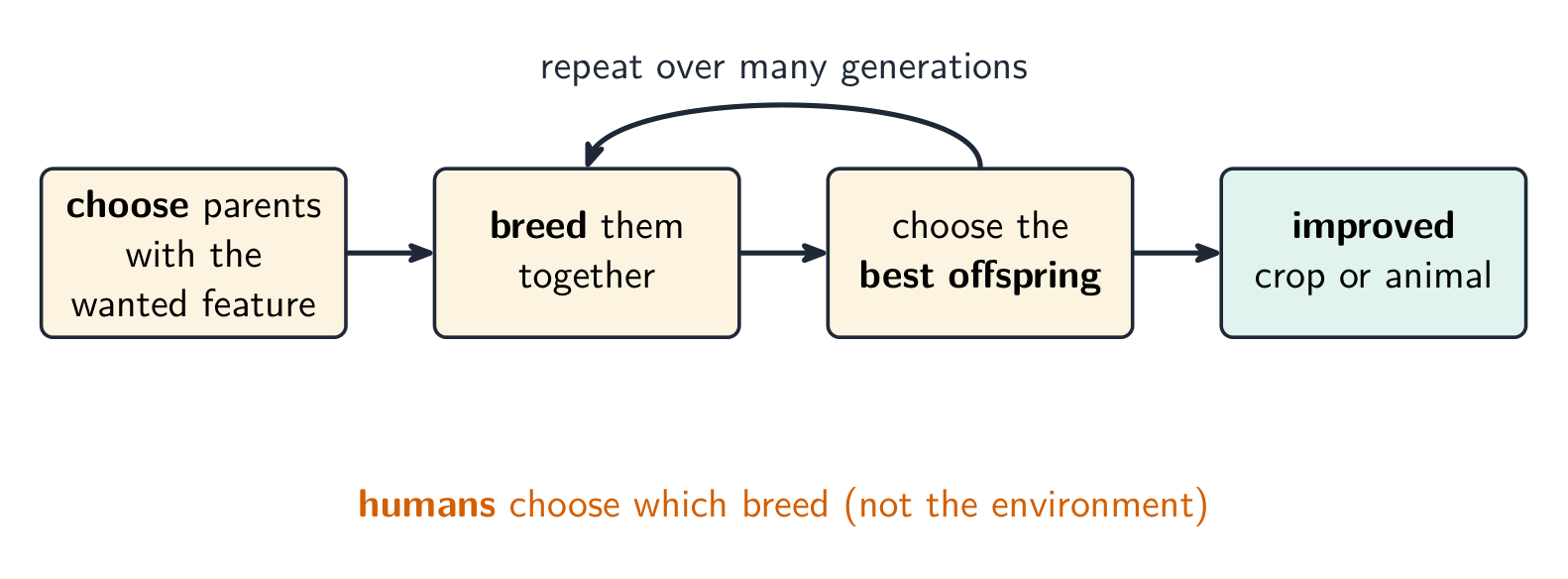
In selective breeding, humans choose which organisms breed, over many generations
Criação seletiva
Humans choose which organisms breed, to develop a useful feature over many generations.
Which are uses of selective breeding? (Select all that apply.)
Dificuldade 2/5 · Moedas 140 + pequeno bônus na primeira conclusão hoje
The first three are selective breeding; the last is not.
Examples
- Crops: bred for higher yield, disease resistance, better taste.
- Animals: cows for more milk, dogs for specific traits.
The main difference from natural selection is that selective breeding is driven by:
Dificuldade 1/5 · Moedas 100 + pequeno bônus na primeira conclusão hoje
Humans choose the parents, not the environment.
Selective breeding can reduce variation in a population.
Dificuldade 1/5 · Moedas 100 + pequeno bônus na primeira conclusão hoje
Breeding from a narrow set shrinks the gene pool.
Like natural selection, but human-chosen
- In natural selection, the environment decides who reproduces.
- In selective breeding, humans decide — choosing the parents each generation.
Selective breeding reduces variation. Repeatedly breeding from a narrow set of "best" individuals shrinks the gene pool 基因库. This can leave a population vulnerable to disease — the downside of artificial selection.
Worked example: breed a better cow
A farmer wants cows that give more milk. Describe the steps of selective breeding, and one problem it can cause.
- Choose the cows that give the most milk and a bull whose mother gave a lot of milk. Breed them. From the offspring, again select the best milk-producers and breed them. Repeat over many generations until most of the herd gives high yields.
- Problem: the herd becomes closely related, so there is less variation. Harmful recessive alleles are more likely to pair up, and a new disease could affect them all.
How is selective breeding different from natural selection?
Dificuldade 1/5 · Moedas 100 + pequeno bônus na primeira conclusão hoje
In natural selection the environment decides who survives to breed; in selective breeding people do.
Selective breeding usually takes many generations to produce a big change.
Dificuldade 1/5 · Moedas 100 + pequeno bônus na primeira conclusão hoje
Each generation shifts the population only a little, so the process is repeated.
You've got it
- selective breeding: choose parents with the desired feature, breed, repeat over generations
- used to improve crops (yield, resistance) and animals (milk, traits)
- it's like natural selection but humans choose; it reduces variation
Write from a farmer's choice
- A farmer breeds only the cows that give the most milk.
- The choice is repeated for many generations.
What is this process, and what happens to variation?
The desired parents are picked on purpose.
In selective breeding, who chooses the parents?
Dificuldade 1/5 · Moedas 100 + pequeno bônus na primeira conclusão hoje
People pick the parents with the feature they want.