Sexual reproduction
Introduzido| English | Significado |
|---|---|
| fertilisation/ˌfɜːtɪlaɪˈzeɪʃn/ | fecundação |
| sexual reproduction/ˈsekʃuːəl rɪprəˈdʌkʃn/ | reprodução sexuada |
| gametes/ˈɡæmiːts/ | gâmetas |
| zygote/ˈzaɪɡəʊt/ | zigoto |
| chromosomes/ˈkrəʊməsəʊmz/ | cromossomos |
| variation/ˌveərɪˈeɪʃn/ | variação |
Two nuclei become one, 1876
- In 1876 the German zoologist Oscar Hertwig watched sea urchin eggs under a microscope as sperm were added. He saw a single sperm enter an egg, and its nucleus move to the egg's nucleus and fuse with it. It was the first clear observation of fertilisation.
- Sexual reproduction 有性生殖 is the fusion of the nuclei of two gametes 配子 to form a zygote 合子, producing offspring that are genetically different from their parents.
What did Hertwig observe in 1876?
Dificuldade 1/5 · Moedas 100 + pequeno bônus na primeira conclusão hoje
The first clear view of fertilisation.
Gametes are haploid
- Body cells are diploid: they have two sets of chromosomes 染色体 (46 in humans). Gametes are haploid: one set (23 in humans).
- At fertilisation 受精, two haploid nuclei fuse, so the zygote is diploid again.
Reprodução sexual
Two parents each contribute a gamete; fertilisation combines them, creating variation.
How many chromosomes are in a human egg cell?
Dificuldade 2/5 · Moedas 140 + pequeno bônus na primeira conclusão hoje
Haploid; one set.
A zygote is diploid.
Dificuldade 1/5 · Moedas 100 + pequeno bônus na primeira conclusão hoje
Two haploid nuclei fused.
Sperm and egg
- The sperm is small and has a tail (flagellum) to swim, many mitochondria for energy, and an acrosome with enzymes to digest a way into the egg.
- The egg cell is large, with stored food in its cytoplasm, and its membrane changes after fertilisation so no other sperm can enter.
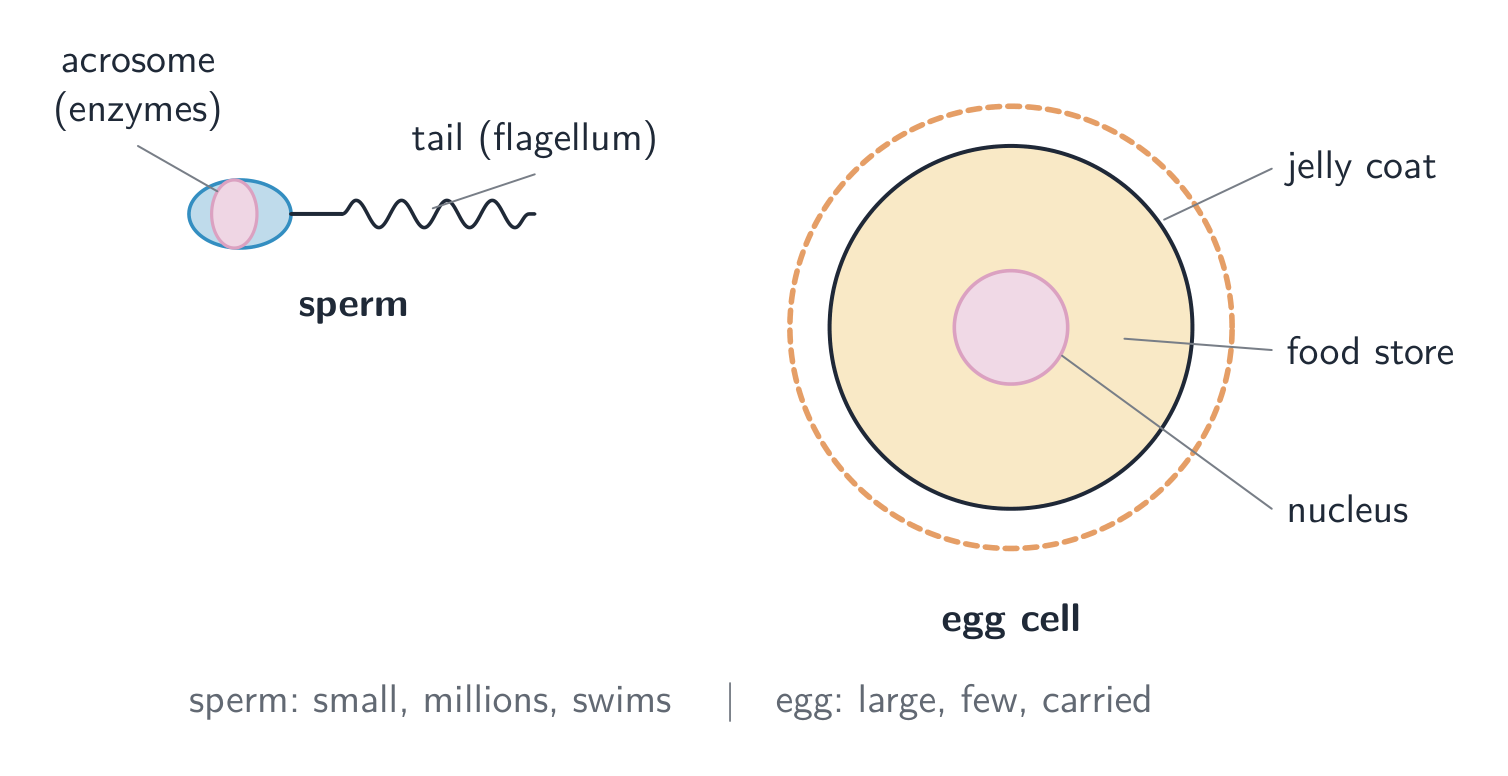
Match each feature to its job.
Dificuldade 2/5 · Moedas 140 + pequeno bônus na primeira conclusão hoje
Adaptations of gametes.
Variation
- Each gamete carries a different mix of the parent's chromosomes, and any sperm can fertilise the egg, so offspring show variation 变异.
- Variation helps a population survive when the environment changes, because some individuals may suit the new conditions.
Why does variation help a population?
Dificuldade 1/5 · Moedas 100 + pequeno bônus na primeira conclusão hoje
Survival in new conditions.
Worked example: count chromosomes
A dog's body cells have 78 chromosomes.
- Gametes: haploid, so 78 ÷ 2 = 39 chromosomes.
- Zygote: 39 from the sperm + 39 from the egg = 78.
- Check: fertilisation restores the diploid number, so every generation keeps 78.
A horse's body cells have 64 chromosomes. How many are in its sperm cells?
Dificuldade 2/5 · Moedas 140 + pequeno bônus na primeira conclusão hoje
64 ÷ 2.
Sexual versus asexual
- Asexual reproduction needs one parent and gives genetically identical offspring — fast, but no variation.
- Sexual reproduction needs two gametes, is slower, and gives variation.
Match each feature to the type of reproduction.
Dificuldade 2/5 · Moedas 140 + pequeno bônus na primeira conclusão hoje
One parent or two gametes.
A gamete is not "half a cell". It is a complete cell with half the number of chromosomes — one of each pair.
In sexual reproduction, two haploid gametes fuse at fertilisation to form a diploid zygote. Sperm are small and mobile; eggs are large with food stores. Offspring show variation, which helps populations adapt.
Explain why gametes must be haploid.
Keeping chromosome number constant.