Asexual reproduction
Introduzido| English | Significado |
|---|---|
| asexual reproduction/eɪˈsekʃuːəl rɪprəˈdʌkʃn/ | reprodução assexuada |
| gametes/ˈɡæmiːts/ | gâmetas |
| clones/kləʊnz/ | clones |
| variation/ˌveərɪˈeɪʃn/ | variação |
Copies of one parent
- Some organisms reproduce all by themselves, with no partner needed.
- This is asexual reproduction 无性生殖, and the offspring are exact copies.
Asexual reproduction needs how many parents?
Dificuldade 1/5 · Moedas 100 + pequeno bônus na primeira conclusão hoje
Only one parent is needed.
The offspring of asexual reproduction are:
Dificuldade 1/5 · Moedas 100 + pequeno bônus na primeira conclusão hoje
They are clones — genetically identical.
Genetically identical offspring are called ______.
Dificuldade 1/5 · Moedas 100 + pequeno bônus na primeira conclusão hoje
Asexual reproduction produces clones.
What asexual reproduction is
- Asexual reproduction needs only one parent and no gametes 配子.
- The offspring are genetically identical to the parent — they are clones 克隆.
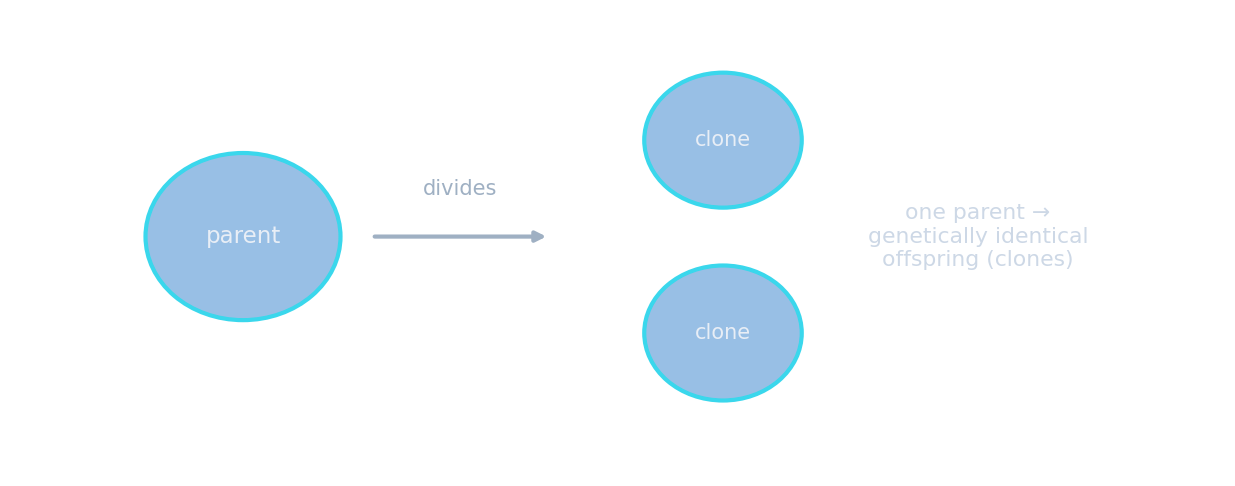
Asexual reproduction: one parent gives genetically identical offspring (clones)
Reprodução assexuada
One parent makes genetically identical offspring (clones) by mitosis — no gametes needed.
Which reproduce asexually? (Select all that apply.)
Dificuldade 2/5 · Moedas 140 + pequeno bônus na primeira conclusão hoje
A baby from two parents is sexual reproduction.
Examples
- Bacteria divide in two; plants grow runners or tubers; some animals bud.
- Many crops are grown asexually (e.g. from cuttings) to keep useful traits.
A disadvantage of asexual reproduction is that the offspring vary too much.
Dificuldade 1/5 · Moedas 100 + pequeno bônus na primeira conclusão hoje
False. Asexual reproduction produces genetically identical offspring, so the disadvantage is a lack of variation: all are vulnerable to the same disease or change.
Advantages and disadvantages
- Advantages: fast, no partner needed, all good traits passed on.
- Disadvantage: no variation 变异 — so a single disease or change could wipe out the whole population.
No variation is the big weakness. Because clones are identical, if one is vulnerable to a disease, they all are. Asexual reproduction is fast but risky in a changing environment.
Worked example: a strawberry farm
A farmer has one strawberry plant with large, sweet fruit. Its runners grow new plants. Give one advantage and one risk of filling a whole field this way.
- Advantage: runners are asexual reproduction, so every new plant is a clone, genetically identical to the parent: all will have the same large, sweet fruit. It is also quick and needs no pollinators.
- Risk: there is no variation. If a new disease or a change in conditions harms one plant, it can harm them all, and the whole crop could be lost.
Potatoes grown from tubers of one plant are:
Dificuldade 1/5 · Moedas 100 + pequeno bônus na primeira conclusão hoje
Tubers are asexual reproduction: no gametes, so the offspring are clones.
Bacteria reproduce asexually by dividing in two.
Dificuldade 1/5 · Moedas 100 + pequeno bônus na primeira conclusão hoje
Binary fission gives two identical cells with no gametes involved.
You've got it
- asexual reproduction: one parent, no gametes, identical offspring (clones)
- examples: bacteria dividing, plant runners/tubers, cuttings
- it is fast but produces no variation — risky if the environment changes
Write from a runner
- A strawberry plant grows a runner that roots and makes a new plant.
- No gametes are involved.
What kind of reproduction is this, and what is the risk?
One parent and no gametes means identical offspring.
Offspring grown from a runner are what?
Dificuldade 1/5 · Moedas 100 + pequeno bônus na primeira conclusão hoje
Asexual reproduction copies one parent.