Homeostasis and blood glucose
Introduzido| English | Significado |
|---|---|
| homeostasis/ˌhəʊmiːəˈstɑːsiz/ | Homeostase |
| internal environment/ɪnˈtɜːnl enˈvaɪrənmənt/ | Meio interno |
| negative feedback/ˈneɡətɪv ˈfiːdbæk/ | Feedback negativo |
| set point/set pɔɪnt/ | Ponto de ajuste |
| glucagon/ˈɡluːkæɡən/ | Glicagona |
| diabetes/ˌdaɪəˈbiːtiːz/ | Diabetes |
Keeping things steady
- Your body works best when its internal conditions stay within a narrow range.
- Keeping them steady is homeostasis 稳态 — and controlling blood glucose is a perfect example.
Homeostasis is the maintenance of:
Dificuldade 1/5 · Moedas 100 + pequeno bônus na primeira conclusão hoje
Homeostasis keeps internal conditions steady.
What homeostasis is
- Homeostasis is the maintenance of a constant internal environment 内环境.
- It controls temperature, water, and blood glucose levels.
Homeostasis & blood glucose
insulina ↓ · glucagon ↑
Blood glucose is held near a ponto de ajuste by insulin and glucagon — negative feedback.
Negative feedback brings a level back towards its set point when it strays.
Dificuldade 1/5 · Moedas 100 + pequeno bônus na primeira conclusão hoje
A rise triggers a lowering response, and vice versa.
Negative feedback 负反馈
- The body uses negative feedback: if a level rises, a response lowers it (and vice versa).
- This keeps the level oscillating gently around a set point 设定点.
When blood glucose is too high, the pancreas releases:
Dificuldade 1/5 · Moedas 100 + pequeno bônus na primeira conclusão hoje
Insulin lowers blood glucose by storing it.
When blood glucose is too low, the liver is told to release glucose by:
Dificuldade 1/5 · Moedas 100 + pequeno bônus na primeira conclusão hoje
Glucagon raises blood glucose.
A failure to produce enough insulin causes type 1 ______.
Dificuldade 1/5 · Moedas 100 + pequeno bônus na primeira conclusão hoje
Type 1 diabetes is treated with insulin injections.
Controlling blood glucose
- After eating, glucose rises → the pancreas releases insulin → glucose stored in the liver → level falls.
- When glucose falls → the pancreas releases glucagon 胰高血糖素 → liver releases glucose → level rises.
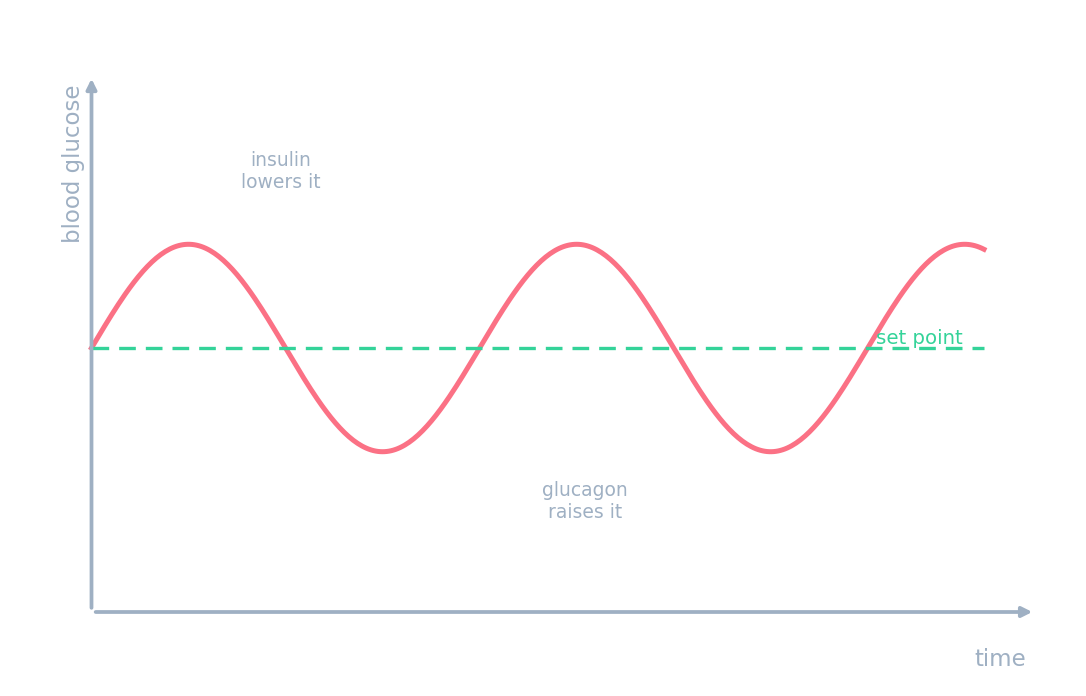
Insulin lowers blood glucose and glucagon raises it, holding the level near a set point.
In type 1 diabetes 糖尿病, the pancreas can't make enough insulin. Without insulin, blood glucose rises dangerously high after eating. It is treated with insulin injections to do the job the pancreas can't.
Worked example: after a meal
A student eats a sugary breakfast. Describe how the blood glucose level is brought back to normal, and what is different in a person with Type 1 diabetes.
- Glucose is absorbed and the blood level rises. The pancreas detects this and releases insulin. Insulin makes the liver (and muscles) take in glucose and store it as glycogen, so the level falls back towards the set point.
- In Type 1 diabetes the pancreas makes little or no insulin, so blood glucose stays high after a meal. It is treated with insulin injections and by watching carbohydrate intake.
Several hours after a meal, blood glucose falls below normal. Which hormone does the pancreas release?
Dificuldade 1/5 · Moedas 100 + pequeno bônus na primeira conclusão hoje
Glucagon raises blood glucose; insulin lowers it.
Insulin causes glucose to be stored in the liver as glycogen.
Dificuldade 1/5 · Moedas 100 + pequeno bônus na primeira conclusão hoje
Converting glucose to glycogen removes it from the blood, lowering the level.
You've got it
- homeostasis keeps the internal environment constant, using negative feedback
- insulin lowers blood glucose (stores it); glucagon raises it (releases it)
- failure to make insulin causes type 1 diabetes
Write from a rise in glucose
- Blood glucose has fallen below the set level.
- The body brings it back up.
Which hormone raises blood glucose, and what is the name of this correcting pattern?
The two hormones pull glucose in opposite directions.
Which hormone raises blood glucose?
Dificuldade 1/5 · Moedas 100 + pequeno bônus na primeira conclusão hoje
Glucagon releases glucose back into the blood.