Hormônios
Introduzido| English | Significado |
|---|---|
| insulin/ˈɪnsjuːlɪn/ | Insulina |
| hormones/ˈhɔːməʊnz/ | Hormônios |
| gland/ɡlænd/ | Glândula |
| target organs/ˈtɑːɡɪt ˈɔːɡənz/ | Órgãos-alvo |
| endocrine system/ˈendəʊkraɪn ˈsɪstəm/ | Sistema endócrino |
| adrenaline/əˈdrenəlɪn/ | Adrenalina |
A boy saved by an extract, 1922
- In January 1922, in Toronto, 14-year-old Leonard Thompson was dying of type 1 diabetes. Frederick Banting and Charles Best had extracted a substance from dog pancreases, and the biochemist James Collip purified it. After injections, Thompson's very high blood glucose fell, and he lived for 13 more years. The substance was insulin.
- Insulin is one of the body's hormones 激素: chemicals made by a gland 腺体 and carried by the blood to target organs 靶器官.
Which hormone saved Leonard Thompson in 1922?
Dificuldade 1/5 · Moedas 100 + pequeno bônus na primeira conclusão hoje
Extracted from pancreases.
The endocrine system
- The endocrine system 内分泌系统 is the set of glands that release hormones straight into the blood.
- Adrenal glands: adrenaline. Pancreas: insulin and glucagon. Testes: testosterone. Ovaries: oestrogen and progesterone. Pituitary gland: several hormones that control other glands.
How hormones work
Hormones are chemical messengers carried in the blood — slower than nerves, but longer-lasting.
Match each gland to a hormone it makes.
Dificuldade 2/5 · Moedas 140 + pequeno bônus na primeira conclusão hoje
The endocrine system.
Adrenaline: fight or flight
- Adrenaline 肾上腺素 is released in danger or excitement. It increases heart rate and breathing rate, widens the pupils and raises blood glucose.
- These effects get more oxygen and glucose to the muscles quickly.
Which are effects of adrenaline?
Dificuldade 2/5 · Moedas 140 + pequeno bônus na primeira conclusão hoje
Fight or flight.
Insulin and blood glucose
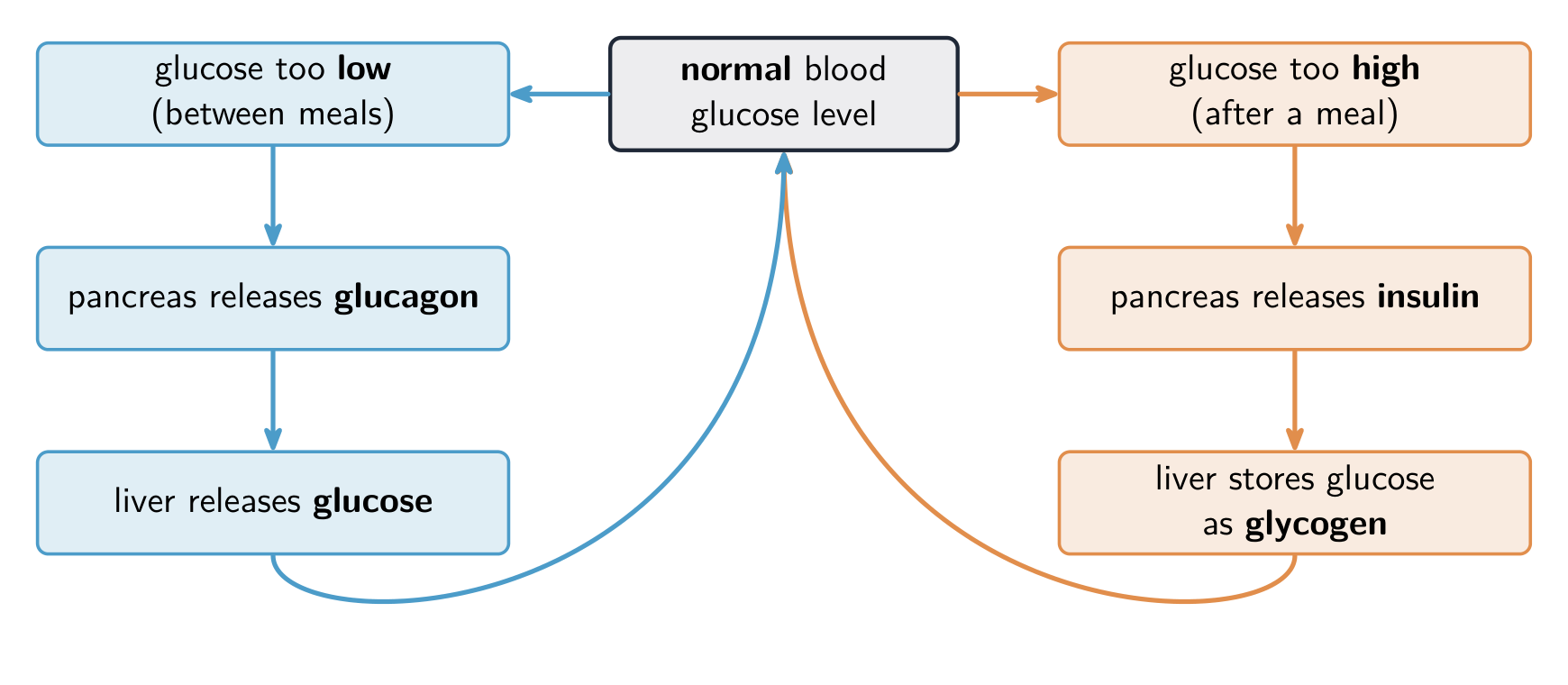
- After a meal, blood glucose rises. The pancreas releases insulin 胰岛素, and the liver turns glucose into glycogen to store it; blood glucose falls.
- When glucose is low, the pancreas releases glucagon, and the liver turns glycogen back into glucose. This is negative feedback.
What does insulin cause the liver to do?
Dificuldade 1/5 · Moedas 100 + pequeno bônus na primeira conclusão hoje
Blood glucose falls.
When blood glucose is low, the pancreas releases glucagon.
Dificuldade 1/5 · Moedas 100 + pequeno bônus na primeira conclusão hoje
Negative feedback.
Worked example: hormones or nerves?
Compare control by nerves and by hormones.
- Speed: nerve impulses are very fast; hormones are slower (carried in blood).
- Duration: nerve effects are short; hormone effects usually last longer.
- Target: nerves act on a precise place; hormones can affect many organs at once.
Compared with nerves, hormones are usually…
Dificuldade 1/5 · Moedas 100 + pequeno bônus na primeira conclusão hoje
Carried in the blood.
Type 1 diabetes
- In type 1 diabetes the pancreas does not make enough insulin, so blood glucose stays too high.
- It is treated with insulin injections, a careful diet and checking blood glucose.
Glucagon is not glycogen. Glucagon is a hormone; glycogen is the storage carbohydrate in the liver and muscles. The spellings are close, so check which you mean.
Glucagon is the carbohydrate stored in the liver.
Dificuldade 1/5 · Moedas 100 + pequeno bônus na primeira conclusão hoje
That is glycogen.
Hormones are made by glands, travel in the blood and act on target organs — slower and longer-lasting than nerves. Adrenaline prepares for action; insulin and glucagon keep blood glucose steady by negative feedback.
Describe how blood glucose returns to normal after a meal rich in starch.
The control loop.