Writing a reflection with evidence
Introduzido| English | Significado |
|---|---|
| reflective learning journal/rɪˈflektɪv ˈlɜːnɪŋ ˈdʒɜːnl/ | diário de aprendizagem reflexiva |
| describe/dɪˈskraɪb/ | descrever |
| evaluate/ɪˈvæljuːeɪt/ | avaliar |
| plan/plæn/ | planejar |
| reflection/rɪˈflekʃn/ | reflexão |
| learning style/ˈlɜːnɪŋ staɪl/ | estilo de aprendizagem |
Keep a record while the learning is fresh
- Goal: write a short journal entry that says what you did, how well it worked (with evidence), and one change you will test. Then, a week later, check whether the change helped.
- A reflective learning journal 反思学习日志 records what you tried, what you noticed and what you will change. Write a short entry soon after an important task: you will not remember the details at the end of the semester. Keep your work and your teacher's feedback with the entry, so you can show your evidence. (This is practice for GAC003; always follow your centre's own task instructions.)
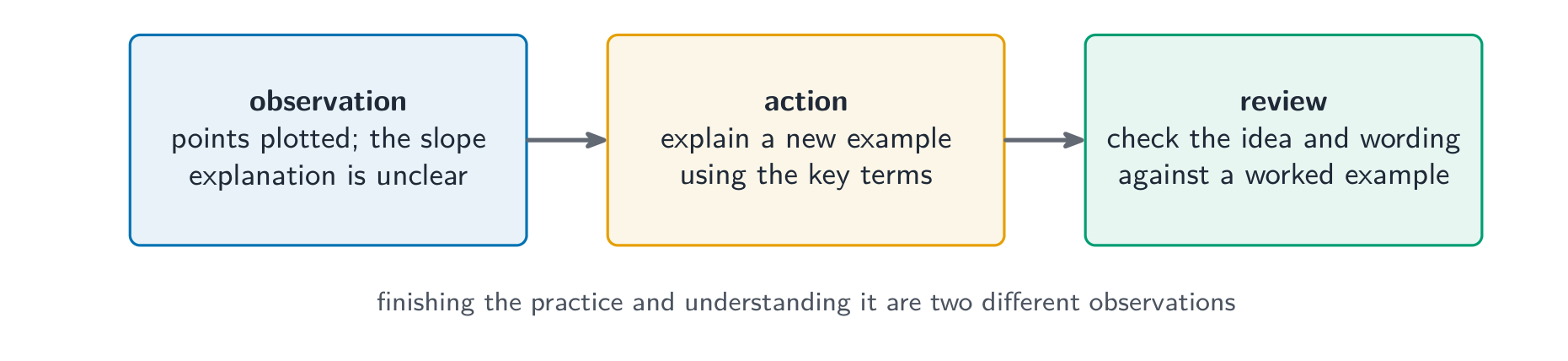
Three moves: describe, evaluate, plan
- Reflection 反思 is more than a diary. Describe 描述 the task and what you did. Evaluate 评价 how well it went, with evidence: a mark, a mistake, a comment, something you could or could not do. Plan 计划 one change that you can check later.
- Useful sentence starters: Describe: "In maths on Monday, I…" · Evaluate: "This worked / did not work because… I know this because…" · Plan: "Next time, I will… on (day). I will know it helped if…"
Put the three moves of a reflective entry in order.
Dificuldade 3/5 · Moedas 200 + pequeno bônus na primeira conclusão hoje
Description alone is a diary. The evaluation and the plan are what make it reflection.
A weak entry and a model entry
Weak: "Today we learned graphs. It was hard. I will study more."
Model:
- Describe: In maths on Monday, I plotted ten points for a speed–time graph. All the points were correct.
- Evaluate: When the teacher asked me what the slope meant, I could not explain it in English. I think the problem may be the words, not the idea, because I can explain it in Chinese. But I am not sure yet.
- Plan: On Thursday, I will explain a new graph to my partner using three key words: slope, steeper, acceleration. I will compare my explanation with the worked answer in the textbook.
- Why the model is better: the weak entry gives no evidence (what was hard?) and no plan you can check (study more when, and what?). The model names a real difficulty, gives a possible reason and says it is not sure yet, and plans a small test with a day and a way to check it.
Which journal entry about an English essay gives evidence AND a plan you can check?
Dificuldade 1/5 · Moedas 100 + pequeno bônus na primeira conclusão hoje
It gives evidence (the teacher's comment about topic sentences), a specific action with a day, and a way to check it (the partner underlines the topic sentences). A target mark is not a plan, because it does not say what you will do differently.
Write one journal sentence about a class this week that names a specific difficulty and one checkable action.
Dificuldade 3/5 · Moedas 200 + pequeno bônus na primeira conclusão hoje
Example: "I could not explain the water cycle in English, so on Wednesday I will record myself explaining it in two minutes."
Which sentence from a journal entry is an EVALUATE sentence?
Dificuldade 1/5 · Moedas 100 + pequeno bônus na primeira conclusão hoje
It judges how well the task went and gives evidence (the results were 2 cm³ apart) and a possible reason. The first sentence describes; the third plans.
A preference is not a permanent limit
- A learning style 学习风格 describes what you prefer, for example "diagrams help me". It does not mean you cannot learn in other ways, and it is not a reason to skip reading or listening tasks.
- Use a preference to get into hard material: draw a diagram next to the paragraph, then try to explain the idea without looking at either. If you still cannot explain it, the method did not help enough, so try another one.
Which use of a learning style is useful rather than an excuse?
Dificuldade 1/5 · Moedas 100 + pequeno bônus na primeira conclusão hoje
A preference tells you how to get in to hard material. It does not tell you which material to skip.
Close the loop a week later
- Go back to your plan and write what actually happened. A follow-up to the model: "On Thursday I explained a velocity graph to Li Na. I used 'slope' and 'steeper' correctly, but I mixed up 'speed' and 'acceleration' once. Next week I will make a short word list with one example sentence for each."
- If you did not do the plan, say so and give it a new date. If it worked, say how you know, and be honest about the limits: one good explanation does not mean every graph is now easy.
"On Tuesday I will redo the two Spanish exercises I got wrong" counts as a decision in a reflective entry.
Dificuldade 1/5 · Moedas 100 + pequeno bônus na primeira conclusão hoje
True. It names the task, the subject and the day, so next week you can check whether it happened. “I will study harder” cannot be checked.
If you did not do the action you planned, you should leave it out of your journal so the journal looks better.
Dificuldade 1/5 · Moedas 100 + pequeno bônus na primeira conclusão hoje
False. Write that you did not do it, say why if you know, and give it a new date. An honest record is more useful to you and to your teacher than a perfect-looking one.
Keep the account truthful and your own
- Write the reflection yourself, in your own words. You may ask for help to understand feedback or to check your English, but follow your task's rules about who writes it. Never invent events or results to make the journal sound better.
- Keep your dated notes and work samples, so you can explain any entry if your teacher asks. If you are not sure about something, say so: "I think…", "It may be because…".
A good entry has three moves: describe what you did, evaluate it with evidence, and plan one change with a day and a check. A week later, write what really happened.
You are not sure why your listening score went up. Which sentence is the most honest?
Dificuldade 1/5 · Moedas 100 + pequeno bônus na primeira conclusão hoje
It gives the evidence (12 to 15), a possible reason with "I think… may", and another possible reason. It does not claim more than the evidence shows.