The passive
When the action matters, not the doer
- The passive focuses on what happens to something, not on who does it.
- English is spoken here. The window was broken.
- The receiver of the action becomes the subject.
The cake was eaten; the suspect left crumbs.
Quando a ação importa, não quem faz
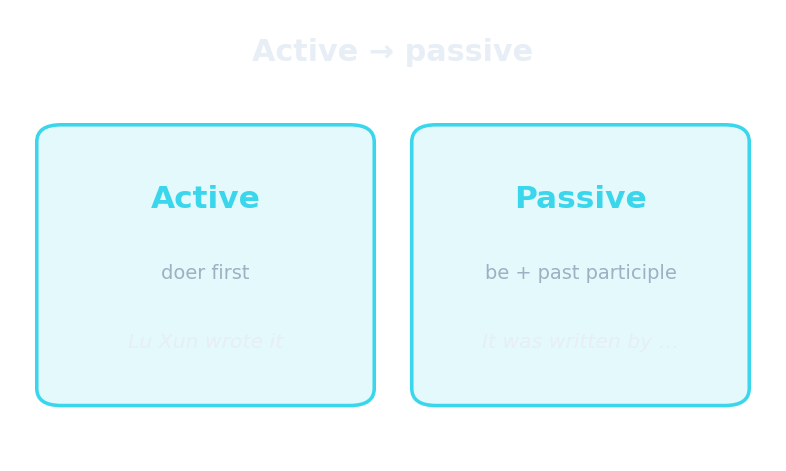
- O passivo foca no que acontece com algo, não em quem o faz.
- Inglês é falado aqui. A janela foi quebrada.
- O receptor da ação torna-se o sujeito.
O bolo foi comido; o suspeito deixou migalhas.
Form: be + past participle
- be (in the right tense) + past participle.
- Present: is / are + p.p. → The cars are made here.
- Past: was / were + p.p. → The house was built in 1990.
Forma: be + particípio passado
- be (no tempo correto) + particípio passado.
- Presente: is / are + p.p. → Os carros são feitos aqui.
- Passado: was / were + p.p. → A casa foi construída em 1990.
Turn active into passive · Transforme ativo em passivo
The object moves to the front, and the verb becomes be + past participle. · O objeto vai para a frente, e o verbo torna-se be + particípio passado.
Make it passive: “People speak English here.” · Torne passivo: “People speak English here.”
Passive = be + past participle: “English is spoken here.”
Complete: The window was ___ (break) yesterday.
was + past participle: break → broken. · was + particípio passado: break → broken.
by + the doer
- Add by to say who did it — if it matters.
- This book was written by Lu Xun.
- If the doer is unknown or unimportant, leave it out.
by + o agente
- Adicione by para dizer quem fez — se importar.
- Este livro foi escrito por Lu Xun.
- Se o agente for desconhecido ou irrelevante, omita-o.
Do we use “by” to say who did the action? · Usamos “by” para dizer quem fez a ação?
Yes — “by + the doer”: “It was written by Lu Xun.” · Sim — “by + o agente”: “It was written by Lu Xun.”
Translate into English: 这本书是鲁迅写的。 · Traduza para o inglês: 这本书是鲁迅写的。
Passive + by: “This book was written by Lu Xun.”
When to use it
- The doer is unknown or unimportant: The road was repaired.
- You want to focus on the receiver: The painting was bought by a museum.
Quando usá-lo
- O agente é desconhecido ou irrelevante: A estrada foi reparada.
- Você quer focar no receptor: A pintura foi comprada por um museu.
Common mistakes
- ❌ The window was broke. → ✓ The window was broken. — the passive needs the participle.
- ❌ The accident was happened. → ✓ The accident happened. — happen has no passive.
- Remember: ✓ I was born in 2008. — always passive in English.
Erros comuns
- ❌ The window was broke. → ✓ A janela foi quebrada. — o passivo precisa do particípio.
- ❌ The accident was happened. → ✓ O acidente aconteceu. — happen não tem voz passiva.
- Lembre-se: ✓ Eu nasci em 2008. — sempre passivo em inglês.
Match the active sentence to its passive. · Combine a frase ativa com sua correspondente na voz passiva.
The object moves to the front; be takes the tense; the verb becomes a participle. · O objeto move-se para a frente; o verbo 'be' assume o tempo verbal; o verbo torna-se um particípio.
Complete: This book was ___ by Lu Xun. (write) · Complete: Este livro foi ___ por Lu Xun. (escrever)
write – wrote – written: the passive takes the third form. · write – wrote – written: a voz passiva usa a terceira forma do verbo.
- Passive = be + past participle (be carries the tense).
- Add by + the doer only if it matters.
- Use it when the doer is unknown/unimportant or to focus on the receiver.
- Passivo = be + particípio passado (be carrega o tempo verbal).
- Adicione by + o agente apenas se importar.
- Use quando o agente for desconhecido/irrelevante ou para focar no receptor.
Write one passive sentence about something that is made, grown or built (for example: “Rice is grown in …”). · Escreva uma frase na voz passiva sobre algo que é fabricado, cultivado ou construído (por exemplo: “O arroz é cultivado em …”).
Example: “Tea is grown in many countries.” · Exemplo: “O chá é cultivado em muitos países.”