have got · ter
Saying what you have
- have got means "have" — it shows what you own or what you're like.
- I have got a bike. She has got brown hair.
- It's very common in everyday British English.
I have got a bike. My dog has got my shoe.
Dizendo o que você tem
- have got significa "ter" — mostra o que você possui ou como você é.
- I have got a bike. She has got brown hair.
- É muito comum no inglês britânico do dia a dia.
I have got a bike. My dog has got my shoe.
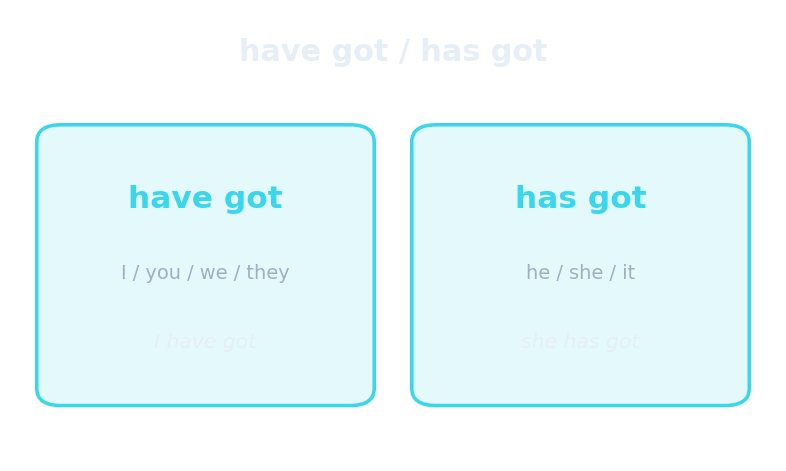
have got / has got
- I / you / we / they → have got.
- he / she / it → has got.
- Short forms: I've got, she's got, they've got.
have got / has got
- I / you / we / they → have got.
- he / she / it → has got.
- Formas abreviadas: I've got, she's got, they've got.
have got or has got? · have got ou has got?
he / she / it → has got; everyone else → have got. · ele / ela / isso → has got; todos os outros → have got.
Choose: He ___ got a new bike. · Escolha: Ele ___ uma bicicleta nova.
he / she / it → has got: “He has got a new bike.” · ele / ela / isso → has got: “Ele tem uma bicicleta nova.”
Complete: I ___ got two sisters. · Complete: Eu ___ duas irmãs.
I / you / we / they → have got: “I have got two sisters.” · eu / você / nós / eles → have got: “Eu tenho duas irmãs.”
Translate into English: 她有一双蓝眼睛。 · Traduza para o inglês: 她有一双蓝眼睛。
she → has got: “She has got blue eyes.” · ela → has got: “She has got blue eyes.”
Negatives
- haven't got / hasn't got.
- I haven't got a pen. He hasn't got a car.
- It means "don't have / doesn't have".
Negativos
- haven't got / hasn't got.
- I haven't got a pen. He hasn't got a car.
- Significa "don't have / doesn't have".
Is this correct? “She hasn't got a car.” · Isso está correto? “Ela não tem um carro.”
has not got → hasn't got. Correct. · has not got → hasn't got. Correto.
Questions
- Put Have / Has before the subject: Have you got a minute? Has she got a dog?
- Short answers: Yes, I have. / No, she hasn't.
Perguntas
- Coloque Have / Has antes do sujeito: Have you got a minute? Has she got a dog?
- Respostas curtas: Yes, I have. / No, she hasn't.
Common mistakes
- ❌ She have got long hair. → ✓ She has got long hair.
- ❌ Do you have got a pen? → ✓ Have you got a pen?
- ❌ Yes, I have got. → ✓ Yes, I have. — short answers stop at have / has.
Erros comuns
- ❌ She have got long hair. → ✓ Ela has got long hair.
- ❌ Do you have got a pen? → ✓ Have you got a pen?
- ❌ Yes, I have got. → ✓ Sim, eu have. — respostas curtas param em have / has.
Put the words in order to make a question. · Organize as palavras para formar uma pergunta.
Questions start with Have / Has: “Has your sister got a bike?” · Perguntas começam com Have / Has: “Has your sister got a bike?”
Short answer: “Have you got a pen?” — “Yes, I ___.” · Resposta curta: “Have you got a pen?” — “Yes, I ___.”
Short answers stop at have / has — no “got”. · Respostas curtas param em have / has — sem “got”.
- have got (I/you/we/they) · has got (he/she/it) = "have".
- Negative: haven't got / hasn't got.
- Question: Have / Has before the subject.
- have got (I/you/we/they) · has got (he/she/it) = "ter".
- Negativo: haven't got / hasn't got.
- Pergunta: Have / Has antes do sujeito.
Write one sentence about something you have, using “have got” or “has got”. · Escreva uma frase sobre algo que você tem, usando “have got” ou “has got”.
Example: “I have got a little dog.” · Exemplo: “I have got a little dog.”