Limits to growth, small firms and demergers
Introduzido| English | Significado |
|---|---|
| growth constraint/ɡrəʊθ kənˈstreɪnt/ | restrição de crescimento |
| demerger/deˈmɜːdʒə/ | desmembramento |
One company becomes three
- General Electric was once the most valuable company in the US, making jet engines, medical scanners, power plants, light bulbs and even TV shows.
- In 2021 it announced it would split into three separate firms — aviation, healthcare and energy — and finished the split in 2024.
- Growth has limits, and sometimes a firm gains by becoming smaller.
What stops firms growing?
- Size of the market: a niche product — handmade violins, a local bakery — has few buyers.
- Access to finance: banks may refuse loans to small firms with little collateral.
- Owner objectives: some owners prefer control and a quiet life to growth. Regulation and paperwork can also limit expansion. Each is a growth constraint 增长约束.
Which are constraints on the growth of a firm?
Dificuldade 2/5 · Moedas 140 + pequeno bônus na primeira conclusão hoje
Strong demand encourages growth.
Worked example: when expansion loses money
A specialist firm sells at a price of 10, with a variable cost of 6 per unit and fixed costs of 300.
- At 100 units: profit $= 1000 - 600 - 300 = 100$.
- It expands: fixed costs rise to 700, but the small market buys only 130 units.
- Profit $= 1300 - 780 - 700 = -180$. Bigger is not always better when demand is limited.
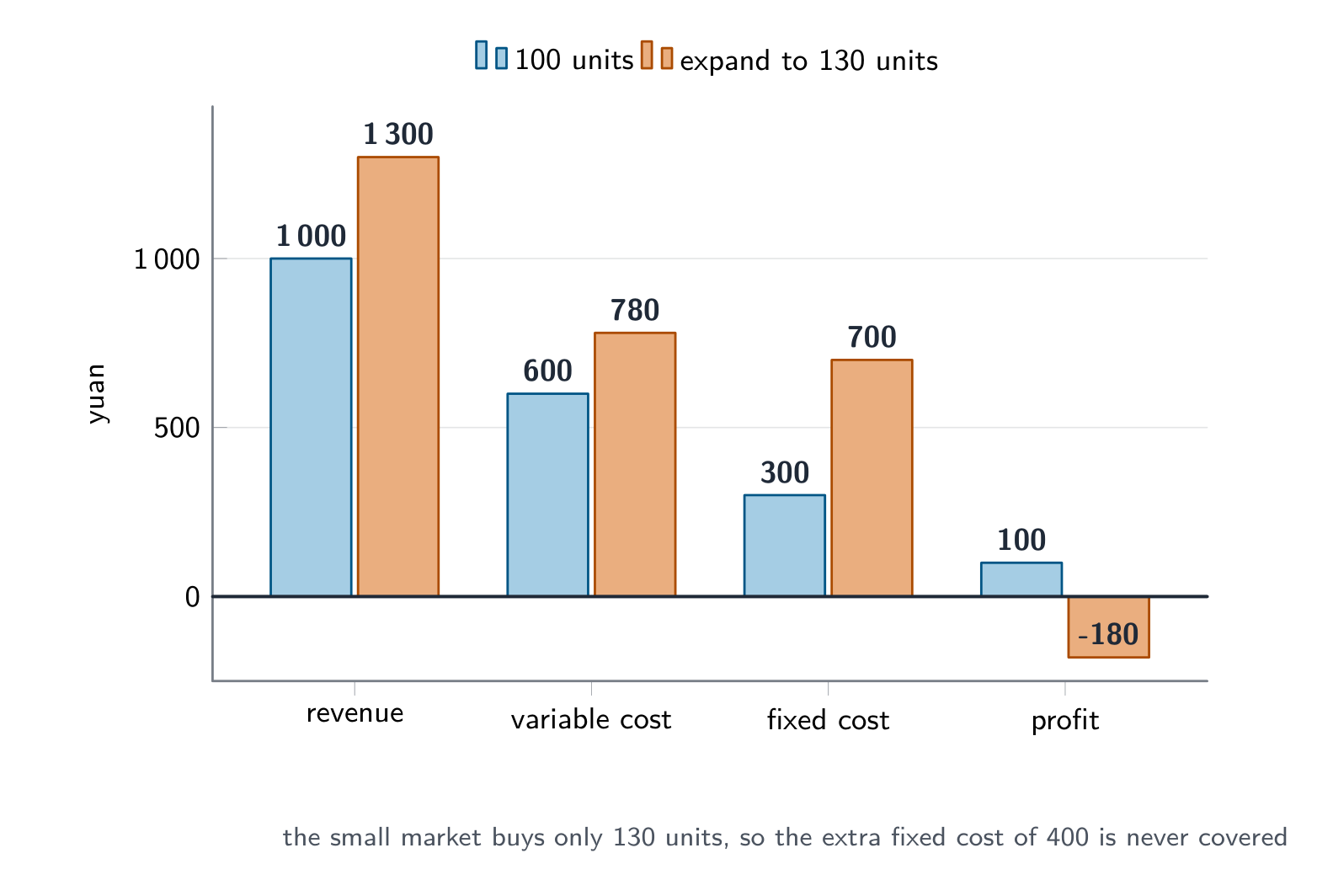
Bigger is not always more profitable
$\pi=(p-v)Q-F$
Price 10, variable cost 6 and fixed cost 300: at 100 units profit = 1000 − 600 − 300 = 100. Expanding raises fixed cost to 700 with output only 130: profit = 1300 − 780 − 700 = −180.
Price 20, variable cost 12, fixed cost 500. What is profit at 80 units?
Dificuldade 2/5 · Moedas 140 + pequeno bônus na primeira conclusão hoje
$1600 - 960 - 500 = 140$.
The firm expands; fixed costs rise to 900 and sales to 100 units. What is profit now?
Dificuldade 2/5 · Moedas 140 + pequeno bônus na primeira conclusão hoje
$2000 - 1200 - 900 = -100$.
Why small firms survive
- They serve niche markets that large firms ignore, and give personal service.
- They can react fast to change, and owners may want to stay small. Many large firms also buy from small specialist suppliers.
Small firms survive only because large firms have not noticed their markets.
Dificuldade 1/5 · Moedas 100 + pequeno bônus na primeira conclusão hoje
They also survive through flexibility, service and owners' choices.
Demergers
- A demerger 分拆 splits one firm into separate businesses.
- Reasons: managers can focus on one market; a weak division no longer holds back a strong one; investors can value each part more easily; regulators may require it.
Which is a common reason for a demerger?
Dificuldade 1/5 · Moedas 100 + pequeno bônus na primeira conclusão hoje
Focus is a main motive, as at GE.
Does a demerger save money?
- Splitting saves 30 a year in coordination costs, but each new firm needs its own offices (cost 18) and loses bulk-buying discounts (cost 8).
- Net saving $= 30 - 18 - 8 = 4$ a year. A one-off splitting cost of 20 takes five years to recover.
A demerger saves 50 a year, adds duplicated costs of 20 and loses discounts of 12. What is the net annual saving?
Dificuldade 2/5 · Moedas 140 + pequeno bônus na primeira conclusão hoje
$50 - 20 - 12 = 18$.
Growth is not the only measure of success. A small firm with loyal customers and high profit per unit can be more successful than a large one with thin margins and high debts. Judge firms by their own objectives.
Firms are limited by market size, finance, owner objectives and regulation. Small firms survive through niches, flexibility and service. A demerger splits a firm to improve focus and value, but it can add duplicated costs and lose economies of scale.
Explain why a firm might choose to demerge, and one cost of doing so.
Weigh focus against lost economies of scale.